
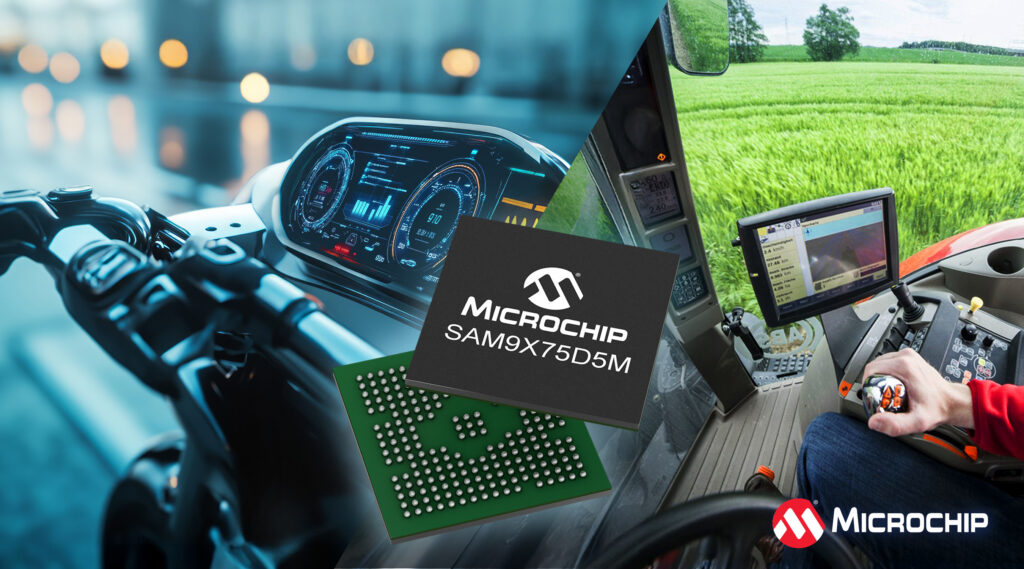
One package combines processor and memory for vehicle displays and control, reduces design steps, and supports dashboards, chargers, and panels.
Microchip’s SAM9X75D5M System-in-Package (SiP) targets automotive and e-mobility HMI designs. It integrates an Arm926EJ-S processor with 512 Mbit DDR2 SDRAM in one package, supports displays up to 10 inches at XGA resolution, and is AEC-Q100 Grade 2 qualified.

Automotive and e-mobility systems use Human-Machine Interfaces (HMIs) for user interaction. This device is for engineers working on digital clusters, two- and three-wheeler dashboards, HVAC control panels, and EV chargers. They can use it to build GUI-based interfaces, manage display output, and run control functions in the same system. It also supports a shift from MCU-based designs to systems with more processing and memory without moving to a full MPU setup.
The SAM9X75D5M is part of Microchip’s hybrid MCU family. It provides MPU-level processing with an MCU-like development setup. Designers can use existing tools and work with RTOS if required. This reduces changes in the development process while enabling designs with more memory and graphics.
The device supports display interfaces such as MIPI DSI, LVDS, and parallel RGB. This allows use with different display panels and HMI configurations.
By integrating processor and DDR2 memory in one package, the device reduces PCB layout complexity and routing effort. It also reduces dependency on external DRAM sourcing. The embedded memory removes the need for separate DDR components, improving availability and making system design more predictable.
The MCU is built for long-term use with a balance of cost, performance, and power. It supports scaling from MCU systems to HMI platforms while controlling design effort, sourcing, and system complexity.
“Microchip’s SAM9X75D5M product redefines the standard for automotive-grade solutions, combining a high-performance processor with memory in a single package and bringing benefits of a SiP to the automotive market,” said Rod Drake, corporate vice president of Microchip Technology’s MPU business unit. “One of the advantages of a SiP is that it provides significantly more RAM buffer space than a traditional MCU implementation and on a much more compact PCB than can be done with discrete memory—giving designers options to fit complex designs into a small space.”
Click here for the original announcement.