
Toshiba and MIRISE deploy SBM on autonomous robots, combining combinatorial optimization and multi-object tracking for efficient movement through dynamic industrial and urban spaces.
Toshiba Corporation and MIRISE Technologies have demonstrated the first deployment of a quantum‑inspired optimization computer on an autonomous mobile robot. The installation integrates Toshiba’s Simulated Bifurcation Machine (SBM) directly into MIRISE’s robot platform to support advanced real‑time decision making in autonomous navigation. The demonstration took place in Kawasaki and Nisshin, Japan, highlighting the potential for embedded optimization in vehicles and mobile robots.

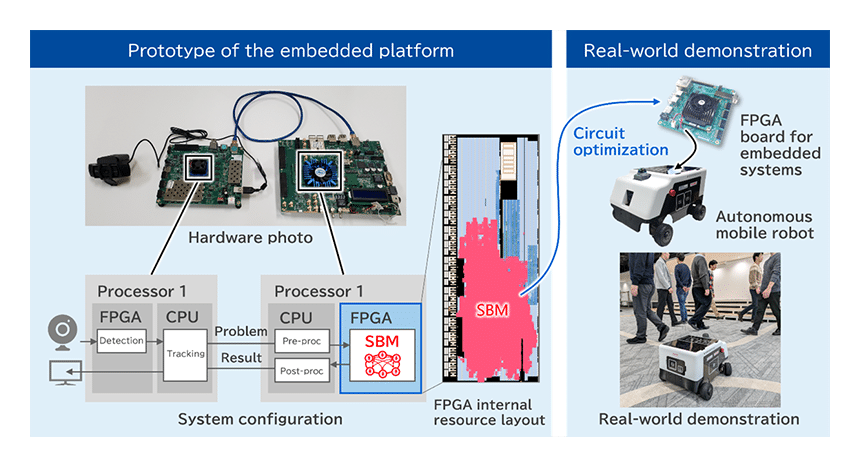
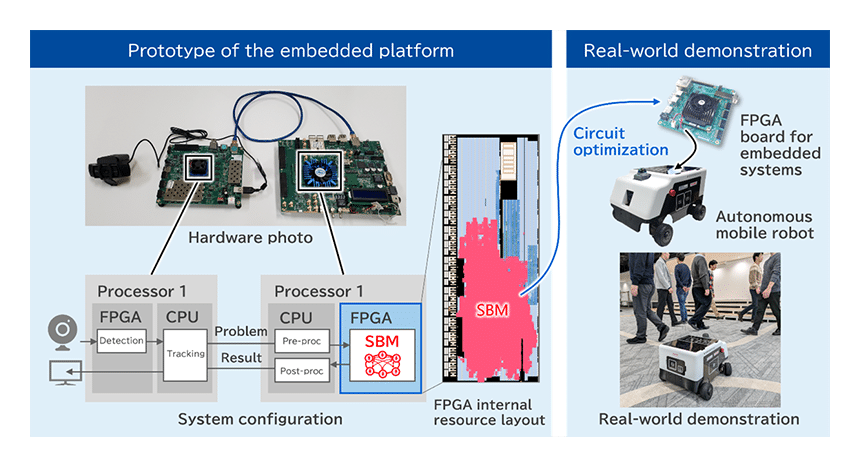
The SBM uses algorithms derived from quantum computing to rapidly solve complex combinatorial optimization problems. Unlike traditional quantum computers, it operates on standard hardware such as FPGAs, GPUs, or ASICs, without the need for dedicated quantum infrastructure. Toshiba implemented a multi‑object tracking algorithm on an embedded FPGA, enabling the robot to process real‑time sensor data under strict size, power, and cost constraints. MIRISE integrated this FPGA into its autonomous robot, which successfully demonstrated path planning and object avoidance in dynamic environments.
At the core of the system is a multi‑object tracking algorithm capable of continuously identifying individual objects, even when multiple items cross paths or become temporarily obscured. By leveraging SBM’s large‑scale, high‑speed search, the algorithm supports one‑to‑many matchings, improving re‑tracking of obscured objects and enhancing motion prediction accuracy. Evaluations using the Higher Order Tracking Accuracy (HOTA) metric indicated a 4% improvement over standard benchmarks and a 23% improvement on custom benchmarks designed for obscured object evaluation.
The embedded SBM operates at 23 frames per second, exceeding the 10 FPS typically required for automated driving systems. This enables advanced optimization processing, previously limited to high‑performance servers, to run in real time on compact, low‑power embedded devices. The robot combined SBM object tracking with positional analysis to adjust predicted object occupancy dynamically, allowing efficient path selection in environments containing both static and moving obstacles.
The companies plan to expand the application of embedded quantum‑inspired optimization to transport robots in factories, autonomous machinery in construction and agriculture, infrastructure monitoring, smart cities, and energy management systems.