
MATERNAL MENTAL HEALTH
In “The Mother of Depressions,” Marla Broadfoot reports on a new type of drug that offers better and faster treatment for postpartum depression. I am a postpartum depression and anxiety crisis survivor, and the article made me stop everything I was doing to give thanks for the work that continues on behalf of mothers and families.
My son was born in 2012. What followed for nearly the next year was what I can only describe as a nightmare of epic proportions. Without two things, I don’t know if I would be here today. First, on our local NPR station, I heard a story about the then recently opened perinatal psychiatry program at the University of North Carolina School of Medicine. The team was able to place me immediately in a critical care outpatient program.
On supporting science journalism
If you’re enjoying this article, consider supporting our award-winning journalism by subscribing. By purchasing a subscription you are helping to ensure the future of impactful stories about the discoveries and ideas shaping our world today.
I also had seen a flyer for our local maternal mental health support group Moms Supporting Moms. A year later I was a trained peer facilitator working our warmline (a phone service for nonemergency support) and meetings. And a few years after that, I was presenting with some of the incredible staff at Postpartum Support International.
Postpartum depression and anxiety survivors are truly the strongest people I know. My son just turned 13 last spring, and not a week goes by when I don’t marvel at the fact that I am here and how grateful I am for that.
AMANDA CADRAN VIA E-MAIL
PLASTICS CRISIS
As a chemist who has worked in polymer science, I read Beth Gardiner’s “The Pivot to Plastic” with deep concern. The environmental crisis associated with synthetic materials is real and urgent, but its nature is more complex than the term “plastics” suggests. What we are facing involves the entire spectrum of synthetic carbon-based materials, a vast family that is far broader and more diverse than that single word conveys.
It is essential to recall that these materials have also democratized access to technology and basic goods. Synthetic fibers, for example, transformed clothing from a scarce, expensive resource into something available to all. This achievement should not be forgotten, even as fast-fashion waste now poses one of our gravest challenges.
The influence of industry in creating this crisis is undeniable. Decades of prioritizing short-term gains have led us to a situation in which shifting from fuel production to ever increasing polymer output is not a sustainable strategy. Indeed, it risks being self-defeating. The industry itself is not the enemy, however. We all share this finite planet, and the very companies that helped to cause the polymer waste problem must also play a vital role in developing the solutions needed to overcome it.
There is no simple remedy. But the “three R’s” rule—reduce, reuse and recycle—may serve as the compass to guide us. Progress will require strict regulation, a drastic reduction of production at the source, the design of materials that can be reused and recycled, and a realignment of economic incentives toward sustainable products and markets. Activism is vital, but lasting change will come from the combined force of education, informed journalism, scientific research and democratic institutions—much as it did with tobacco, chlorofluorocarbons (CFCs) and industrial pollution.
JUAN CÁMPORA INSTITUTE FOR CHEMICAL RESEARCH, SPAIN
CANCER VACCINES
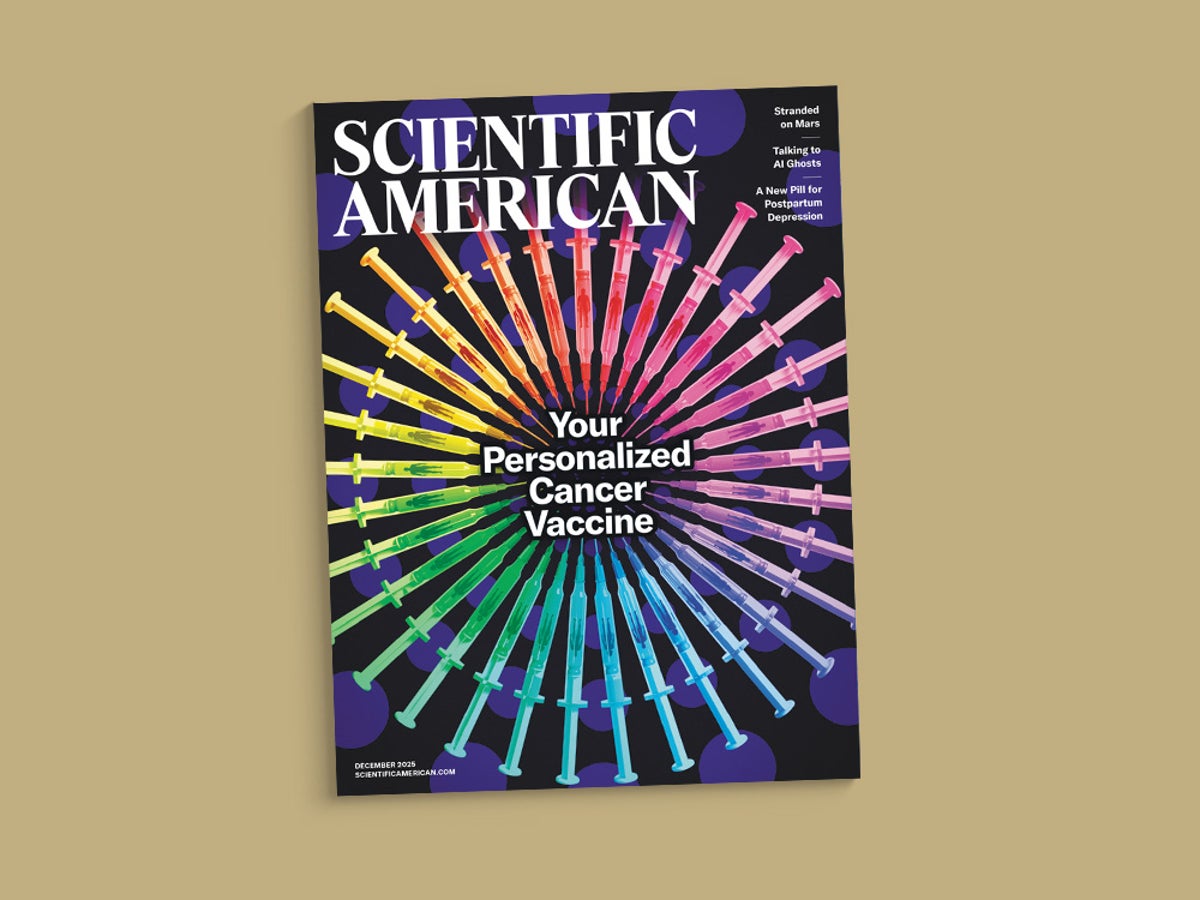
It has been 60 years since I was in graduate school, where I recorded mouse melanoma cells using time-lapse micrography. Now the exciting potential for personalized vaccines to control pancreatic cancer and possibly other cancers such as melanoma, as described by Rowan Moore Gerety in “Your Personalized Cancer Vaccine,” has given hope for those with these deadly diseases. It is appalling that federal funding for mRNA vaccine research has been put on hold or canceled. Secretary of Health and Human Services Robert F. Kennedy, Jr., should be held accountable for the unnecessary suffering and death this will cause.
TIM HANNERT BELLAIRE, MICH.
BOTS AREN’T BUDDIES
In “Are AI Chatbots Healthy for Teens?” [The Science of Parenting], Elizabeth Englander discusses the dangers of teenagers using “chatbot companions.”
As a teen today, I am no stranger to using artificial intelligence. But I have spent much more time with my real friends and have come to understand, through my own experience, that no robot will ever be able to replace time spent making real connections with real people.
The rise of AI and technology in general has made parenting today’s young people much more complicated, especially when it comes to spending time with friends. Most kids want to stay inside, chatting either with real people online or with AI. To combat this, parents should teach their kids that AI is a tool and nothing more.
AI is not going away; it is a rapidly growing industry, and children need to know how to use it safely and effectively. Children should not be allowed to have “friendships” with chatbots. Their relationship with AI should be made to be professional, with AI kept around as a tool, not a friend.
JACK FESLER VIA E-MAIL
ANCIENT MORAL PHILOSOPHY
In “The Neuroscience of Morality” [November 2025], Elizabeth Svoboda presents some findings on a topic well worthy of consideration: moral character and the psychology of character development. The subject is so worthy, in fact, that it has been a central concern of moral philosophers for at least two and a half millennia. The findings Svoboda reports are well worth repeating, and their relationship with known neurophysiological processes informative, if not surprising.
I’d like to add that these matters, except for the neuroscience data, were studied and understood in much greater detail by the ancient Greek thinkers. Outstanding examples are provided by Plato’s dialogues—the Meno, The Republic and the Crito, among others—to which one must of course add Aristotle’s Nicomachean Ethics. (Svoboda does in passing allude to Plato’s arguments regarding the definition of virtue in the Meno.) There is much we can still learn from these pioneers.
EVAN FALES DEPARTMENT OF PHILOSOPHY, UNIVERSITY OF IOWA
CLARIFICATION
“Human on a Bicycle,” by Allison Parshall and DTAN Studio [Graphic Science; November 2025], noted that bicycles let us coast without putting in power by pedaling. This is possible because the wheels and bearings roll with low friction.