
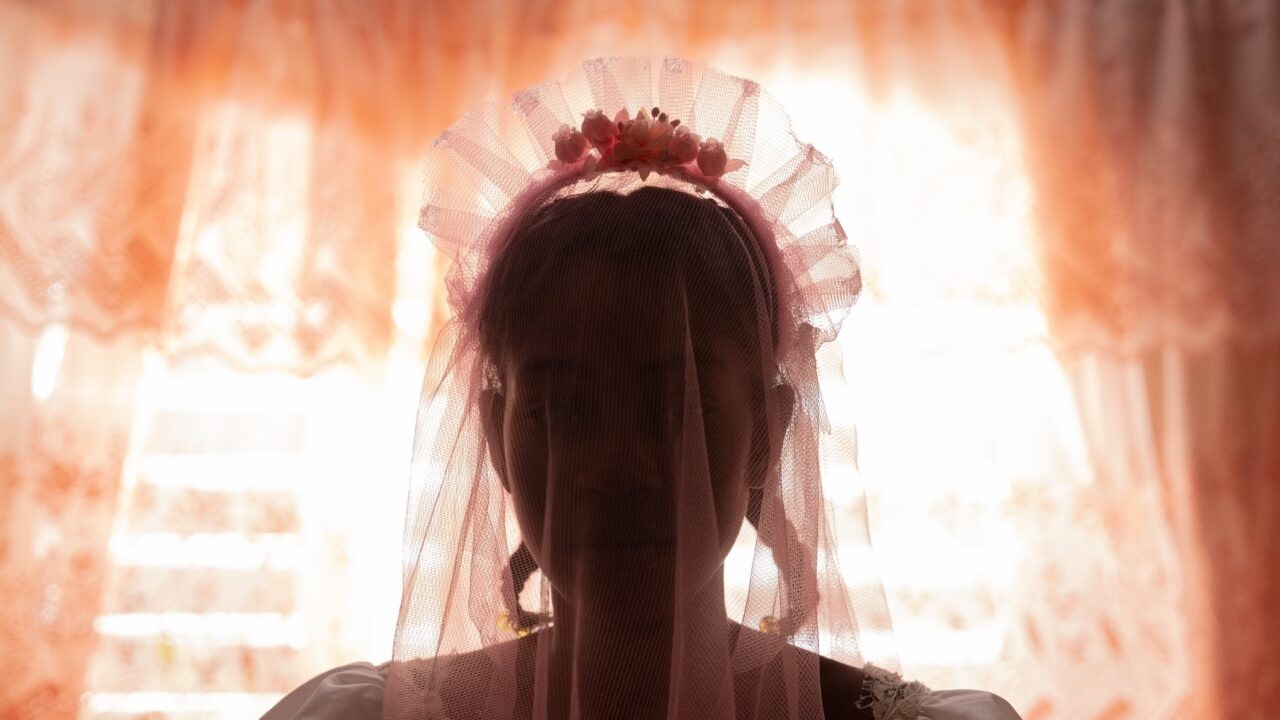
Five women reflect on their experiences with forced motherhood and clandestine abortions in the Dominican Republic in Paula Cury’s debut feature, Scarlet Girls. After all, the Dominican Republic (DR) is still one of the few countries where abortion is criminalized without exception.
The film, exploring what it means to be a woman in the DR and the quiet violence of stigma, among other things, world premieres at the Copenhagen International Documentary Film Festival CPH:DOX on Thursday, March 12. It is featured in the Human:Rights competition section of the Danish festival’s 23rd edition, which runs March 11-22, and will then screen at SXSW.
Through a visual mix of evocative imagery and archival material, as well as the voices of five women, Scarlet Girls takes us inside women’s struggles. The testimonies shared come from four women who lived through abortion or forced motherhood, and from one mother whose daughter was denied cancer treatment because she was pregnant. To protect the women, their faces are not revealed, however.
Instead, the images shown feature girls and women, all non-actresses, caught in private moments inside their homes and in ordinary life, mixed with improvised scenes in a school, as well as landscape and observational scenes. “This intimate, poetic approach offers a glimpse into girls’ and women’s everyday life, becoming a sort of autopsy of intergenerational trauma and inviting a reflection on how trauma is often hidden in everyday life, while raising questions about the impact of severe abortion legislation in the Dominican Republic,” highlight the press notes for Scarlet Girls.
“To say that Scarlet Girls is a film just about abortion would be a lie,” Cury shares in a director’s statement. “Scarlet Girls aims to unravel the multifaceted truths, encompassing issues such as the relentless control over women’s bodies, the pervasive influence of systemic sexism in women’s daily experiences, the isolating burden of guilt, pain, and shame they are made to bear alone, and the transformative shift in identity when a woman realizes society deems her actions for autonomy as criminal. In Scarlet Girls, there is an eerie representation of the concept of everyday life; there is a language that alludes to the prison perpetuated by the patriarchy.”
Cury worked on Scarlet Girls as director, producer, with Samuel Didonato, co-screenwriter, with Claudia Galeano, and co-editor, with Laura Basombrio. Omar Lara, Natalia Imaz, and Paulina Villavicencia are co-producers. The cinematographer is Nana Baez. Well Mejia Peña is responsible for sound, and Naruyibe Montero for sound design, while Alejandro Karo handled the music.
Cury, in an interview with THR ahead of the doc’s world premiere, discussed her motivation for bringing Scarlet Girls to the world, finding brave women speaking out about their experience, and the backlash against women’s rights in various parts of the world.
When and why did you decide to make this film and show us as topic and personal stories that I wasn’t aware of?
Ever since I recorded my short documentary Adrift in 2017, in which teenage girls from the Dominican Republic speak about their experience with unwanted pregnancy, I was so moved emotionally that I knew I had to dig deeper into the topic of abortion, since it is not a solution offered to women or girls in my country due to the severe legislation.
I’ve always been very introspective about every topic that relates to women’s rights and bodily autonomy as well, from a very young age. I think it’s due to going through my teenage years without a mother, since she passed away when I was 14, mixed with the fact that the DR is an extremely religious and conservative country, and so all these topics related to sexuality and autonomy were like a dark, mysterious fog around me that I was forced to clear out on my own. I used to think, “What if I get pregnant and I don’t want to be?” and that terrified me.
How did you find the women you talked to, and did you have to go beyond not showing them to protect them?
In 2021, the topic of the three abortion exceptions – when the woman’s life is at risk, when the fetus is incompatible with life and when the pregnancy is the result of rape or incest – was being discussed in Congress and received significant attention. Therefore, I decided to launch an open call online, inviting women from around the DR to share their stories if they wanted to form part of the documentary. Within 24 hours, we got over 100 responses, which I definitely did not expect. This made me understand how lonely so many of these women feel and how deeply they feel the need to express something that they’ve been forced to keep a secret, since they are considered criminals just for choosing to act with autonomy over their own bodies and lives.
Besides informing all participants about the current legislation and asking for their consent to be interviewed for the documentary, we decided to limit the recordings to audio only to protect their identities. Even though the practice is illegal, there have not been any publicly known cases of women or doctors ending up in prison due to abortions in the DR. The biggest negative impact is the lack of accessibility for women, who have to seek out unsafe methods, as well as the social stigma.
They are all very brave for speaking up and sharing their stories, and some of them even wanted their names included in the credits. All the actresses’ names and some of the participants’ names are under the same title card: “With the participation of.” I think this is a powerful statement because the audience doesn’t know which names belong to the actresses, all of whom are non-professional, or to the actual women who speak.

Paula Cury behind the scenes during the ‘Scarlet Girls’ shoot
How did you choose and film the imagery? I was particularly curious about how much was scripted and improvised.
During the development stage, I recorded all the audio interviews that form part of the finished film. These recordings led to me writing the script, and the grand theme that really stood out for me, when looking back at them, was trauma as a consequence of clandestinity. That’s what all the testimonies had in common – the difficult part was not the abortion itself, but the secrecy and uncertainty around it. All of the women shared that even after such an experience, they had to go through their daily life as if nothing had happened. It’s shocking to think that a girl or woman could be at school, cleaning the bathroom, or running errands, and they probably had an extremely unsafe abortion 24 hours ago and no one would know, because they have to stay silent.
So I knew I wanted most of the scripted scenes to take place in moments of daily life and intimacy. However, there was definitely a lot of improvisation, even within the scripted scenes. All of the dialogue is improvised, even the rant of a school teacher toward the beginning. I knew I wanted the scene of a sex ed teacher speaking to young girls, but I only gave her a broad thematic direction to speak about, and she improvised everything. All of the students’ opinions are their own as well, so the scene of “young girls in a classroom” is scripted, but the dialogue is not.
What was the hardest part of making the doc?
Besides having to finance a first feature film about such a controversial topic – I asked myself many times why I decided to take the hard route for my first film – the hardest part was definitely sitting down with the women who share their stories and knowing that there was nothing I could really do besides making this film. The editing stage was very tough as well, because I had to listen to these very difficult testimonies over and over again and really submerge myself into this emotional world in order to piece the material together.
Do you have any hope that these laws will change in the near future?
A new penal code was finally approved in 2025 – it had never been updated since 1884! – and the three abortion exceptions were excluded, so abortion is still completely criminalized in the DR. So, in the near future? Absolutely not.
There is a monumental amount of work to be done in order for us to get there, which is definitely upsetting, and I’d say that the penal code approval was very demoralizing, but it just speaks to the fact that we cannot shut up about this topic. The work starts now, not when we are eventually able to have legislators who maybe don’t hate women.
Is it just me, or is the film shockingly timely given the backlash against abortion and women’s rights in the U.S. and other parts of the world?
I’ve always felt that even though this film takes place in the Dominican Republic, which some people could dismiss as just an island in the Caribbean, it is still a very loyal reflection of how it feels to live in a country where women have no right to their own bodies, and this itself is relevant to any country anywhere, because as you say, some countries, including the U.S., have taken and are looking to take regressive legislative action in terms of reproductive justice.
How early or late did you choose the title of the film and what was the inspiration?
Very early in the development stage. In the bible, there is a story about a “scarlet woman” and “the whore of Babylon,” so “scarlet” has a connotation of sin, shame and immorality. This was also popularized by the novel The Scarlet Letter and even by the movie starring Emma Stone called Easy A. So I felt that choosing this title was a way to reappropriate the term. And seeing that most cases related to violations of bodily autonomy occur during childhood, I preferred Scarlet Girls over Scarlet Women. Plus, it sounds better!
Will we see more films from you? Any next projects you are developing?
I am very monogamous with my film projects, and creating this movie was a titanic task in which I had to wear multiple hats – producer, director, co-screenwriter and co-editor, so I’m currently not developing another film. But I know it will happen eventually, and I’m excited to create another film in the future.