
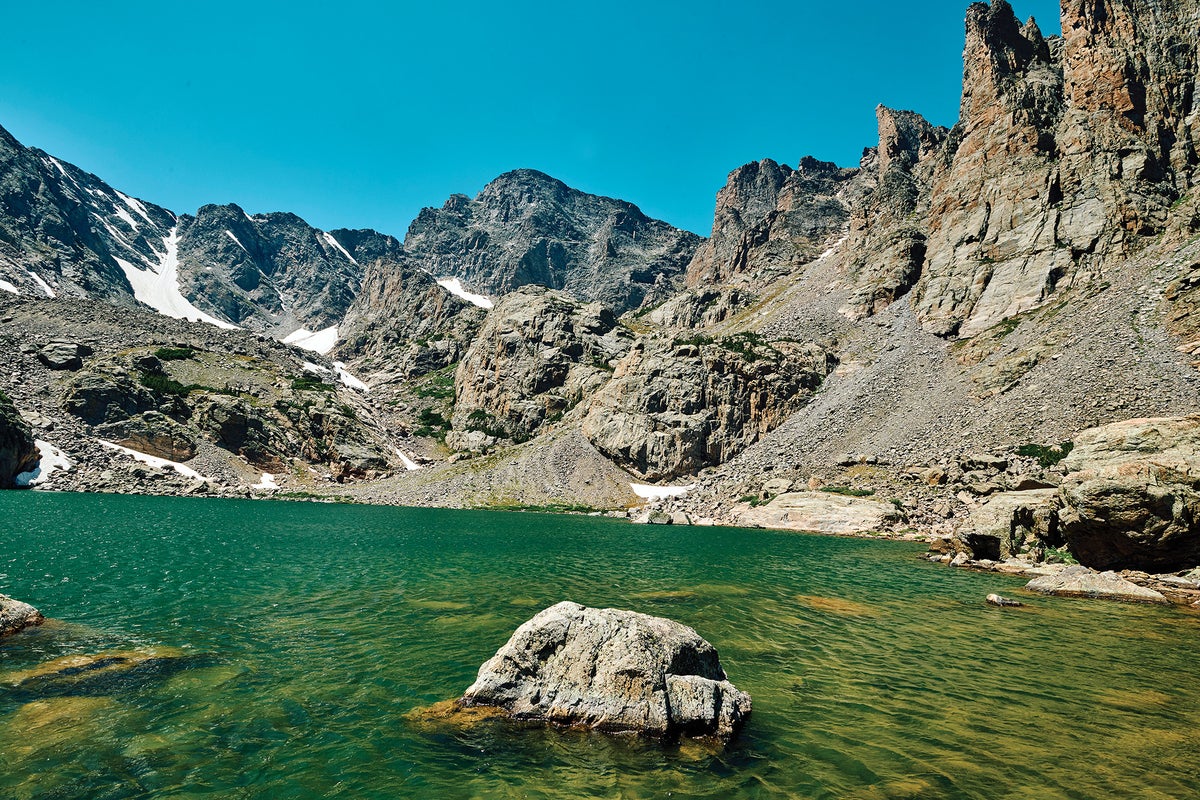
One sunny July morning, on a lake in Colorado’s San Juan Mountains, two scientists skimmed a black inflatable raft back and forth across the water. Isabella Oleksy, an ecologist at the University of Colorado Boulder, and undergraduate Julia Pop were hunting for a string of sensors they’d left submerged underneath a buoy the previous summer. Those instruments held a year’s worth of data on temperature and dissolved oxygen throughout the water column—clues to a puzzling change in the lake’s color and clarity.
After half an hour, Pop yelled back to me, “It’s too murky to see the buoy!” We’d spent a full day driving and another trekking eight steep miles with a team of pack mules and horses to our camp. After all that, the very problem they hoped to unravel now threatened their investigation. But just as they considered calling off the search, Pop spotted a block of orange foam suspended several feet underwater. They hauled up the buoy, with its dangling sensors, and paddled back to me on the rocky shore.
Once she was out of the raft, Oleksy, in waterproof pants and a hooded sun shirt, squinted at Turkey Creek Lake—“Murky Turkey,” she called it. The opaque, pale-green water looked alien; normally, mountain lakes are so pure you can see through 20 feet of crystal blue water. Here, however, a dense algal bloom had reduced visibility to a depth of just four feet.
On supporting science journalism
If you’re enjoying this article, consider supporting our award-winning journalism by subscribing. By purchasing a subscription you are helping to ensure the future of impactful stories about the discoveries and ideas shaping our world today.
At an elevation of 11,135 feet, in the state’s largest federally designated wilderness, this degree of algal abundance would have been unthinkable not long ago. And the trend isn’t limited to Colorado: algal blooms are clouding waters in the Andes, the Alps, the Himalayas and beyond.
In August 2019 Josh Kurz, a high school science teacher from Pagosa Springs, ran up to Turkey Creek Lake. That day the water shone as clear and blue as it had the first time he saw it, almost two decades earlier. But when he returned in 2021, the lake had transformed—through a haze of algae, Kurz could barely see below the surface. Something was wrong. “It’s an alpine environment,” he thought. “It shouldn’t be turning green.”
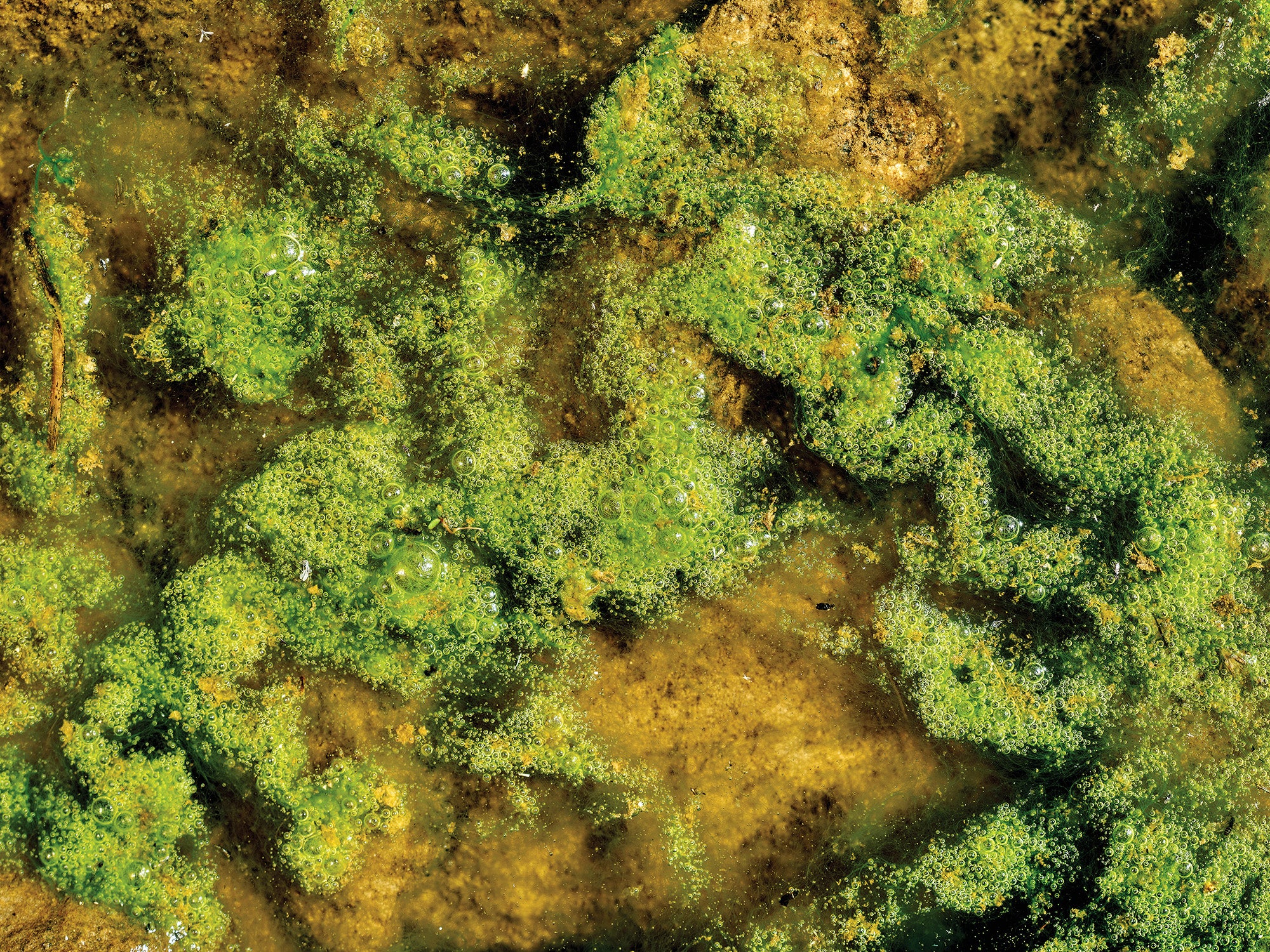
In the Rocky Mountains, lakes famous for water so clear you can see 20 feet down are turning into opaque green soup. Fueled by nitrogen pollution and warming temperatures, algal blooms like the one seen here are choking alpine ecosystems.
Kurz hoped the color was a one-off. But it recurred in 2022, and he sent photographs to the rangers with the regional U.S. Forest Service district. They, in turn, contacted Oleksy, who leads a long-term lake-monitoring program in Colorado’s Rocky Mountain National Park. There, amid the craggy peaks outside Denver, she and her predecessors have documented a decades-long rise in algae.
Years of data collection helped them pin the blame on industrialization from the nearby metropolis, which began artificially fertilizing these mountains around 1950. But the San Juans lie nearly 200 miles to the southwest, far from metropolitan pollution sources. Why, Oleksy wondered, should they be suffering the same fate?
Algae feed largely on nitrogen and phosphorus. Both are common in oceans and low-elevation lakes, which often lie downstream of pollution sources such as farms or sewage outlets. They’re supposed to be scarce in high-elevation terrain, but human activity is spreading these nutrients to far-off peaks at an unprecedented rate.
Last April, in an analysis of mountain lakes across the continental U.S., researchers reported that 25 percent were eutrophic, or nutrient-rich. Amalia Handler, an ecologist at FB Environmental Associates in Maine and lead author of the study, says this statistic reflects “substantial challenges” for mountain waters. It also mirrors a broader trend: in 2012, 57 percent of nearly 1,000 sampled lakes were eutrophic, but by 2022 the proportion had soared to 73 percent, according to the U.S. Environmental Protection Agency.
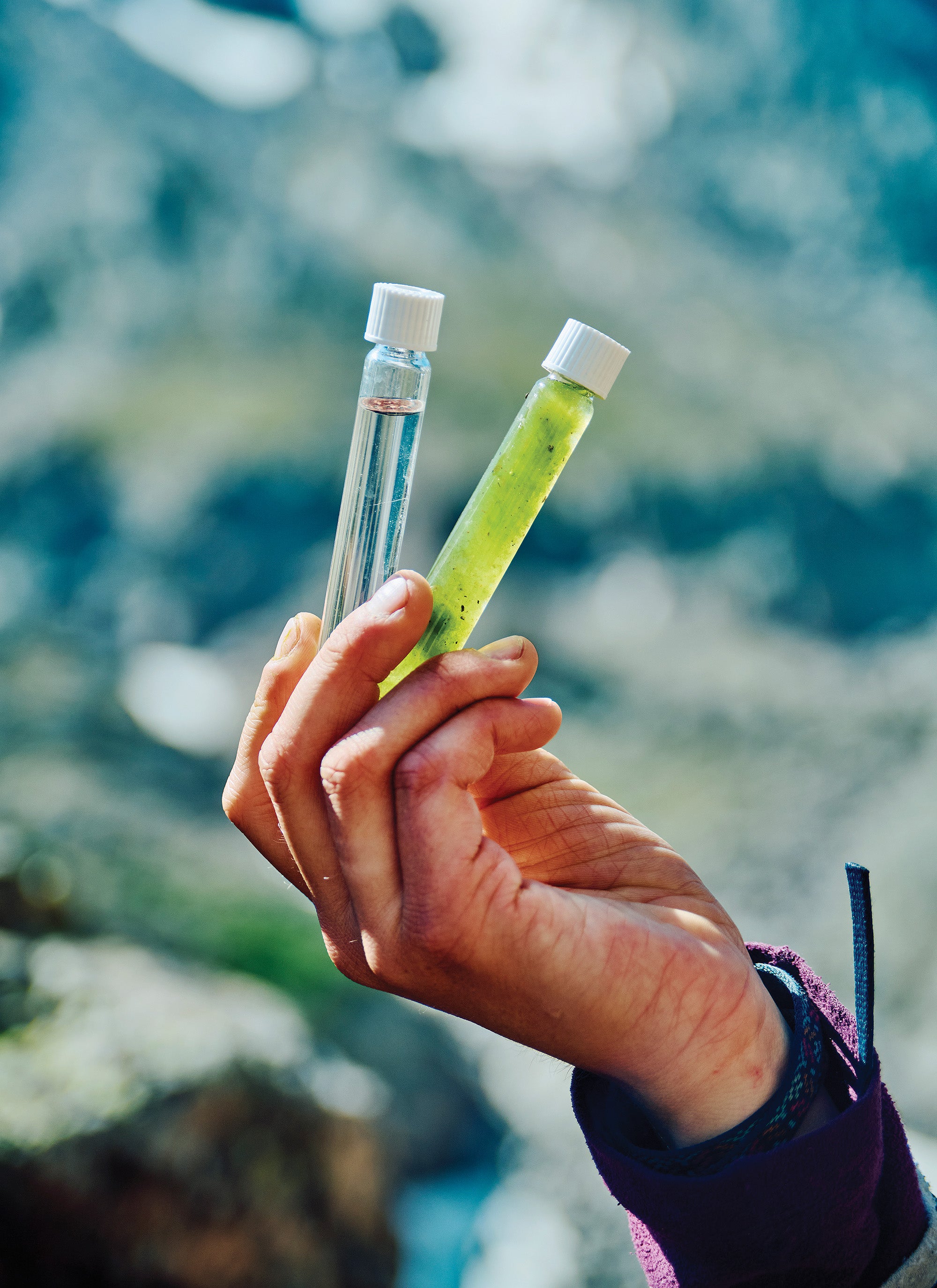
To understand how the water is changing, ecologists filter water samples. The vial shown on the right holds murky fluid teeming with algae.
Much of that nutrient load begins its journey elsewhere. Car exhaust releases nitrous oxides that can be converted into nitrate; nitrogen-bearing ammonia from agricultural fertilizer readily volatilizes, becoming airborne gas; wind-blown dust from eroded soil carries particulate phosphorus. Some of these molecules drift up into alpine zones, where they rain down on the once pristine lakes. Even trace amounts can have outsize effects. Biogeochemist John R. Vallentyne wrote in 1974’s The Algal Bowl that, under the right circumstances, phosphorus “can theoretically generate 500 times its weight in living algae.”
In other cases, the ingredients for algal blooms may lie dormant within a watershed, waiting to be awakened. Wildfires, burning millions of acres each year, free up the nitrogen in vegetation they consume, and meltwater from warming glaciers leaches phosphorus from freshly exposed minerals.
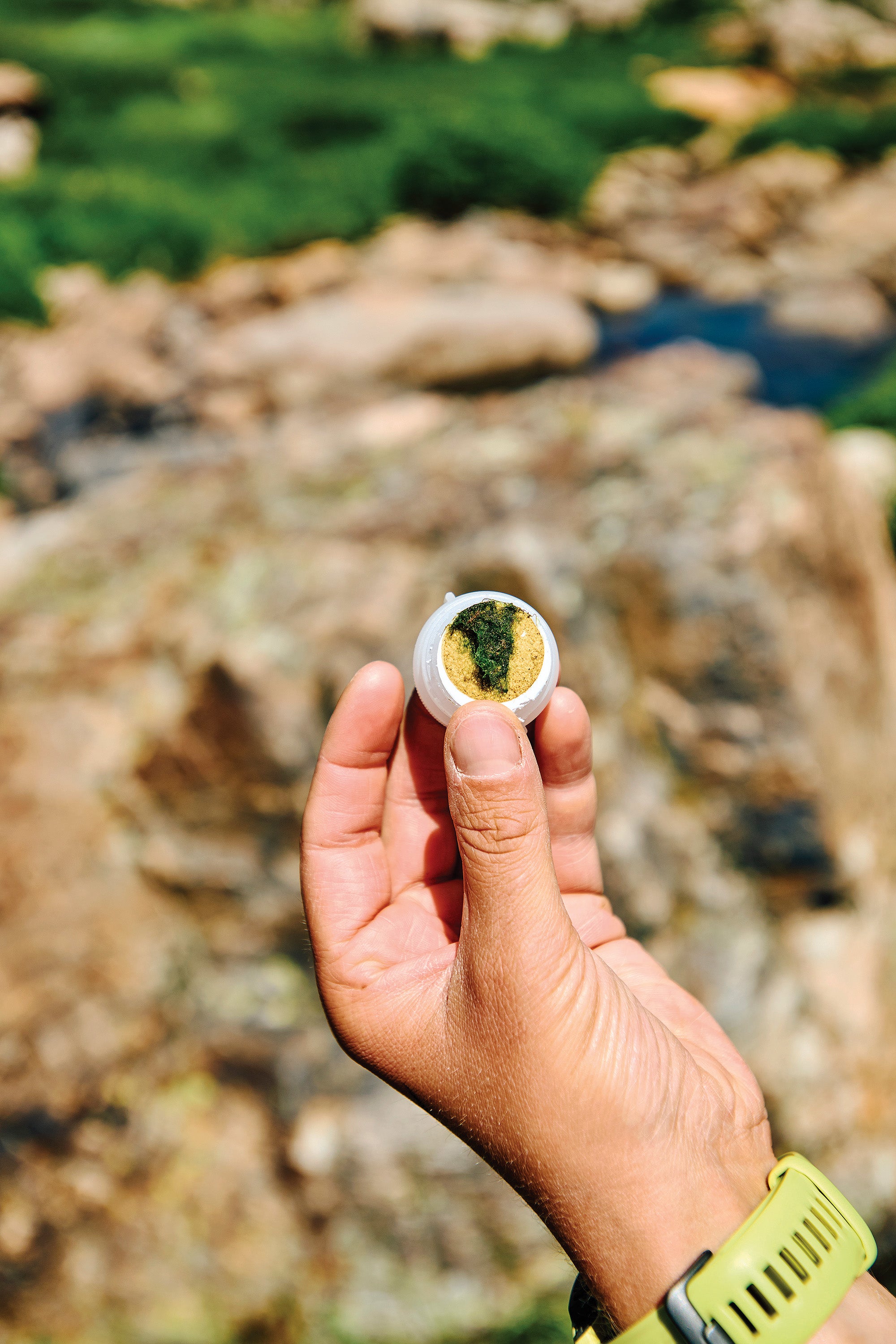
The vivid green muck left behind on the filter paper is filamentous algae, confirming the lake is moving toward a nutrient-rich future.
At Turkey Creek Lake, Oleksy discovered another curveball: the shore is ringed with skeletal spruce trees killed some 15 years ago by a bark beetle infestation. As those trees decomposed, they dumped the nitrogen and other organic chemicals stored in their tissues. Presumably, Oleksy says, the liberated nutrients drained into the lake.
This diversity of nutrient sources makes it difficult for scientists to discern large-scale patterns. But rising global temperatures tie together the variables—snow melts faster, lakes heat up quicker and stay warm longer—leading to the widespread upswing in algae. Climate change “is the one thing that all of these lakes have in common,” Oleksy says.
As she and I paddled back out to collect more water samples, I saw that the water was laced with countless fine, pale filaments—strings of dead algal cells from a bloom we’d just missed. “If I saw this at Sky Pond,” Oleksy said, referring to one of Rocky Mountain’s most beloved lakes, “I’d be freaking out.”
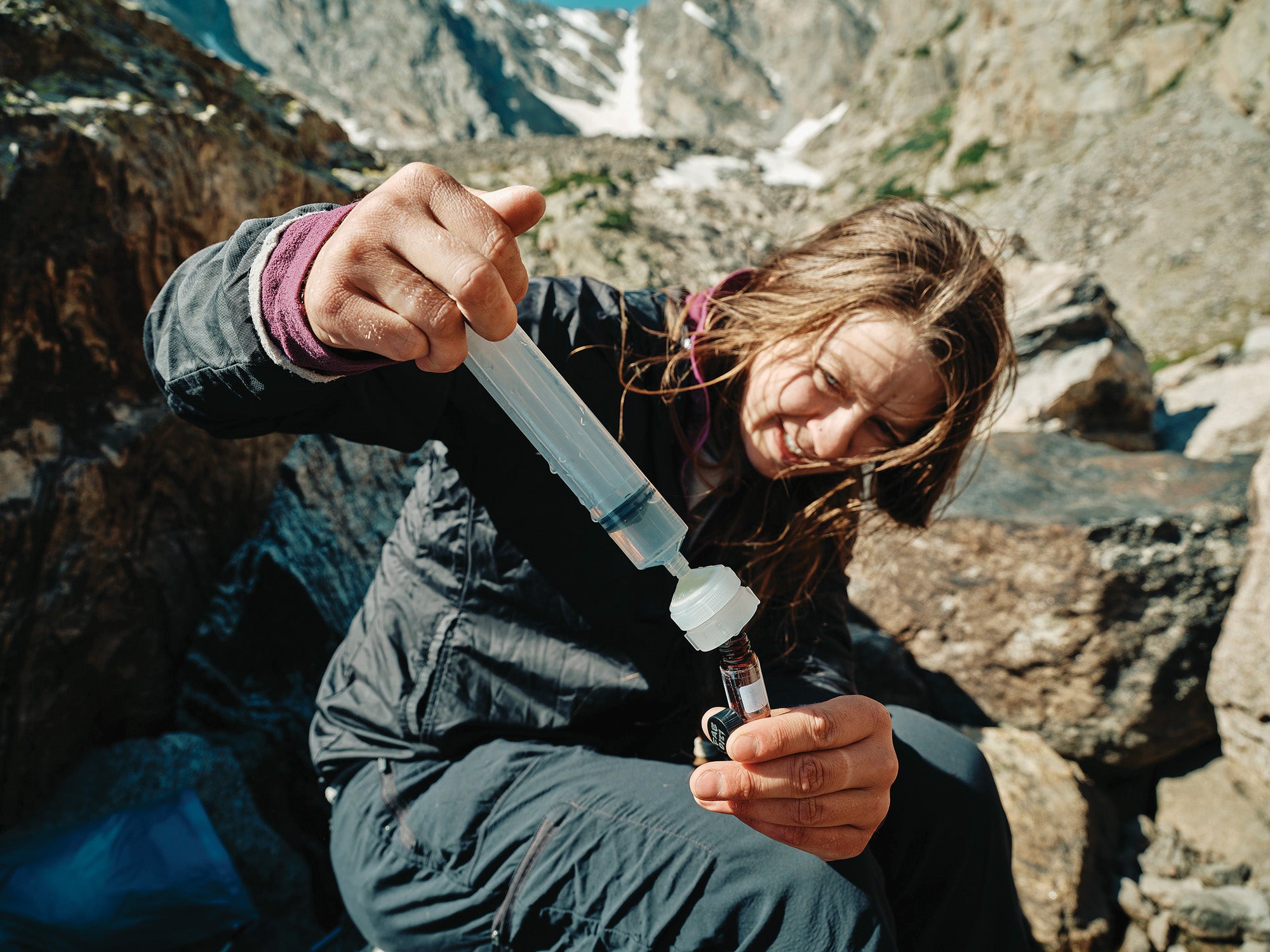
Katie Gannon filters water at Sky Pond. She uses these samples to distinguish organic matter produced from algae from material washing in from the surrounding landscape–a key step in understanding the shifting chemistry of alpine lakes.
We anchored at Turkey Creek’s deepest point, and Oleksy lowered a batonlike sensor through the water. On a screen readout, we watched as dissolved-oxygen levels dropped, plummeting almost to zero around 30 to 40 feet down. This decrease is a hallmark of high algal productivity: when algae die and sink, the decomposition process fuels chemical reactions that use up oxygen. Such anoxic conditions often kill fish, and they also can trigger a death spiral that renders a lake increasingly more likely to bloom again—in oxygen-depleted sediment, phosphorus that’s normally bound to iron becomes unshackled, free to circulate and nourish the next generation of algae.
After hauling up the sensor, Oleksy grabbed a transparent plastic cylinder with hinged lids at either end. She dropped it into the lake, fed out some line as it sank, then sent a small metal weight hurtling down the line. A muffled thump told us the lids had clapped shut on impact, sealing in whatever secrets the water held.
At camp that evening, we regrouped. Katie Gannon, a graduate student, sat at the edge of a wildflower-spangled meadow, hand-pumping the water samples we’d collected from Murky Turkey through an hourglass-shaped filter. The relatively clear water from near the surface flowed steadily, but she could tell the turbid bottom water would require some elbow grease.
“That’s just gross,” Gannon said, pouring some into the filter. It looked rusty—iron gets released from lake-bed sediment under anoxic conditions—and stained the filter paper deep yellow. The smell of sulfur, another indicator of anoxia, filled the air. These were indirect signs of a bloom, but the researchers wanted the algae. The evidence wasn’t hard to find: the filter soon became so clogged with algal cells it could pass only a few droplets per minute, and Gannon took mercy on her cramping hands. Later, back at the lab, Oleksy’s team would test the filter paper for chlorophyll a, the green pigment photosynthesizers use to absorb sunlight. Unsurprisingly, the results would place Turkey Creek Lake squarely in the eutrophic category.
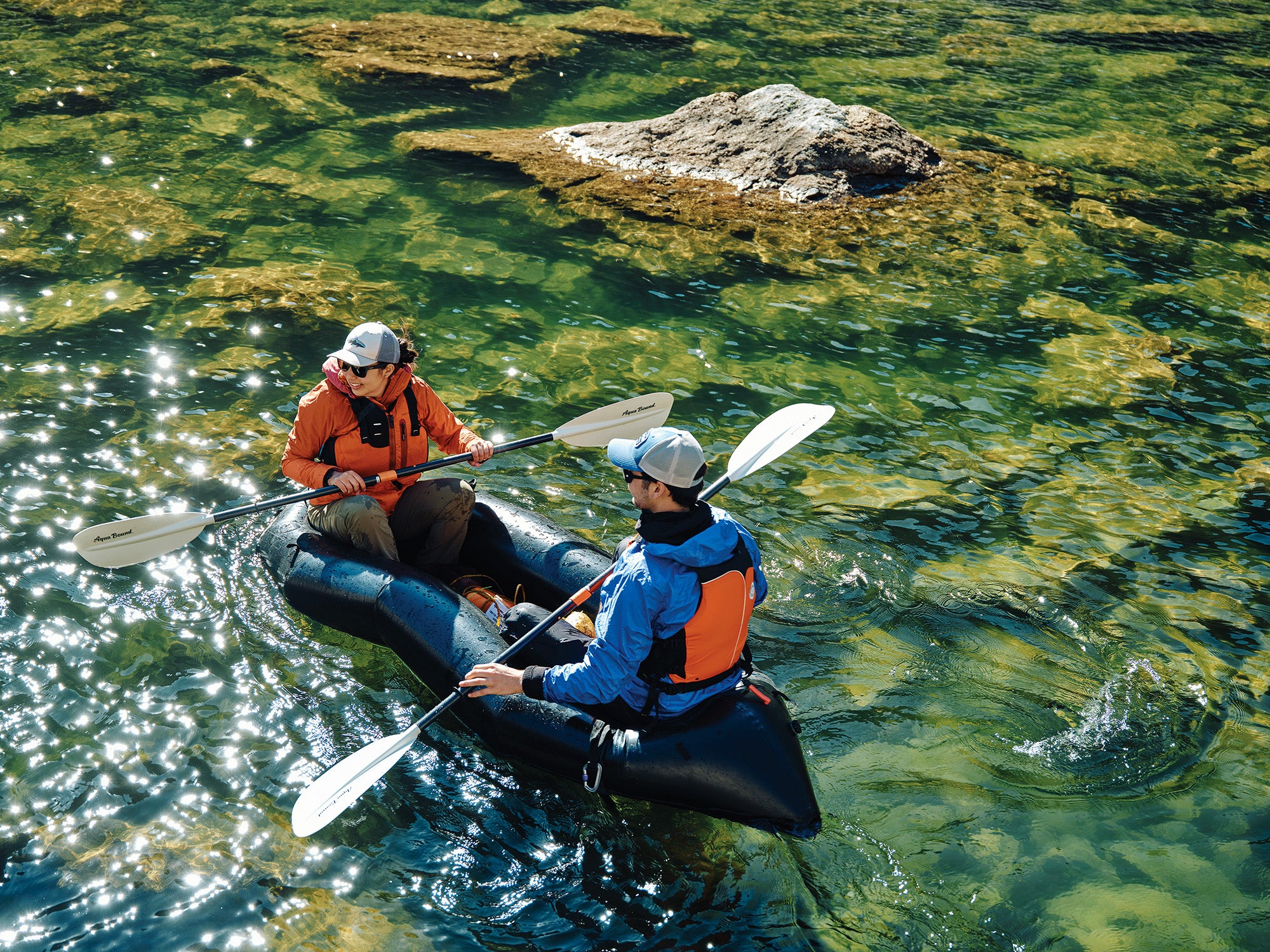
Lab manager Charlie Dougherty and researcher Mary Jade Farruggia paddle across Sky Pond. Their sampling adds to a dataset amassed over decades, showing algal biomass here has doubled since 1950.
The question then becomes how great a departure this is from the norm. Those samples offer only a snapshot of the lake; they don’t place its present troubles in historical context. But chlorophyll a can illuminate the past, too. When dying algae settle, they become entombed in the lake-bed sediment, and their pigments are preserved as a record of algal biomass, alongside chemical signatures representing the climate of years past. By matching the chlorophyll layers in sediment cores to their corresponding chemical signatures, scientists can piece together the timeline and conditions under which algae have thrived.
In the summer of 2024 Oleksy’s team collected sediment cores from Turkey Creek Lake. They haven’t yet assigned dates to individual chlorophyll a layers, but the overall trend is clear: moving from the bottom of the sediment to the top, pigment abundance rises, indicating higher algal productivity over time.
Researchers have found the same trend elsewhere. In sediment cores from Sky Pond and the Loch, another popular lake in Rocky Mountain National Park, Oleksy and her colleagues discovered that algal biomass more than doubled over the past 70 years, in lockstep with regional pollution and climate change. In the Uinta Mountains of northeastern Utah, Katrina Eyvindson, an associate professor at Western University in Canada, has used sediment cores to reconstruct the history of some 20 lakes. Taken together, they attest to a recent, unprecedented surge in both airborne nutrients and chlorophyll a. “Almost all of them say the same story,” Eyvindson says. “We’re in a unique situation.”
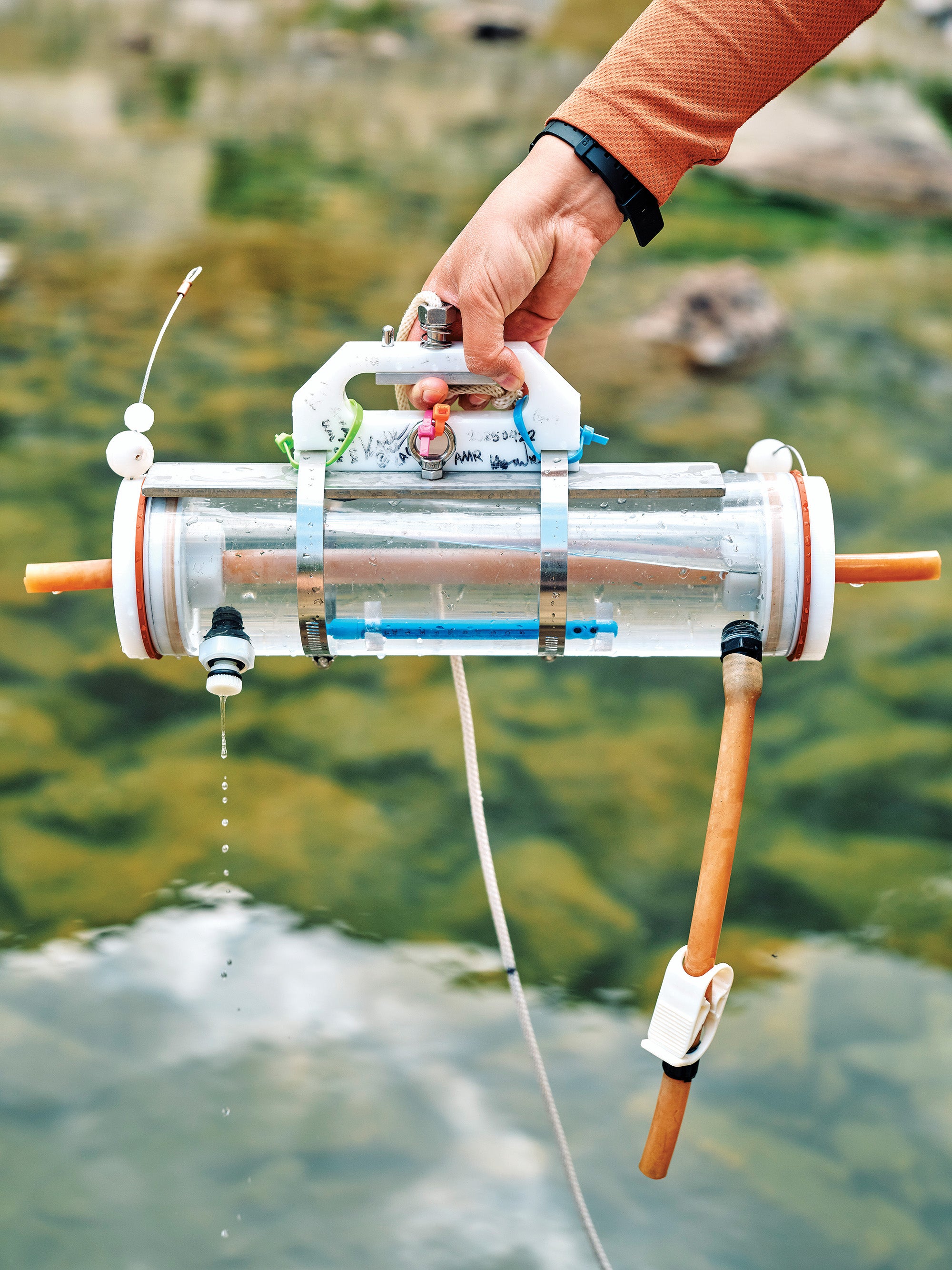
This cylinder snaps shut to trap water at specific depths. Although this sample from Sky Pond looks transparent–a sharp contrast to Turkey Creek Lake–it holds invisible chemical clues. Analysis will reveal how nitrogen and a warming planet are slowly altering even the clearest alpine lakes.
Sediment-core analysis has also revealed turnover in the cast of characters. Mountain lakes are typically dominated by cold-loving diatoms, a kind of algae whose high fatty-acid content makes for easily digestible fish food. But diatoms are giving way to less nutritious green algae, a trend that could ripple unpredictably across alpine food webs.
Food-web impacts are one concern, but mountain lake researchers fear an even greater threat: cyanobacteria, which produce toxins that can poison wildlife, contaminate drinking water and close off lakes to recreation. So far they remain rare in mountain lakes, largely because they are adapted to warmer water. But climate change may be pushing the alpine thermostat toward cyanobacteria’s preferred setting, giving them a foothold in high-elevation ecosystems. “They can be there in low numbers,” Oleksy says, “waiting in the wings until they have a competitive advantage.”
That, it turns out, is exactly what happened at Turkey Creek Lake. Back in the laboratory, Pop and diatom expert Sarah Spaulding, a research associate at the University of Colorado Boulder, identified the filaments we’d seen as a species of toxin-producing cyanobacteria in the genus Dolichospermum. Like other cyanobacteria, Dolichospermum doesn’t always produce toxins, and it’s difficult to forecast when it will. The researchers’ samples tested negative for two common toxins. But they weren’t able to test for a potent neurotoxin called anatoxin—also known by the alarming alias Very Fast Death Factor—because Oleksy simply didn’t think to bring the necessary preservative. “The ecosystems I work in don’t historically have toxic algae,” she says.
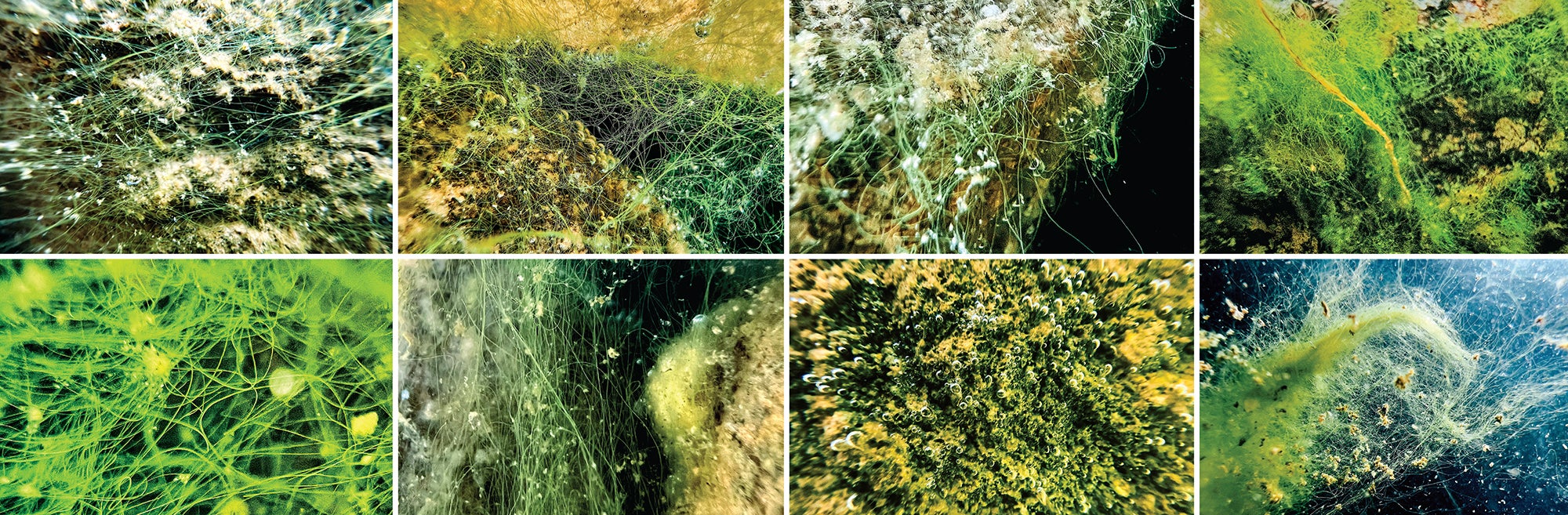
Thriving in nutrient-rich water, microscopic algae form abstract, ethereal filaments. They create the blooms that are slowly reshaping the character of the Rocky Mountain high country.
Toxins in mountain lakes could threaten those who live and recreate there. People generally assume such lakes are unpolluted, yet these waters could become toxic without any obvious warning sign. Public safety could depend on consistent monitoring, but most mountain lakes—by one count, there are more than 12,000 in the contiguous U.S.—are too inaccessible for routine visits.
Monitoring via remote sensing also comes with challenges. Mountains often cloud up when satellites pass overhead, and many lakes are too small for their color changes to register in images taken from space. The Cyanobacteria Assessment Network, a collaboration between several government agencies to detect and provide early warning for toxic blooms, relies on the Sentinel-3 satellite system. Its pixels measure roughly 980 feet on each side, the area of more than a dozen football fields—ideal for the ocean and other expansive water bodies but not for the average tarn. It captures only the largest of small mountain lakes, Handler says. Inevitably, some blooms go undetected.
On our hike into the San Juans, we had encountered only one person: a fit man in his late 40s named Mat deGraaf. He introduced himself, serendipitously, as an employee of the Pagosa Area Water and Sanitation District, which serves southwestern Colorado’s Archuleta County. He seemed surprised to hear that part of the water supply he stewards had become infected at the source.
“Is it pretty bad?” he asked Gannon. “It’s getting worse,” she said.
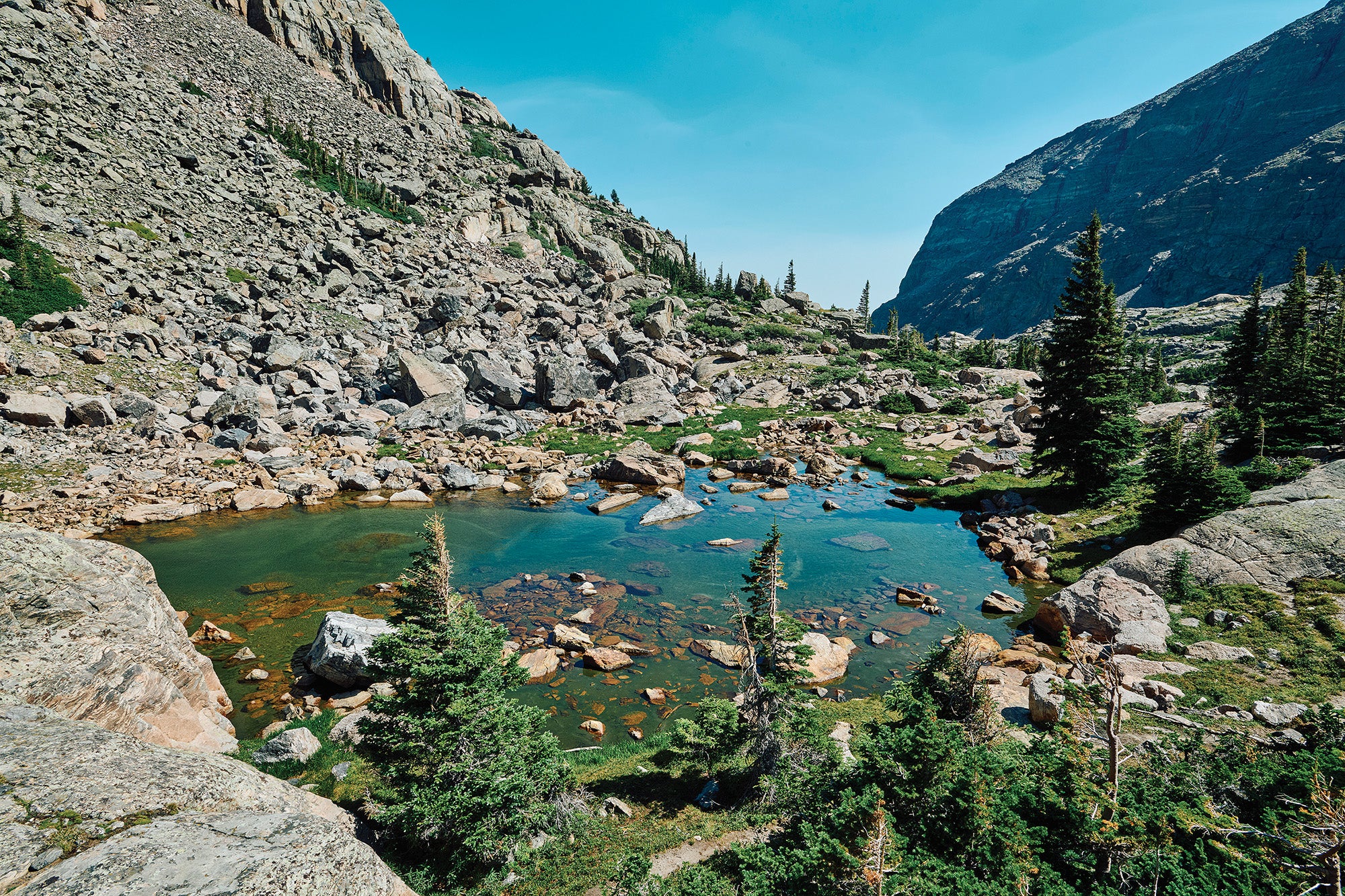
Even Sky Pond is under threat.
When I called deGraaf later, he clarified that, from a water-treatment perspective, it makes little difference where in the hydrological chain algal blooms occur. The district monitors its reservoirs for algae, adding copper sulfate as needed to neutralize blooms. More algae means more tax dollars spent on treatment, but mainly, as a fisher and environmentalist, deGraaf lamented the degradation of headwaters for less tangible reasons. “That’s the nectar of the gods,” he said wistfully.
Henry David Thoreau wrote that a lake is “Earth’s eye.” If Turkey Creek Lake is the eye, Earth appears to have something like jaundice. But on our last morning in the backcountry, I hiked to Upper Fourmile Lake. Perched higher in the watershed at about 11,800 feet, just below the tree line, it was translucent, shading into midnight blue as the rocky shore sloped away. It looked much as it likely would have centuries ago. Geographically, all that separates it from Turkey Creek Lake is a mile of alpine tundra and 665 feet of added elevation. But ecologically, they have grown worlds apart.
The two lakes seem to offer alternative visions of the future: Upper Fourmile is holding on to the past, while Turkey Creek is showing us what comes next.