
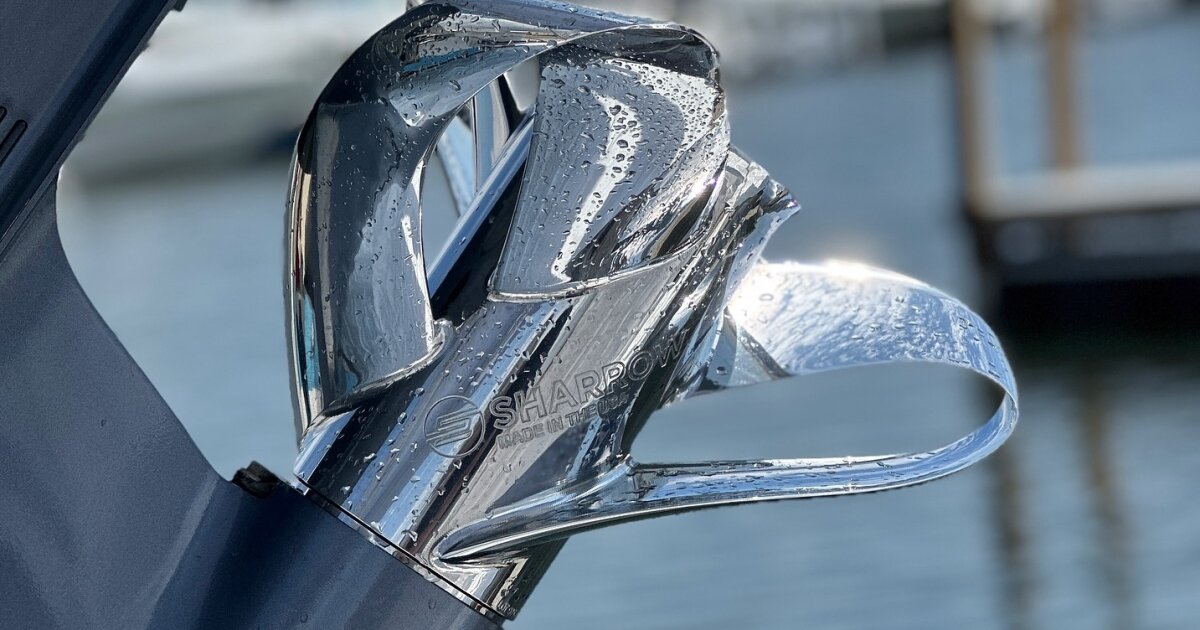
Sharrow knew it had a market disruptor on its hands the instant it transformed propeller blades into more efficient twisted loops. The hold-up of that disruption, however, has been in getting those props out of the factory and onto the actual market. Now it receives a big helping hand from a rather well-known fellow Detroiter: Ford Motor Company. Ford’s expertise in 3D sand-casting technology has broken open Sharrow’s path to scaled production, promising to fractionalize build times.
Since we first looked at Sharrow’s technology in 2023, the company has made a quick succession of steps toward getting its propellers onto the outboards and inboards of more customers. It’s continually released new models and drastically dropped the pricing floor from an initial US$5,000+ all the way down to a current base of $795. It has also increased production capacity via a combination of internal manufacturing growth, alternative easier-to-work-with materials and external partnerships.
In 2025, Sharrow moved its headquarters to a new space within Detroit’s Michigan Central complex. Opened in 2024, Michigan Central is a 30-acre technology and cultural hub located in downtown Detroit around the historic Michigan Central Station. It was spearheaded by Ford and meant to spur innovation and synergy by bringing together top minds in technology, mobility and other disciplines.
“Since we introduced the Sharrow Propeller, the market response has been extraordinary, but scaling production has been our biggest challenge, particularly getting high-quality castings fast enough to meet demand,” says Sharrow founder and CEO Greg Sharrow. “That’s one of the reasons we came to Detroit — to tap into a level of manufacturing capability and ecosystem we couldn’t find anywhere else, including the network at Michigan Central.”
Sharrow’s move is already paying dividends, as it introduced it to the manufacturing expertise it needed to alleviate slow, time-intensive manufacturing and long customer lead times and scale production dramatically.

Sharrow
By collaborating with experts on Ford’s Advanced Industrial Technology & Platforms (ATP) team, Sharrow gained insight and experience in using advanced 3D sand-casting to build its propellers. The parties worked together over the course of nine months to adapt Ford’s state-of-the-art sand-casting techniques to Sharrow’s propeller designs.
Sharrow has previously used investment casting to build its stainless-steel propellers, a process that traditionally involves creating a wax model of the finished product, or in Sharrow’s case, a 3D-printed polymer model, then coating that model in ceramic or plaster to create the mold. Once that outer mold has hardened, the wax or polymer is melted out from the inside, leaving an empty shell in which molten metal is poured and set into the precisely detailed final product.
From there, Sharrow thins down its propeller to precise specification with a five-axis CNC machine and polishes it.

Sharrow
If that multistep process sounds time-consuming, it only gets more so when you realize that each plaster/ceramic mold needs to be broken in order to recover the final product. So the whole process has to be performed for each individual unit.
That said, investment casting delivers the high level of quality and precision Sharrow demands. Outside of Sharrow, it’s used to manufacture finely detailed metal parts with tight tolerances for demanding applications like aerospace and defense, medical and surgical, and luxury consumer goods like jewelry.
Sand casting works similarly but uses a binder-fortified sand mold in place of the ceramic/plaster. The sand mold is much quicker to build and the process cheaper and more mass production-friendly, but it’s not traditionally as capable as investment casting in creating thin, smooth, intricate and/or high-precision metal components.

Sharrow
So the mountain Ford and Sharrow faced was adapting the fast, affordable sand-casting method to the precise, intricately looped stainless-steel propellers. They worked for the better part of the past year refining and validating sand-casted mold creation and steel casting for high-volume production of Sharrow products, calling in the metallurgic and molten pour expertise of metal foundry partners to finalize the process.
“This collaboration with Ford Motor Company has solved [the production scaling] problem for us in a big way,” Greg Sharrow said in this week’s announcement about plans to scale up production. “What used to take an entire boating season to produce can now be made in just a few weeks. That’s game-changing. It’s a powerful example of what can happen when companies like Ford help bring breakthrough technologies to industrial scale.”
A “boating season to a few weeks” – that does sound game-changing and exactly the kind of manufacturing breakthrough Sharrow and its backed-up queue of customers have long needed. To put a finer point on it, Sharrow says that production processes that used to take over four months can now be completed in as little as two weeks.
The real evidence of how well the new manufacturing process and production scaling are working will come when customers start seeing that type of turnaround in real time and prices of Sharrow’s stainless-steel props start to fall.
When Sharrow dropped its price sheet down to $795 last October, it did so by introducing a new AX model made from aluminum rather than stainless steel. Aluminum can be machined rather than cast and is therefore cheaper and quicker to manufacture.
Will the new sand-casting process prove the turning point necessary to drag down the price of more durable stainless-steel props and make them a viable option for more boaters? We certainly hope to see it happen.
In addition to streamlining manufacture of its current lineup, the new production system could lead to faster expansion into additional propeller markets, such as aerospace, defense and renewable energy.
Source: Sharrow