

A 100 kW-class inverter reference platform that helps design engineers accelerate development of high-efficiency SiC-based traction and motor drive systems.
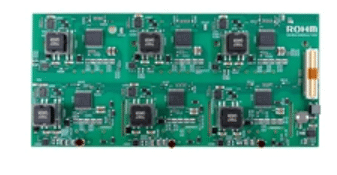
For design engineers working on next-generation power electronics, especially in electric vehicles (EVs) and industrial drive systems, validated reference designs play a critical role in reducing development risk and accelerating time-to-market. Designing high-voltage, high-efficiency traction inverters presents complex challenges, including gate-drive optimisation, isolation, EMI control, and thermal management. The ROHM Semiconductor REF68004 reference design addresses these challenges by offering a proven, system-level solution that engineers can directly evaluate, adapt, and scale for high-power applications.
The reference design provides a ready-to-implement platform for developing high-power traction inverters. It is centred around a 3-phase gate driver board (GD6112TRC3P-EVK-003) designed to control silicon carbide (SiC)-based power modules using ROHM’s TRCDRIVE pack architecture. The design is validated for real-world operation and can drive motors in the 100 kW class, making it suitable for EV traction systems and industrial motor drives.

From a system design perspective, the architecture simplifies one of the most complex sections of inverter development, the gate drive stage. The board operates from a 12 V supply with 5 V logic input, generating dual output rails of +18 V and 3 V required for effective SiC MOSFET gate control. This bipolar gate drive configuration ensures fast switching, reduced switching losses, and reliable turn-off performance, particularly in high dv/dt environments associated with wide-bandgap devices. The design supports switching frequencies between 10 kHz and 30 kHz, aligning with modern efficiency optimisation requirements.
A key strength lies in its integration of isolated power supplies and gate driver ICs. The design incorporates an isolated switching regulator along with linear regulation stages to maintain stable biasing and minimise noise coupling. This ensures robust operation and enhances reliability by maintaining strict isolation between control and high-voltage power domains, an essential requirement in automotive and industrial systems.
The reference design also demonstrates compatibility with high-performance SiC power modules, enabling engineers to leverage advantages such as lower switching losses, higher efficiency, and improved thermal performance. At the same time, it provides practical guidance on addressing associated challenges such as PCB layout optimisation, EMI mitigation, and thermal design through comprehensive documentation, including schematics, a bill of materials, and layout files.
Overall, it serves as a strong foundation for engineers developing high-power inverters. By providing a validated hardware platform and detailed design resources, it significantly reduces prototyping effort, shortens validation cycles, and enables faster deployment of efficient SiC-based power conversion systems.
For more information, click here.