

Something extremely weird is happening to our galactic neighbor. Scientists think they know why
The stars in the Small Magellanic Cloud aren’t behaving the way they should. A cataclysmic collision with another nearby galaxy may be the culprit
Himansh Rathore/University of Arizona
Astronomers may have finally explained why the Small Magellanic Cloud isn’t spinning like it should. The cause: it’s still reeling from an ancient run-in with its big sister, the Large Magellanic Cloud.
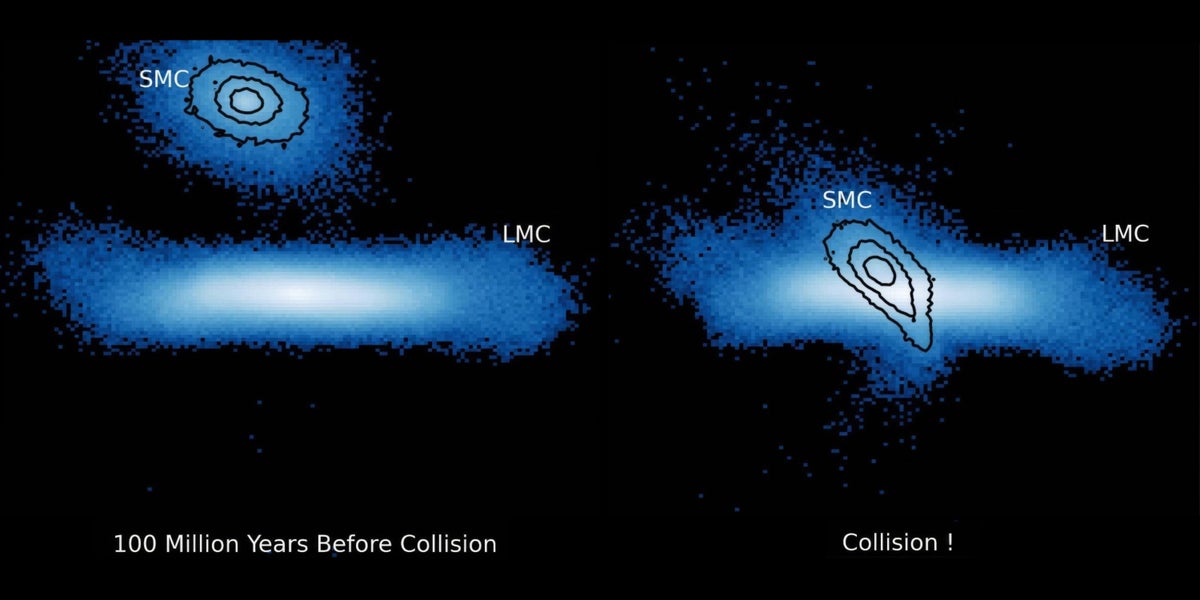
In a new study published on Monday in the Astrophysical Journal, researchers used computers to simulate the two dwarf galaxies’ 100-million-year-long collision. They charted the Large Magellanic Cloud’s impact on its smaller sibling to answer the long-standing question of why the latter’s stars aren’t orbiting as fast as they should.
“Understanding of the inner structure and dynamical state of the Small Magellanic Cloud is a long-standing struggle in the field,” says Michele De Leo, an astronomer at the University of Bologna in Italy, who wasn’t involved in the new paper. Any study to help explain this “is a step in the direction of solving the puzzle of complex interactions between galaxies.”
On supporting science journalism
If you’re enjoying this article, consider supporting our award-winning journalism by subscribing. By purchasing a subscription you are helping to ensure the future of impactful stories about the discoveries and ideas shaping our world today.
Galaxies contain hundreds of millions of stars and are suffused in sparse, ambient clouds of gas and dust as well. For a galaxy with a given size and brightness, the rotation of both the stars and the disk of gas follow a reliable pattern.
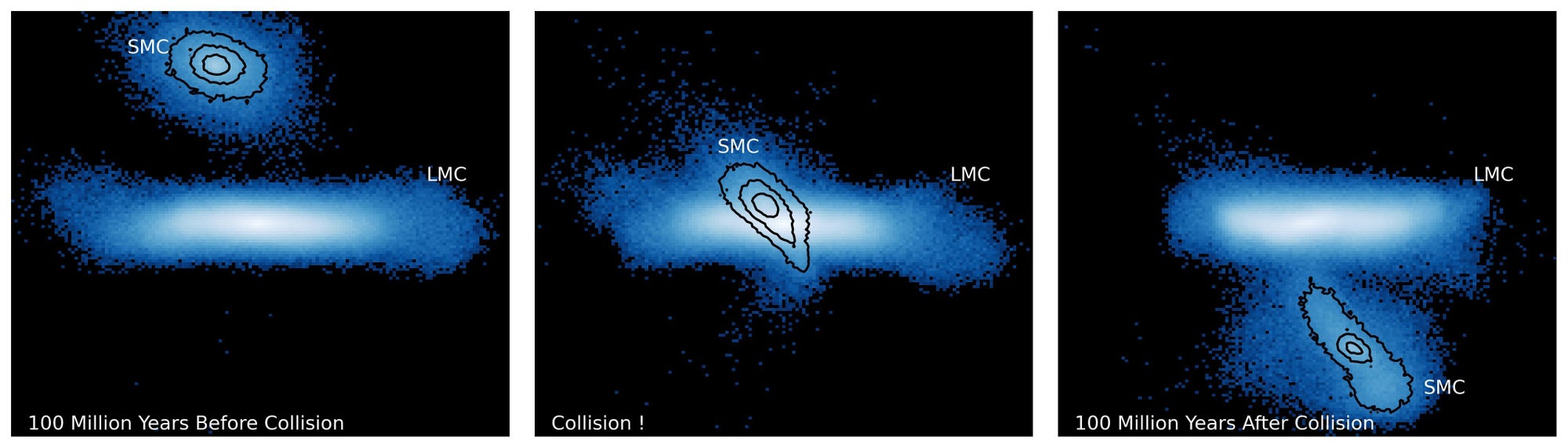
A simulated collision between the Small Magellanic Cloud and the Large Magellanic Cloud that was used in a new study to explain why stars in the former are not rotating as fast as they should be.
Himansh Rathore/University of Arizona
The Small Magellanic Cloud is a conspicuous exception. It’s a small, elongated galaxy that people in the Southern Hemisphere can see regularly in the night sky—20 degrees from its neighbor, the Large Magellanic Cloud. (The two galaxies are named after Ferdinand Magellan, even though it was actually one of his crew who reported them, and he wasn’t the first European to see the objects.)
In the past few decades, astronomers have noticed that the stars in the smaller galaxy aren’t swirling around its center as fast as they should be, especially when compared with the rotation of its disk of gas. To explain this, they’ve floated the idea that we’re looking at the Small Magellanic Cloud after it ripped through the Large Magellanic Cloud, disrupting the former’s rotation.
To test this, a team of four scientists built a computer simulation of this hypothetical collision. It produced snapshots of the two galaxies before, during and after the crash, a time frame that spanned hundreds of millions of years. The violence, they found, left the smaller galaxy in disarray, with its stars and gas rotating far less than before.
The Small Magellanic Cloud (SMC) is often used as a comparison point for galaxies in the early universe because it’s poor in heavy metals. So this dramatic update to its cosmic history might lead astronomers to revisit those comparisons.
“The SMC went through a catastrophic crash that injected a lot of energy into the system,” says Gurtina Besla, an astronomer at Steward Observatory and a co-author of the study. “It is not a ‘normal’ galaxy by any means.”
It’s Time to Stand Up for Science
If you enjoyed this article, I’d like to ask for your support. Scientific American has served as an advocate for science and industry for 180 years, and right now may be the most critical moment in that two-century history.
I’ve been a Scientific American subscriber since I was 12 years old, and it helped shape the way I look at the world. SciAm always educates and delights me, and inspires a sense of awe for our vast, beautiful universe. I hope it does that for you, too.
If you subscribe to Scientific American, you help ensure that our coverage is centered on meaningful research and discovery; that we have the resources to report on the decisions that threaten labs across the U.S.; and that we support both budding and working scientists at a time when the value of science itself too often goes unrecognized.
In return, you get essential news, captivating podcasts, brilliant infographics, can’t-miss newsletters, must-watch videos, challenging games, and the science world’s best writing and reporting. You can even gift someone a subscription.
There has never been a more important time for us to stand up and show why science matters. I hope you’ll support us in that mission.