
The Inner Guru: Finding the Infinite Within in the Age of Kali
The Eternal Need for a Bridge
Every human being, regardless of culture, language, or era,
carries within them a restless longing — a deep, unspoken hunger to touch
something greater than the self. The finite mind, bounded by birth and death,
by desire and fear, reaches out toward something boundless, something it cannot
quite name but cannot stop seeking. In the vast landscape of Hindu wisdom, this
gap between the finite seeker and the infinite reality has always been
acknowledged, and the bridge across it has always had a name — the Guru.
The word Guru is composed of two syllables: Gu, meaning
darkness, and Ru, meaning the one who dispels it. The Guru is therefore not
merely a teacher in the academic sense. The Guru is the living force that tears
away the veil of ignorance and reveals the eternal light that was always
shining within. And this Guru need not be a person. A river, a flame, a moment
of profound grief, a blade of grass bending in the wind — anything that
illuminates truth and dissolves illusion qualifies as Guru.
The Shadow That Falls Over Kali Yuga
Hindu cosmology divides cosmic time into four great ages, or
Yugas. We presently live in Kali Yuga, the age of darkness, confusion, and
spiritual decline. The ancient texts describe Kali Yuga as a time when
righteousness stands on a single leg, when truth is traded for convenience, and
when those who wear the robes of wisdom often do so for power, prestige, and
profit.
The Guru-disciple relationship, one of the most sacred bonds
in Hindu civilization, has suffered enormously in this age. False teachers have
multiplied. The marketplace of spirituality is crowded with those who speak the
language of liberation while binding others more tightly to illusion. Genuine
Gurus exist even now, but as the tradition honestly admits, they are
extraordinarily rare and exceedingly difficult to find. This is not a
pessimistic observation — it is a compassionate warning, one that the great
beings of this tradition foresaw long ago.

Krishna’s Gift: The Gita as the Eternal Guru
Recognizing the spiritual crisis that Kali Yuga would bring,
Bhagavan Krishna offered humanity something unprecedented — a scripture so
complete, so luminous, and so universally applicable that it could function as
a living Guru for any sincere seeker at any point in time. The Bhagavad Gita,
delivered on the battlefield of Kurukshetra to the warrior Arjuna, is not
merely a philosophical text. It is a direct, intimate conversation between the
Divine and the human soul in crisis.
In 700 verses across 18 chapters, Krishna addresses every
dimension of human suffering and confusion. He speaks to the person paralyzed
by duty, overwhelmed by emotion, confused about identity, terrified of death,
and uncertain about God. He does not offer escape — he offers transformation.
Krishna declares in the Gita (Chapter 4, Verse 7-8):
“Whenever righteousness declines and unrighteousness
rises, O Arjuna, I manifest myself. For the protection of the good, the
destruction of the wicked, and the re-establishment of righteousness, I appear
age after age.”
The Gita itself is that appearance — not always in flesh,
but in wisdom. For the seeker in Kali Yuga who cannot find a living Guru, the
Gita becomes the voice of Krishna speaking directly to their condition. It asks
nothing except sincerity. It requires no ritual of initiation. It opens itself
to whoever opens it with a genuinely seeking heart.
Krishna further assures (Chapter 18, Verse 65):
“Fix your mind on Me, be devoted to Me, worship Me, bow
down to Me. So shall you come to Me. I promise you truly, for you are dear to
Me.”
This is the Guru speaking — not from a distant throne, but
from the very core of the seeker’s own being.
Shiva and the Tantric Path: The Guru in Symbol and Form
While the Gita addresses the seeker through philosophical
discourse and devotion, the Tantric tradition, arising from the wisdom of
Bhagavan Shiva, takes a different but equally profound approach. Tantra
recognizes that the human being is not just a mind but a body, an energy
system, a field of sensation and symbol. It teaches through form — through
ritual, image, sound, breath, and gesture.
Shiva himself is the Adi Guru, the first and original
teacher. He transmitted the Tantric wisdom to the Saptarishis, the seven great
sages, and from them it flowed into the world in countless streams. The Tantric
path does not ask the seeker to abandon the world — it asks the seeker to look
more deeply into the world and find the sacred hiding within the ordinary.
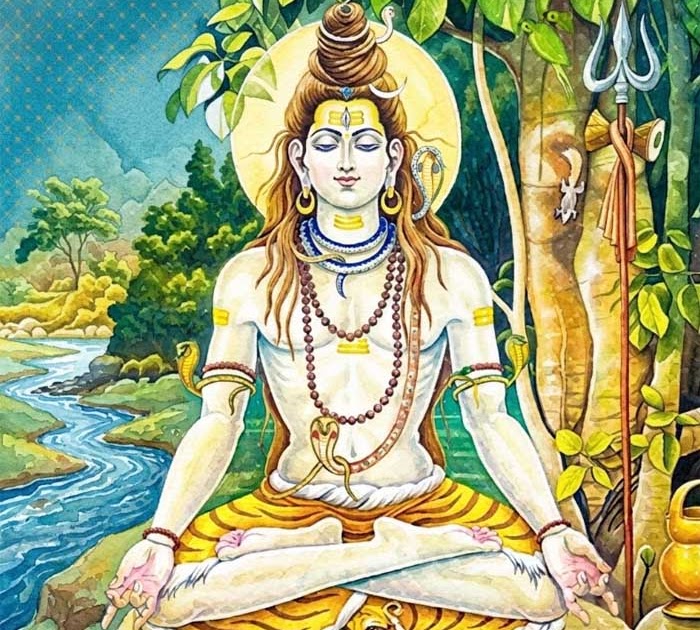
The outward symbols of Shiva — the crescent moon, the
trident, the serpent, the third eye, the Ganga flowing from his matted locks —
are not decorative. Each one is a precise teaching. The crescent moon
represents the mind in its waxing and waning, always cycling, never absolute.
The trident represents the three fundamental forces of creation, preservation,
and dissolution. The third eye represents the awakening of inner vision that
sees beyond duality. The serpent coiled at his neck is Kundalini — the dormant
spiritual energy lying within every human being, waiting to rise.
In Kali Yuga, these symbols function as Gurus. The sincere
seeker who contemplates the image of Shiva does not merely see a deity — they
receive a transmission of wisdom encoded in form. This is the genius of Tantra
— it made the sacred visible, touchable, and accessible even to those who could
not read, even to those who had no teacher.
You Are the Bridge: The Seeker as Their Own Guru
Perhaps the most radical and most compassionate teaching
available to the modern seeker is this — in Kali Yuga, you yourself can become
the bridge between the finite and the infinite. This is not arrogance. It is
the culmination of what both the Gita and Tantra have always pointed toward.
The Gita teaches, in its opening chapters, that the Self —
the Atman — is eternal, unborn, and undying. It is not separate from the
supreme reality, Brahman. The entire drama of spiritual seeking is ultimately
the infinite pretending to be finite and then waking up to its own nature.
“The Self is the friend of the self for him who has
conquered himself by the Self; but for him who has not conquered himself, the
Self is inimical to him like an enemy.” (Bhagavad Gita, Chapter 6, Verse
6)
This verse is extraordinary. It places the entire journey of
liberation within the relationship the seeker has with their own inner being.
The inner Guru — the higher Self, called Antaryami or the inner witness — is
always present, always guiding, always illuminating. The problem is never the
absence of guidance. The problem is the noise of the restless mind that drowns
out the inner voice.
The Wealth Already in Your Hands
The sincere seeker in Kali Yuga is not impoverished. The
wisdom of thousands of years sits before them. The Bhagavad Gita, the
Upanishads, the teachings of Tantra, the lives and words of realized masters —
all of this is accessible. The tragedy of Kali Yuga is not the absence of
light. It is the abundance of distraction that prevents people from sitting
quietly long enough to see the light that was always there.
The Mundaka Upanishad declares: “The Self cannot be
attained by the weak.” Weakness here does not mean physical frailty. It
means the weakness of a mind unwilling to turn inward, unwilling to be still,
unwilling to question the noise it has mistaken for truth.
The Life Lesson That Kali Yuga Teaches
Kali Yuga, for all its darkness, carries a peculiar gift.
When the external world offers no reliable guide, when institutions have failed
and teachers have disappointed, the seeker is left with only one direction to
turn — inward. This turning inward is precisely what every scripture has always
demanded. In this sense, Kali Yuga is not a punishment. It is a forceful
invitation.
The life lesson is this — do not wait for the perfect Guru
to appear before you begin. Begin now. Use what is in your hands. The Gita is
your Guru. The symbols of Shiva are your Guru. The silence after a deep breath
is your Guru. The grief that breaks your heart open is your Guru. Everything,
looked at with enough sincerity and stillness, points toward the same truth —
you are not separate from what you are seeking. The bridge and the destination
are one.
The infinite is not elsewhere. It is the very ground upon
which the finite seeker stands.
The seeker who looks within with sincerity needs no other
temple. The truth was never hidden — only overlooked.