
Bhima and the Elephant Legion: Strength, Symbolism, and Scriptural Insights
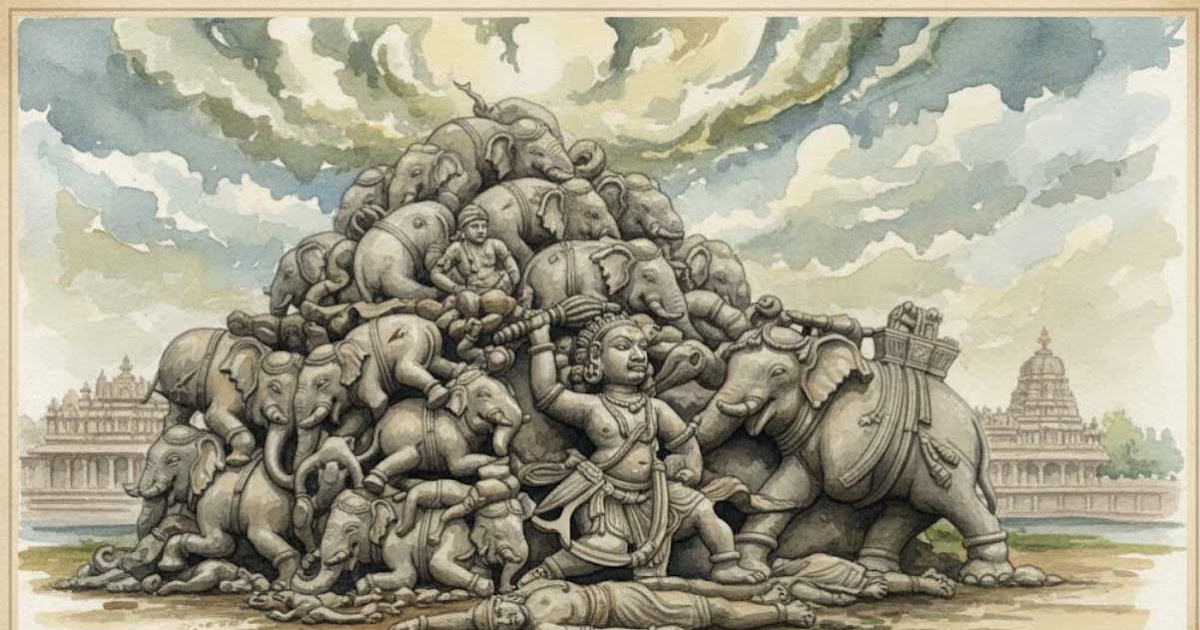
The Kurukshetra War, as narrated in the Mahabharata, contains countless episodes that reveal not only the physical might of warriors but also the deeper spiritual currents guiding the destiny of Bharatavarsha. One such powerful moment is the encounter of Bhima with the elephant divisions of the Kaurava army. This episode, deeply etched in the collective memory of Hindu tradition, is also immortalized in temple sculptures such as those in the Hoysaleshwara temple at Halebidu, carved nearly eight centuries ago. These carvings bear witness to a history, not imagination, and preserve the sacred narrative through art.

The Decimation of the Elephant Army
The Mahabharata describes the moment Bhima charged into the elephant platoons like a storm scattering restless clouds. His blows shattered the massive beasts, and soon a mountain of fallen elephants covered the battlefield. Sculptors centuries later captured this very scene: a heap of intertwined elephant bodies, their forms rising so high that they appear to merge with carved clouds above. It is as if the artisans wanted to convey that the force of Bhimas destruction reached the heavens themselves.
In these carvings one also sees Bhima battling the mighty elephant Supratika. Depicted holding the trunk of the raging beast with his left hand while striking with his mace in the right, Bhima stands as the embodiment of courage and physical perfection. Another figure, a soldier crushed beneath the foot of an elephant, and a mahout pinned between two fallen animals, reminds the viewer of the overwhelming scale of the conflict.
The Strength of a Thousand Elephants
A famous episode preceding the war speaks of Bhimas descent into the Naga realm after being poisoned and drowned by Duryodhana. There, Bhima was revived and strengthened by the Nagas, who offered him bowls of a divine elixir. Each bowl granted the power of one thousand elephants. Bhima consumed eight, explaining the unmatched force he displayed throughout his life.
The idea of elephant-strength is significant in Hindu philosophy. Elephants represent might, steadiness, and unstoppable momentum. Bhima, as the son of Vayu, the wind god, embodies both power and movement. His strength is not merely physical; it symbolizes the unstoppable energy of dharma when it rises to confront adharma.
Scriptural Resonance
Though the elephant episode is not paired with a direct verse commonly quoted, the Bhagavad Gita gives us a window into the nature of divine strength. Krishna declares: “Of weapons I am the thunderbolt, and of elephants I am the lord of elephants” (Bhagavad Gita 10:28). This verse highlights the sacred symbolism of elephant might, aligning Bhimas power with divine manifestations of strength and righteousness.
Symbolism and Meaning
Bhimas destruction of the elephant divisions is not merely a tale of physical prowess. It teaches that when strengthened by divine force, dharma is unstoppable, no matter how massive the opposition. The sculptures at Halebidu, capturing clouds above the fallen beasts, subtly remind us that human valor, when aligned with righteousness, rises beyond earthly limits.
Bhimas story continues to inspire devotees, artists, and seekers, representing the fusion of human effort and divine blessing. His heroic feats are not only historical events but spiritual lessons carved into the cultural memory of India.