

Politics
/
March 24, 2026
The GOP shouldn’t win this case, but the fact that Trump has been throwing a tantrum about it for years means they likely will.
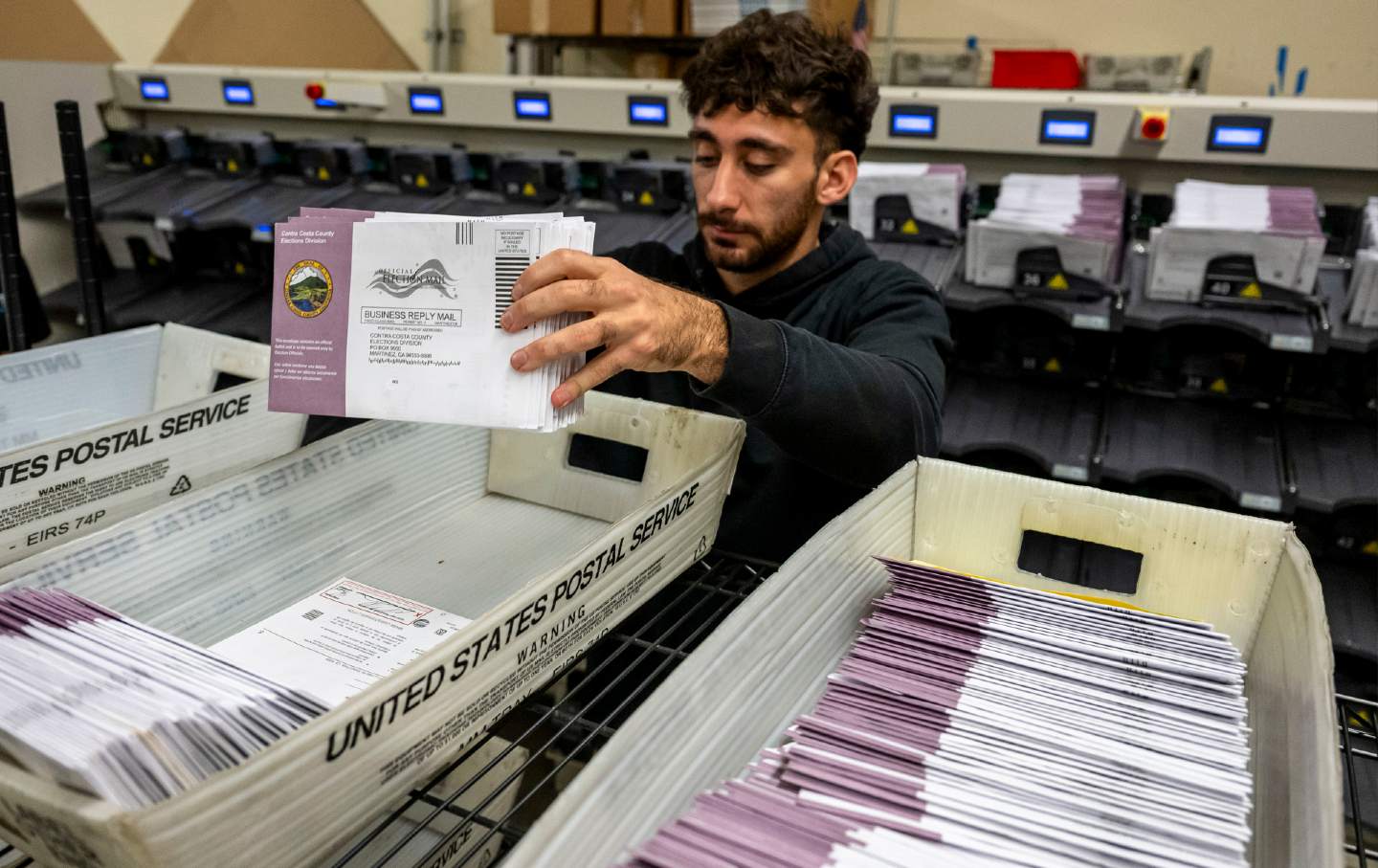
An election worker sorts mail-in ballots for the 2024 presidential election in Martinez, California, on Election Day.
(David Paul Morris / Bloomberg via Getty Images)
The Supreme Court heard oral arguments on Monday in a case that exists only because Donald Trump lost the 2020 election, threw a temper tantrum, attempted a coup d’état, failed at that, and has spent the last six years claiming he won the election he clearly lost. The case is called Watson v. Republican National Committee, and it involves a Mississippi law that allows mail-in ballots postmarked by Election Day to be counted as long as they are received by the state board of elections within five days of the election.
Mississippi adopted this law during the Covid-19 pandemic, but over 30 states have similar laws. Legally speaking, this is a standard application of “states’ rights.” Congress set the date for federal elections in the Presidential Election Day Act of 1845 (“the Tuesday next after the 1st Monday in November, in every even numbered year”) but it’s left to the states to determine how to administer those elections. Obviously, mail-in ballots weren’t really a thing in 1845—indeed paper ballots weren’t really a thing (which I explain in my best-selling book Bad Law: Ten Popular Laws Ruining America, which you can find here, if you haven’t honored me by picking it up yet). But as voting has evolved, most states reasonably concluded that people who mail ballots by the federally mandated election day should have those ballots counted when they arrive.
Counting mail-in ballots was an uncontroversial practice until Donald Trump lost an election. Trump declared, without a scintilla of evidence, that mail-in ballots were “rigged,” and the Republicans have lined up like lemmings to follow Trump off the antidemocratic cliff. Mail-in ballots received after Election Day do not change the outcomes of elections. But they can change the initial reports called out by newscasters standing in front of giant touch screens on election night.
Those early reports are called the “red mirage.” For reasons that we still don’t fully understand, Republicans tend to perform better with voters who cast their ballots on Election Day, while Democrats tend to perform better with voters who cast their ballots early or by mail. Because states tend to count the ballots cast on Election Day before they count ballots cast through other means, the television people often report Republican leads that slowly get whittled away as more votes are counted. There’s nothing “fishy” or “rigged” about that. But if you have a problem with it, you should really send your complaints to Steve Kornacki and John King, not the state boards of elections that are just counting votes.
Again, none of this was a problem until Trump lost. Trump’s inability to understand or accept how counting works—and the GOP’s slavish desire to do Trump’s bidding—is what has spurred this case all the way up to the Supreme Court.
The case began with a challenge of Mississippi’s mail-in ballot counting by the Republican Party. The Republicans lost in district court, but then a panel of judges who are all vying to be Trump’s next Supreme Court nominee—James Ho, Stuart Kyle Duncan, and Andy Oldham, all of the US Court of Appeals for the Fifth Circuit—overturned the district court and ruled that the Mississippi law violated the 1845 Election Day Act.
Current Issue

The crux of the Fifth Circuit argument, and the argument made by GOP and Trump administration lawyers at the Supreme Court, was this: When Congress set the nation’s Election Day in 1845, it meant to set the day for when votes had to be cast and received; moreover, the only people capable of “receiving” ballots are those “cloaked in government authority,” and the officials wearing this magic cloak of timely democracy somehow do not work at the post office—which is probably a surprise to everybody who mails their taxes on April 15 and doesn’t know when their taxes are actually received by the IRS.
As my friend Mark Joseph Stern said of the Republican position: “It’s the kind of argument that makes sense if you think about it for five seconds, but falls apart if you think about it for five minutes.”
The act of casting and receiving votes was instantaneous in the Athenian era when “voting” meant shouting Yea or Nay until Zeus rumbled with pleasure or whatever. Once you add any form of “mail” into the equation, or the “collection” of votes from, say, a voting machine or a ballot drop box, voting becomes a two-step process—the casting of the vote and the receiving. Things like mail and voting machines have been with us for a very long time now, and at no point has Congress decided to update its 1845 Act to specify when votes must be received, only the date by which those votes must be cast. It has been left to the states to determine when the votes cast in accordance with the congressional deadline must be received. To accept the Republican argument is to believe that the states have been doing elections wrong for over 150 years, and Donald Trump was the first person to figure that out.
Predictably, during oral arguments, the wild GOP assertion that the last century-and-a-half of election law should be thrown out because it displeases Donald Trump found purchase among at least four Supreme Court justices: Clarence Thomas, Sam Alito, Neil Gorsuch, and alleged attempted rapist Brett Kavanaugh. Alito’s argument was particularly risible, as he claimed that Mississippi’s law needs to be changed (by Supreme Court fiat) because “losing candidates…would not accept” the results of an election where votes received after Election Day changed the outcome.
I take issue with Alito’s framing, because it’s very clear that only one “losing candidate” was such a sore loser as to not accept the clear results of the election, and that loser was Trump. And the results Trump wouldn’t accept did not “change” because of ballots received after Election Day. Again, ballots received after Election Day have not changed the outcome of any presidential election in any state; they have only changed the incorrect reporting of the results of the election done by people who started mouthing off on television before all the votes were counted. Alito should be concerned with the law and the Constitution, not with placating a man-baby and making CNN’s job easier.
Kavanaugh also cared more about the appearance of who won the election than about the actual winner of the election. But everybody should remember that Kavanaugh rose to professional power through his dogged defense of George W. Bush in Bush v. Gore—which was another case in which Republicans preferred stopping the counting of votes while a Republican was ahead.
But the achievement for weirdest and most fanciful argument goes to Gorsuch. That guy equated putting your ballot in the mailbox with handing it to your friend “Bob” (this was after an extended discussion of how voting worked during the Civil War, which I will not bore you with because both sides of the argument could twist that history to support their position, and because pretending that our modern election laws hinge on how the Union army was allowed to vote is beyond dumb). He then went on a wild non sequitur about how if you mail your ballot via FedEx, you could “recall” your ballot and instruct the mail carrier to not deliver it, thus placing the election in turmoil. Has this ever happened? Is it conceivable that it would happen in great enough numbers to tilt or even muddle the outcome of an election? No, of course not, but things as petty as the nature of our shared reality do not matter to people like Gorsuch, at least not when he’s trying to overturn settled constitutional law.
Still, those three plus Thomas (who said nothing of import, as is his wont) only gets the anti-democracy forces to four votes. Chief Justice John Roberts didn’t really give away his opinion, but he piped up to question the Republicans on how their theory of Election Day might apply to early voting and didn’t sound too happy with the Republicans’ answers.
If you take the Republican arguments about Election Day to its logical conclusion, their theory of the case also kills the ability of states to have an early voting period. If the 1845 Election Day Act sets the date certain by which votes must be received, there’s every reason to say that it also sets the date certain for when votes must be cast. Obviously, in 1845, there was no “early” voting. Since then, states have been given the power to decide for themselves when Election Day starts. If the Republicans’ theory holds, ballots cast before Election Day are just as invalid as ballots received after Election Day.
The other problem with the Republican argument was voiced by Amy Coney Barrett, who more or less pointed out that there are three acts that make up a valid vote: casting, receiving, and “adjudicating” whether a ballot is legitimate. In a world in which Republicans regularly kick people off voter rolls and challenge their voter registration credentials, we have a lot of people casting “provisional” ballots, and the legality of those ballots is determined after Election Day. Under the Republican theory, these ballots may also be disregarded.
Republican lawyers responded to these questions by doing something that I’ve really only seen the Trump administration do: They told the Supreme Court that they were not challenging early voting or provisional ballots “yet.” Republican super lawyer Paul Clement (who argued the case on behalf of the Republican National Committee) joked that “maybe I have a different challenge to bring in the future” and said that he didn’t want to close himself off from the possibility of challenging early votes, but that it was not the issue in this case. Solicitor General John Sauer echoed Clement, saying the Trump administration’s current position is not to object to early voting. It’s a thing Trump’s lawyers, and only Trump’s lawyers, seem to get away with: essentially telling the justices not to worry their pretty little heads about what the administration is going to do next. It’s like going to the court and asking for an ax to chop down a tree, and when the justices say, “You’re just going to use this ax for chopping trees, and not humans, right?” you respond, “Wouldn’t you like to know?” And then laugh about it.
Popular
“swipe left below to view more authors”Swipe →
Roberts and Barrett seemed unsatisfied with the Republican lawyers’ responses to their concerns, and for that reason one might feel confident that the Republicans will lose their case, and Mississippi (and all the other states) will be allowed to count ballots received after Election Day.
But, I do not feel confident. Yes, Roberts and Barrett had objections, but Roberts and Barrett have taken a hatchet to voting rights before. As I’ve written recently, Roberts loves to treat the Trump administration with the presumption of normalcy, and so the government’s assurance that it’s not coming for early voting just yet might be enough for him.
The Republicans shouldn’t win this case. They shouldn’t have won it in front of the Fifth Circuit. We shouldn’t be here at all. The only reason their argument hasn’t already been thrown out of court is that Donald Trump lost an election and can’t handle that loss like an adult.
But “Donald Trump is whining on social media and might launch another coup” is often enough of a reason for the Supreme Court to upend settled law. They might do it again. My ears tell me this is a 5–4 loss for the Trump administration’s antidemocratic position, but my gut tells me it’s a 6–3 win for the hysterical man throwing a six-year temper tantrum.
Let’s hope John Roberts’s powers of rational thought triumph over his fear and cowardice.
Even before February 28, the reasons for Donald Trump’s imploding approval rating were abundantly clear: untrammeled corruption and personal enrichment to the tune of billions of dollars during an affordability crisis, a foreign policy guided only by his own derelict sense of morality, and the deployment of a murderous campaign of occupation, detention, and deportation on American streets.
Now an undeclared, unauthorized, unpopular, and unconstitutional war of aggression against Iran has spread like wildfire through the region and into Europe. A new “forever war”—with an ever-increasing likelihood of American troops on the ground—may very well be upon us.
As we’ve seen over and over, this administration uses lies, misdirection, and attempts to flood the zone to justify its abuses of power at home and abroad. Just as Trump, Marco Rubio, and Pete Hegseth offer erratic and contradictory rationales for the attacks on Iran, the administration is also spreading the lie that the upcoming midterm elections are under threat from noncitizens on voter rolls. When these lies go unchecked, they become the basis for further authoritarian encroachment and war.
In these dark times, independent journalism is uniquely able to uncover the falsehoods that threaten our republic—and civilians around the world—and shine a bright light on the truth.
The Nation’s experienced team of writers, editors, and fact-checkers understands the scale of what we’re up against and the urgency with which we have to act. That’s why we’re publishing critical reporting and analysis of the war on Iran, ICE violence at home, new forms of voter suppression emerging in the courts, and much more.
But this journalism is possible only with your support.
This March, The Nation needs to raise $50,000 to ensure that we have the resources for reporting and analysis that sets the record straight and empowers people of conscience to organize. Will you donate today?