
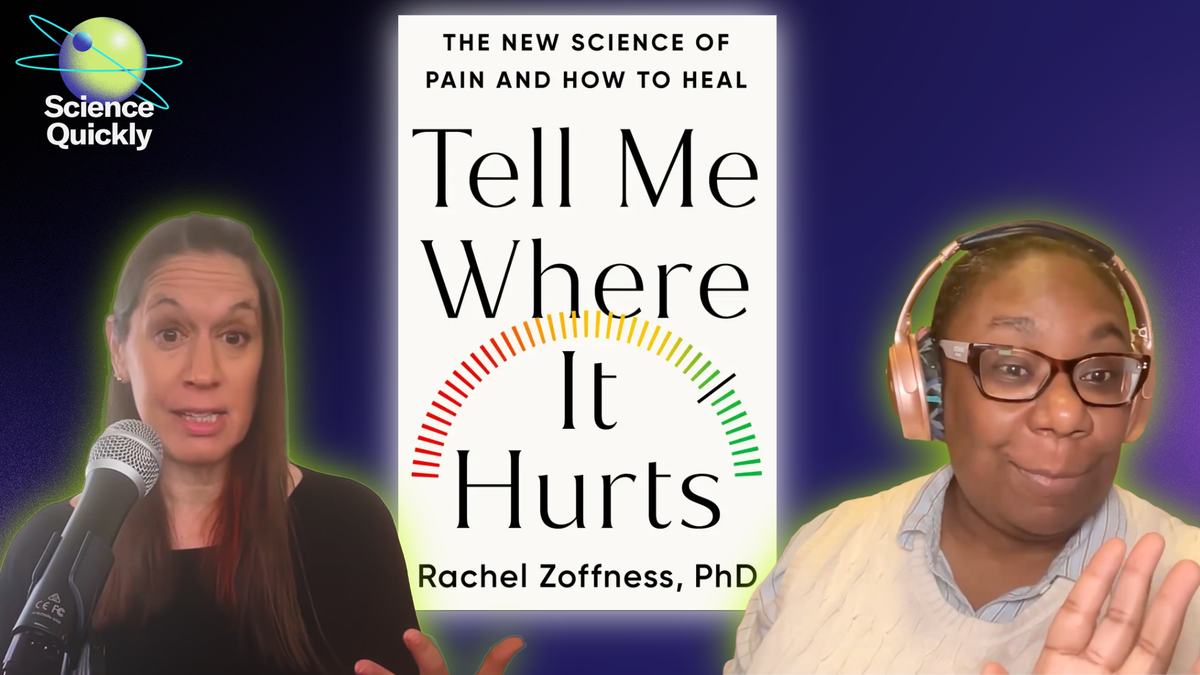
Kendra Pierre-Louis: For Scientific American’s Science Quickly, I’m Kendra Pierre-Louis, in for Rachel Feltman.
From stubbing your toe to dealing with the occasional headache or sore back, to experience pain is to be human. And for minor aches and pains, the occasional over-the-counter medication is usually enough. But what happens if the pain we’re dealing with isn’t a one-off? What happens when that pain becomes chronic?
According to 2023 data from the U.S. Centers for Disease Control and Prevention, roughly a quarter of U.S. adults experience chronic pain. Rachel Zoffness, a pain scientist and an assistant clinical professor at the University of California, San Francisco who also teaches pain science at Stanford University argues that pain is often misunderstood by the general public and by doctors. The end result, she says in her new book, Tell Me Where It Hurts: The New Science of Pain and How to Heal, is that many of us are suffering from more pain than necessary.
On supporting science journalism
If you’re enjoying this article, consider supporting our award-winning journalism by subscribing. By purchasing a subscription you are helping to ensure the future of impactful stories about the discoveries and ideas shaping our world today.
I talked with Rachel about our misconceptions around pain and what we can do to reduce how much pain is in our lives. Here is our conversation.
So what got you into studying pain?
Rachel Zoffness: A couple of things. First of all, I was scared of pain. You know, pain’s an aversive experience, and I think most humans are scared of pain. But when I took my first neuroscience class as an undergrad nerd at Brown University, I discovered that pain lived at the intersection of all these things I wanted to study.
So I couldn’t decide what I wanted to be when I grew up. So I was taking neuroscience, and I was taking human biology, brain and behavior. I was taking psychology courses. And pain lived smack in the center of all of those things, and I really glommed onto it, so I ended up conducting my honors thesis on pain, neuroscience and the endogenous neurotransmitters that regulate pain, and I just really never stopped studying it.
Pierre-Louis: So it’s actually funny that we’re doing this interview today because I’m actually in pain. I tweaked my shoulder last week. [Laughs.] I’ve hit that age where it takes longer to bounce back. And basically, I think one of the questions that your book raises—and answers, I think—but at a basic level what is pain? Because so often we’re taught that pain is a signal, that you tweak your neck or you touch a hot stove and so you feel pain. It’s our body’s response to injury. But you say in your book that pain is a lot more nuanced than that. So in your definition what is pain?
Zoffness: Yeah, so simply put, pain is our body’s warning system. It’s our danger-detection system. And it’s adaptive and evolutionary, right? Like, pain helps us survive. It tells us, “Pay attention. You may need to change your behavior. Something dangerous and bad might be happening.”
The problem is that we’ve all been fed a lie. It’s a lie that really bothers me. And the lie we’ve been sold is that pain lives exclusively in the body part that hurts. Like, if we have chronic back pain, we will see 15 back doctors and maybe have multiple back surgeries and probably get some prescriptions. And those things can be helpful. But here’s the problem: many, many decades of neuroscience tell us that pain is ultimately constructed by the brain—of course, in concert with input from the body and also our environment.
But one of the reasons we know that pain is constructed by the brain is because of a condition called phantom limb pain. And phantom limb pain is when someone loses a limb, an arm or a leg, and they continue to have terrible pain in the missing body part. Now, if you can have terrible leg pain in a leg that is no longer attached to your body, that tells us pretty definitively that pain can’t just live in the body part alone. And of course, we now know pain is ultimately constructed by our brain and our central nervous system.
So, you know, what we know about pain is that it’s a lot bigger and more complex than we’ve been led to believe. But in my mind that’s actually good news, not bad news, because if the surgery hasn’t worked, there’s a million other things we can do to change pain volume.
Pierre-Louis: I think the examples in your book were, I think, a construction worker put a nail gun through his nail boot, and then he got to the ER, and he was, like, in so much pain, and then he got to the hospital, and they realized that the nail hadn’t gone through his foot. So, like, the pain was completely constructed by the brain in that kind of example. And then on the flip side there was that gentleman who, like, put a nail gun through his skull and, like, didn’t even know until he went to the dentist and they X-rayed him for an unrelated tooth pain. And that man had no pain.
I guess the question that I have is, like, what does that tell us about treating pain? ’Cause really, fundamentally, like, if you break your ankle and you’re in pain, that’s one to one: you take pain meds, and your ankle heals, and you’re done. But your book really hones in on, like, chronic and systemic pain that’s a little bit more different.
Zoffness: You’ve asked good questions and, like, seven of them, and that’s how it goes with pain, you know? So I wanna try and answer your question which to me is at the real heart of what pain is and how we treat it.
So there’s this word that describes what pain is, and the word is “biopsychosocial.” And if folks listening remember nothing else from this interview, I want you to take home this word with you: biopsychosocial. Pain is always biopsychosocial, and I wanna say what that means.
So if you imagine a Venn diagram with three overlapping circles, one of those circles is “bio,” like, biological factors that make pain; one of those circles is “psych,” psychological factors that contribute to pain; and one of those circles is “social,” or sociological factors. Pain lives smack in the middle of those three domains of pain. I go into that in the book for a reason: because it’s not necessarily intuitive. It’s a little more complicated than we realized. But what’s really cool about telling people that pain is biopsychosocial—and I’ll say a couple of examples of what that means in a moment—is that it gives us literally a million ways to adjust pain volume and change the pain we feel.
So in the bio domain of pain, we have, like, the things we’ve heard about the most: genetics, tissue damage, system dysfunction—which includes disease—and also diet, exercise, and sleep. And I like including those there ’cause it reminds us, of course, pain feels worse when sleep is poor, when nutrition is poor, and, you know, depending on how much or how little we’re moving our bodies, we all know that changes the pain we feel. We have a lot of agency over those things.
The psych domain of pain is full of stigma and misunderstanding. Like, if you even talk about that, people assume you’re saying, “It’s all in my head. It’s just psychological.” So I’m very careful to always say, “All pain all the time is biopsychosocial.” Just as pain is never purely physical, it’s never purely emotional. It’s always all the things.
So in the psych domain of pain, most importantly in my mind is emotions. Emotions change the pain we feel, and I can tell you why: like, just basic, straight-up neuroscience—the parts of the brain that make emotions also make pain, so, like, our limbic system and our amygdala are critical parts not just of the emotion machinery but also the pain machinery. So negative emotions will amplify pain volume, and positive emotions will turn pain volume down.
And also in the psych domain, believe it or not, we have predictions and expectations. Like, we’ve all heard of the placebo effect. That is real, right? We also have coping behaviors: Like, how do we cope with pain once it starts? Do we isolate—stay home, stay inside, stay in bed, stop moving? That will amplify pain volume.
And then in the sociological domain of pain, I like to think of that as, like, the “everything else” domain because it’s socioeconomic status; it’s access to care; it’s race and ethnicity. It’s also social support and our social health: Are we isolated and alone? Do we have social support?
You know, so all of these things together actually create the pain we feel, and that’s very hopeful for treatment ’cause it gives us a road map for treatment.
Pierre-Louis: I have a good friend who had chronic pain for about a decade. She’d been in a pretty severe car accident. They ended up, I think, doing, like, spinal fusion on her back, and it didn’t work, basically. And so she would be in this state where she would wake up in the morning, and she worked remotely before working remotely was cool. So she would, like, work through part—midday, and by midday the pain would be so severe, she’d have to take pretty strong pain meds. And that would be, like, the end of her day.
And she tried hypnosis, and it worked. And what the hypnotist told her, and I don’t know if this is made-up, but they were like, “You went through a car accident, you were in pretty severe pain, and sometimes that pain signal just gets stuck. So you’ve hit past the point where your injury is healed, but your brain is still sending the pain signal.” And what the hypnotist said is that the hypnosis disrupts that pain signal. Is there any truth at all to that? [Laughs.]
Zoffness: Hypnosis really needs major rebranding. Like, who wants to be hypnotized? Like, are you gonna make me, like, bawk like a chicken?
Pierre-Louis: [Laughs.]
Zoffness: You know, the word has such terrible associations. But clinical hypnosis was established by medical doctors—clinical hypnosis—and it does have evidence of effectiveness for pain. Of course, it’s different for different people …
Pierre-Louis: Right.
Zoffness: But it hits a lot of those things in, like, just the pain science, the pain-recipe thing that I just explained, that actually can lower pain volume for lots of people.
So I, obviously, I can’t speak to your friend, but I can tell you how pain becomes chronic and how it relates to your friend.
Pierre-Louis: Sure.
Zoffness: So you said she had pain for 10 years, and I get that question a lot from people with chronic pain, like, “My injury clearly has healed. It has been 10 years. What is happening in my body?” And this goes back to that thing we just established where pain ultimately isn’t constructed just by the body part that hurts. Pain is ultimately constructed by the brain. And the brain is a fascinating and gnarly place, where lots of interesting things happen. [Laughs.]
One of the things that happens is neuroplasticity. Neuroplasticity is the ability of the brain to morph and change with experience, time, and exposure. So here’s one of the ways pain becomes chronic—I’m gonna use science words because we’re a science podcast and we love science. So one of the predominant ways pain becomes chronic is by a process called central sensitization. What does that mean? “Central” because it’s [the] central nervous system. “Sensitization” because the nervous system, our pain system in particular, becomes hypersensitive over time.
So here’s how this works: I want you to think of a skill, any skill you were bad at, you practiced over time, and you got good at it. For me it was the piano. My mom used to make me practice, and I was really grouchy about it, but I got good at it. What about you?
Pierre-Louis: Clarinet.
Zoffness: Clarinet,perfect. So I’m gonna use your example. The more you practiced the clarinet, in, like, neuroscience nerd language, the bigger and stronger the clarinet pathway in your brain got. So, too, for me with piano—like, I got to a point, after a lot of practice and time, where I could sit down at the piano and my fingers just magically knew what to do. Like, I didn’t even have to look at the sheet music. That’s because of neuroplasticity.
Now, unfortunately, the brain strengthens the pathways we use, whether it’s something we want or something we don’t want. So the more we have pain, the bigger and stronger the pain pathway in the brain gets with time. And when that happens we say that our brain and our pain system have become sensitive to pain.
And it’s taken me a while to sort of explain that word because there’s some, like, stigma and shame attached to the word “sensitive.” So I wanna say very clearly—like, I live in the Bay Area, where we have earthquakes. You want a sensitive seismograph looking for earthquakes because a sensitive machine, yes, detects input and magnifies it, right? So, you know, if there were a dog in this room and it came into [it] and started sniffing around, it has a sensitive nose, a sensitive sense of smell. When—it would detect really faint scents that you and I can’t detect, and to a dog’s nose and brain, faint scents are amplified.
So, too, is it true of a brain that has become sensitive to pain. When our brain has become sensitive to pain, it picks up and amplifies small bits of sensory data from the body, and it exaggerates it, it amplifies it, and it tells us there’s danger when there isn’t.
So like with my patients who have, for example, fibromyalgia, they will tell me they will go to a picnic, and their brain will give them this terrible, loud danger alarm—’cause, again, that’s what pain is: it’s our body’s danger system. And I will ask, “Is going to a picnic dangerous when you have fibromyalgia?” The answer is no. But your sensitive brain is giving you this loud danger alarm anyway. So when it comes to chronic pain, we know chronic pain is a disease process in its own right, and the brain has become sensitive—central sensitization has occurred.
That’s my long way of saying I suspect that probably is what was happening with your friend who was in pain for 10 years post-accident, especially given that clinical hypnosis administered by a care provider was able to lower pain volume.
Pierre-Louis: If you’ve had an injury before—like, let’s say you sprained an ankle—like, you were talking about how central sensitization—can it be as specific as, like, a specific pathway? So, like, the ankle that you’ve injured before might be more sensitive to pain than the ankle that was, like, never injured.
Zoffness: Yeah, that’s such a good question, and I think the answer’s yes, and I don’t wanna answer definitively. But it would make sense because one of the parts of the brain that makes pain is your hippocampus, which is part of your brain that stores pain memories, and we learn from past pain experiences—those are stored in our hippocampus. So like, as a kid, if you touch a hot stove, you bet your ass you will remember that that triggered pain and potentially damage, and you won’t do it again. And I think so, too, you know, the body keeps the score; we know that’s true. So past injuries are remembered by your brain, and I think we hold maybe a little more protectively the parts of the body that we’ve injured in the past.
Pierre-Louis: Your book’s central thesis is that because we so fundamentally misunderstand pain, especially chronic pain, we don’t have great treatments for it. I was, like, shocked in reading your book to learn that the U.S., even though it’s roughly 5 percent of the world’s population, uses around 80 percent of the world’s opioids. What other ways does mismanaging pain kind of impact us, or turn up in sort of American culture, if you will?
Zoffness: Yeah, so you mentioned before what I call the “Tale of Two Nails,” and you summarized it well. There was a gentleman who jumped off a plank onto a seven-inch nail. It went through his boot, clear through to the other side. He was in terrible pain. But when the doctors removed his boot, they discovered that there was no tissue damage and there was no wound and there was no blood. And his brain, of course, our danger-detection system, used all available data to decide whether or not to make pain and how much.
I think the biggest problem we have in Western medicine is that we sell people—and I do use the word “sell” on purpose—this big lie that pain is a purely biomedical problem, something to do just with anatomy and physiology, that requires a purely biomedical solution, which usually comes in the form of pills and procedures.
We have a profit-driven health-care system. Like, pharma is finally being taken to task, to the tune of $54 billion, for selling us the lie that chronic opioids are safe for chronic pain. We, of course, know that that isn’t true. But if you have pain, you will go to the doctor, or maybe five or maybe 10 doctors, and you will be told that your pain lives in the body part that hurts, like your bad back or your aching knee, and you will be prescribed solutions that focus, again, on anatomy and physiology.
Now, why is that a problem? Neuroscience has known for going on 65 years that pain is a biopsychosocial problem, that there’s a whole recipe of ingredients that contribute to the production and reduction of chronic pain. Yes, body parts are important, but they’re not the whole picture. And there are so many things we can do to reduce pain volume beyond pills and procedures.
And again, like, I am not anti-medication or anti-surgery; those can be lifesaving. But they’re just not the full picture. So there’s—part three of the book is an entire pain protocol for people living with pain to walk people through—like, there’s no point in me holding the information. I’ve been studying pain a long, long time, but, like, me holding the information and helping the handful of people who can come see me isn’t the answer, you know? I want power to be in the hands of people living with pain. I just wanna say, like, there’s actually a lot of hope for treating pain; there’s many, many things we can do. But as long as our culture persists with this myth, what are we, as patients, supposed to do?
And to add to that, one of the reasons this myth persists is that 96 percent of medical schools in the United States have zero dedicated, compulsory pain education. That is mind-blowing. And, like, the 4 percent of medical schools that do have pain education really focus on the biomedical model: anatomy, physiology, biochemistry. So, like, I say this with great compassion for our health-care providers. Like, our doctors go into this field to help and heal, and we’re not arming them with the information they need to do the job that they signed up to do.
Pierre-Louis: So can we talk a little bit about the pain protocol that you kind of outline towards the end of your book? Obviously, it’s an entire section, but what are the highlights, if you will? [Laughs.]
Zoffness: Let’s see, okay, so the pain protocol—I think that pain can feel extremely overwhelming, and what that means for a lot of us is that treatment can also feel very overwhelming. Like, great, I threw this big word at you, “biopsychosocial.” Like, what am I supposed to do now?
So I divided the protocol up—you know, we said there’s three major pillars of pain: We said bio. We said psych. We said social. So I divided each one of those into very discrete parts with very discrete activities that are extremely achievable. And every person who will approach it will have a different experience of pain and will need to start in a different place, and certain activities will resonate and others won’t.
But in the bio domain of pain, for example, we have sleep hygiene because painsomnia is a real thing. Painsomnia is that thing where we have pain, and pain makes sleep hard, but the poorer our sleep, the worse pain feels. So it has a whole protocol for sleep hygiene. It has some tips for nutrition.
So in the psych domain we talked about emotional health, so just some, like, low-hanging fruit: we know that stress is one of the biggest pain amplifiers, and my patients know that—they will tell me that during periods of intense stress, their bodies feel worse. By the way, that’s just biology. When our bodies are stressed, our muscles are tense. Our bodies are cranking out high levels of stress hormones like cortisol, which raise pain volume. It also changes our brain chemistry in a way that will amplify pain volume. So low-hanging fruit for the emotional domain of pain is mapping out our stressors and then putting caps around them: Like, what are things we can do? For example, maybe I won’t doom-scroll at night or watch the news before bed …
Pierre-Louis: Yes.
Zoffness: You know?
And in the sociological domain of pain, there’s also in part three some other low-hanging fruit. For example, we know that social isolation is a pain amplifier, so what can I do to increase my social support and set boundaries around toxic relationships? Because we know that those make us feel worse.
Pierre-Louis: That is awesome. And obviously, if people want to know the full sweep, they can check out your book. Can you remind everyone what the title of your book is?
Zoffness: Yes, the book is called Tell Me Where It Hurts, and I believe you can find it on Bookshop.org as well as Amazon.
Pierre-Louis: Thank you so much for taking the time to speak with us today.
Zoffness: Thank you for your great questions.
Pierre-Louis: You can watch the video version of this conversation on the Scientific American YouTube channel.
That’s it for today! See you on Monday for our weekly science news roundup.
Science Quickly is produced by me, Kendra Pierre-Louis, along with Fonda Mwangi, Sushmita Pathak and Jeff DelViscio. This episode was edited by Alex Sugiura and Naeem Amarsy. Shayna Posses and Aaron Shattuck fact-check our show. Our theme music was composed by Dominic Smith. Subscribe to Scientific American for more up-to-date and in-depth science news.
For Scientific American, this is Kendra Pierre-Louis. Have a great weekend!