
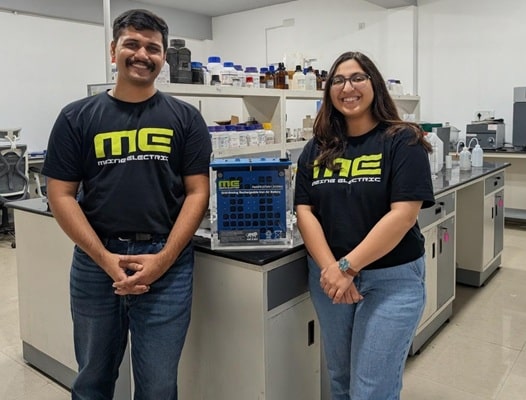
Can rust power the future? AChennai startup is betting on iron, air and water to deliver low-cost electricity.
Founded in 2022, Meine Electric Private Limited was started by Priyansh Mohan and Stuti Kakkar. The company is working on iron-air battery technology in the Asia-Pacific (APAC) region and says it is among the early companies globally to develop this type of battery for large-scale use.
The startup’s main focus is on a long-duration energy storage system capable of storing power for 16 to 100 hours. This is different from lithium-ion batteries, which are usually designed to store energy for shorter periods, such as 15 minutes to four hours. Meine Electric’s system is designed to provide electricity for longer periods.
According to Priyansh, the battery works through a reversible rusting process. Iron reacts with oxygen from the air in the presence of water to form rust, and this reaction releases electricity. When electricity is supplied back to the system, the rust is converted back into iron, which stores energy again. The battery mainly uses iron, water, and air to carry out this cycle in a controlled, repeatable manner.
Its initial target customers are energy-intensive commercial and industrial enterprises that operate large campuses and often rely on captive power or open-access renewable energy. “These facilities can charge the iron-air batteries using solar power during the day and discharge them for 18 to 20 hours, thereby meeting peak demand without relying heavily on the grid. We also aim to serve independent power producers and utilities, potentially adopting build-own-operate models and entering into long-term power purchase agreements in the future”, shares Stuti.
The startup says its main advantage is lower cost. Meine Electric aims for a storage cost of less than ₹4 per kilowatt-hour, which would be among the lower projected costs for long-duration energy storage systems.
When combined with solar power, which costs around ₹2.5 per kilowatt-hour, the overall cost of electricity could be about ₹5 to ₹6 per unit. This is lower than the ₹8- ₹9 per unit that many large commercial and industrial users usually pay. Due to this price difference, the technology may help facilities reduce their reliance on the grid and maintain more stable energy costs, Priyansh adds.
The startup is currently in a pre-revenue stage, with commercial deployment targeted for 2027–28. Over the past four years, it has focused heavily on research and development, initially supported by bootstrapping, government grants, and venture capital funding.
Meine has already secured four granted patents and filed seven more internationally, covering areas such as electrochemistry, cell design, system architecture and core processes.
Meine Electric operates out of a 5000 sq ft (equivalent to 464.51 square metres) product development facility in Ambattur Industrial Estate, Chennai. The 18-member in-house team spans electrochemistry, engineering, automation and validation, commercial operations and supply chain management. The facility is equipped for both advanced research and development (R&D) and limited batch production, with the capability to deploy up to 5kW per month. Pilot deployments are expected within the next six to seven months. The company plans to first install a multi-kilowatt unit internally before moving to live customer sites.
From a performance standpoint, the startup claims that the system is designed for a 10-year lifespan in its first commercial iteration, comparable to lithium-ion systems, with future generations targeting 15 to 20 years to align with solar asset lifecycles.
Both founders say that while the basic chemistry has been proven, scaling up manufacturing is still a major challenge. Producing large-format batteries requires strong process engineering, automation, and significant capital investment.
In addition to developing the technology, the startup is also focusing on building a broader ecosystem for long-duration energy storage. This includes working with suppliers, engaging with regulators, and increasing market awareness. At the research and development stage, more than 80 per cent of its supply chain is based in India, and the company plans to further increase local sourcing.
Priyansh explains that the name Meine Electric derives from the idea of limitless renewable energy, reflecting the company’s vision. It means ‘my electricity’, symbolising affordable and accessible power for everyone. The goal is to make low-cost electricity available across the country and eventually to people around the world.