
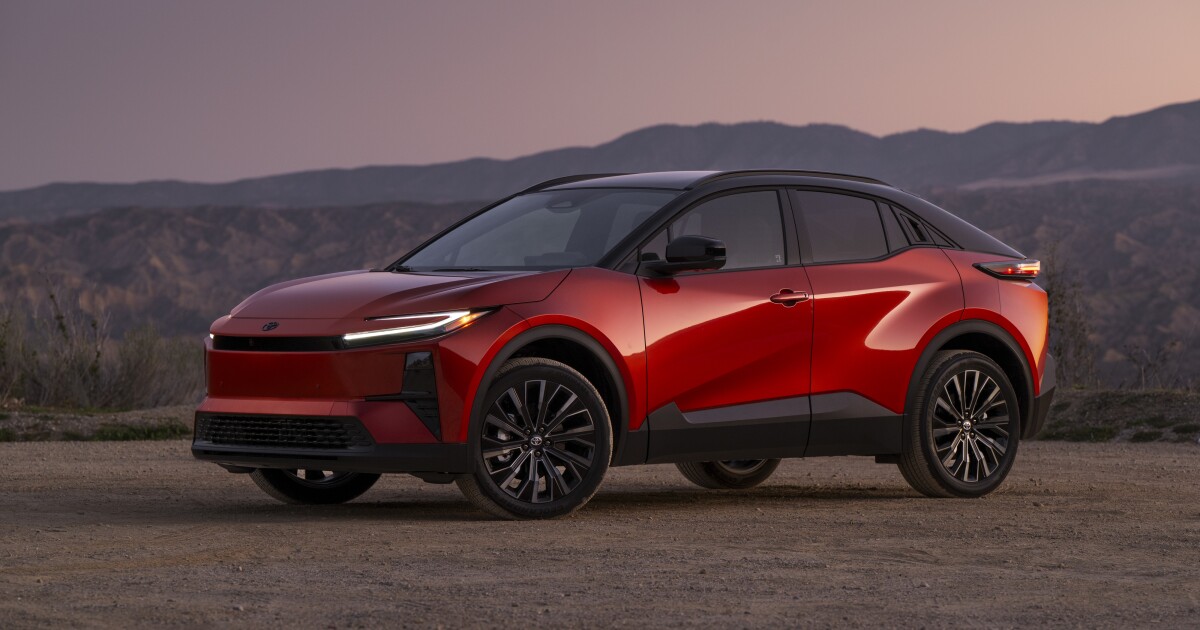
Toyota is suddenly bullish on electric vehicles, now that it’s got its own platform and manufacturing facilities for them. The Toyota C-HR has officially re-emerged as a fully-electric compact crossover instead of as the quirky hybrid crossover we remember.
The new C-HR has been given a more coupe-like silhouette and muscular stance. It stands out with its athletic proportions and swooping roofline, and looks less like the toy it once was and more like a corner-cutting contender.
That design ethos translates inside, too, where a clean, modern cabin centers around a 14-inch touchscreen and soft-touch materials highlighted by customizable ambient lighting. Rear passengers look to be getting decent space (unlike its predecessor). Cargo capacity is up to 59.5 cubic feet with the rear seats folded, which is pretty decent for this size of vehicle.

Toyota
Underneath the C-HR’s new skin sits Toyota’s dedicated e-TNGA battery architecture, shared with other members of the brand’s sudden BEV push. Standard dual-motor all-wheel drive delivers a healthy 338 horsepower (249 kW), and Toyota cites a brisk 0–60 mph (97 km/h) sprint in the neighborhood of 4.9 seconds. This and the C-HR’s new look hint at a spirited drive. Time will tell if that’s delivered.
Range is respectable for the segment, too. With a 74.7-kWh battery, EPA estimates put the SE model at around 287 miles (462 km) on a full charge, with slightly lower range on the larger-wheel XSE trim. More importantly for real-world use, the C-HR embraces the North American Charging Standard (NACS), giving access to a vast network of Tesla Superchargers and other high-speed DC fast-charging infrastructure. The C-HR can top from roughly 10 to 80% in about 30 minutes under ideal conditions and with Toyota’s Active Remote Connect subscription service (three years included).

Toyota
With the new C-HR EV’s price tag, Toyota couldn’t skimp on creature comforts or tech. Wireless charging, multiple USB-C outlets, a panoramic roof option, and Toyota’s suite of connected services round out the experience.
Two trim levels, SE and XSE, let buyers dial up the experience, with the latter bringing larger wheels, suede-accented seats, and additional driver assists to the mix. Pricing starts at a projected US$37,000 (excluding destination and dealer fees) as the C-HR heads to US showrooms in March.
Source: Toyota