

Two hundred chimpanzees are embroiled in a ‘civil war’
The world’s largest-known group of chimpanzees split into two factions that are now engaged in deadly combat
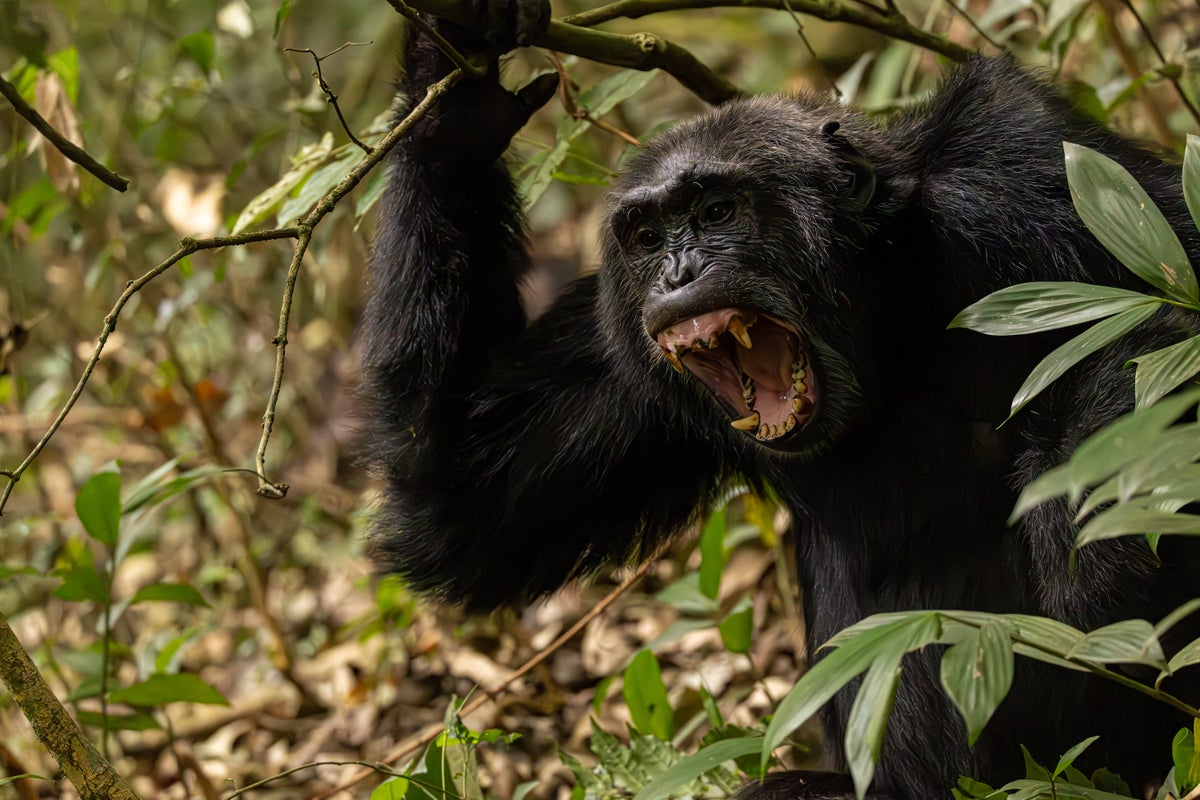
A group of about 200 chimpanzees has split into two factions in Uganda’s Kibale National Park.
Beata Whitehead/Getty Images
The world’s largest-known group of chimpanzees recently burst into a lethal conflict. Much like in a civil war, the group fractured into two. Then one faction began killing their former group mates on the other side, researchers write today in the journal Science. It’s an exceedingly rare event: scientists estimate that chimpanzee communities split, on average, every 500 years.
The paper is “a tour de force,” said Joseph Feldblum, an evolutionary anthropologist affiliated with Duke University, who was not involved in the study.
The research relied on three decades of data dating to 1995 from Kibale National Park in Uganda, home to the Ngogo chimpanzees—a community of about 200 individuals. Social relationships here clump around two primary groups, named the Central and Western clusters. For decades, they formed a single community in which chimpanzees shared territory, changed which cluster they most often affiliated with and mated with individuals from the other cluster—until 2015, says the study’s lead author Aaron Sandel, a primatologist at the University of Texas at Austin.
On supporting science journalism
If you’re enjoying this article, consider supporting our award-winning journalism by subscribing. By purchasing a subscription you are helping to ensure the future of impactful stories about the discoveries and ideas shaping our world today.
On June 24 of that year, Sandel was observing Ngogo chimpanzees when a Western party approached a Central one. Normally, the two would mingle and then split. But this time, the Western chimps quieted when they heard their Central group mates. Then they ran away, and the Central bunch chased after them.
“Nothing like that had been observed before,” Sandel says. Even his colleague John Mitani, a University of Michigan behavioral ecologist, who had studied chimpanzees for two decades, didn’t know what to make of the scuffle. And Mitani is “rarely surprised by what they do,” Sandel adds.
The clusters began to separate geographically and socially. By 2017, the two groups occupied entirely distinct territories and patrolled their borders against outsiders. The following year, deadly violence ensued.
Between 2018 and 2024, the researchers witnessed Western adults kill seven males and 17 infants from the Central group, the paper reports. An additional 14 adolescent or adult Central males disappeared during that time, and their bodies were never recovered—these males hadn’t shown signs of illness, so at least some of them also may have been victims of Western chimpanzee aggression. Sandel’s team has documented at least two more attacks on Central males since the data analysis for this study ended in 2024.
The authors say that the group split because its social relationships broke down. Sandel suspects those ties were strained by an unusually large group size, competition over food and reproduction, alpha male changes and diseases that killed adults that were key bridges between clusters.
A similar fracture happened in Gombe National Park in Tanzania in the 1970s. There the late primatologist Jane Goodall observed that several chimpanzees had split off into a new group, and former groupmates later killed many of them. Similar events preceded that break: the clustering of social relationships, a rise in reproductive competition, a change in alpha males and the deaths of several community-bridging males. But because Gombe chimpanzees frequently ate bananas from humans, some primatologists doubted whether the group fission was a natural behavior.
“[Ngogo] is the first time that you could say definitively that the civil war is actually happening,” Sandel says.
Now he wants to understand if social relationships drive conflicts in humans as they do for our closest living relatives. One prominent theory is that war stems from cultural differences such as ethnicity, language and religion. Peace interventions, such as cultural diplomacy, focus on bridging these divides. But if, like chimpanzees, our conflicts boil down to maintaining cordial and inclusive social networks, then these efforts may miss the most important point, Sandel says: it’s not just about learning about the cultures of other groups but also about nurturing friendships that connect them.
“What we have to do is maintain interpersonal relationships,” he says. “In our own daily lives with the people that we interact with, if we can reunite—even in the face of conflict—then I think that’s a recipe for maintaining peace.”
It’s Time to Stand Up for Science
If you enjoyed this article, I’d like to ask for your support. Scientific American has served as an advocate for science and industry for 180 years, and right now may be the most critical moment in that two-century history.
I’ve been a Scientific American subscriber since I was 12 years old, and it helped shape the way I look at the world. SciAm always educates and delights me, and inspires a sense of awe for our vast, beautiful universe. I hope it does that for you, too.
If you subscribe to Scientific American, you help ensure that our coverage is centered on meaningful research and discovery; that we have the resources to report on the decisions that threaten labs across the U.S.; and that we support both budding and working scientists at a time when the value of science itself too often goes unrecognized.
In return, you get essential news, captivating podcasts, brilliant infographics, can’t-miss newsletters, must-watch videos, challenging games, and the science world’s best writing and reporting. You can even gift someone a subscription.
There has never been a more important time for us to stand up and show why science matters. I hope you’ll support us in that mission.