
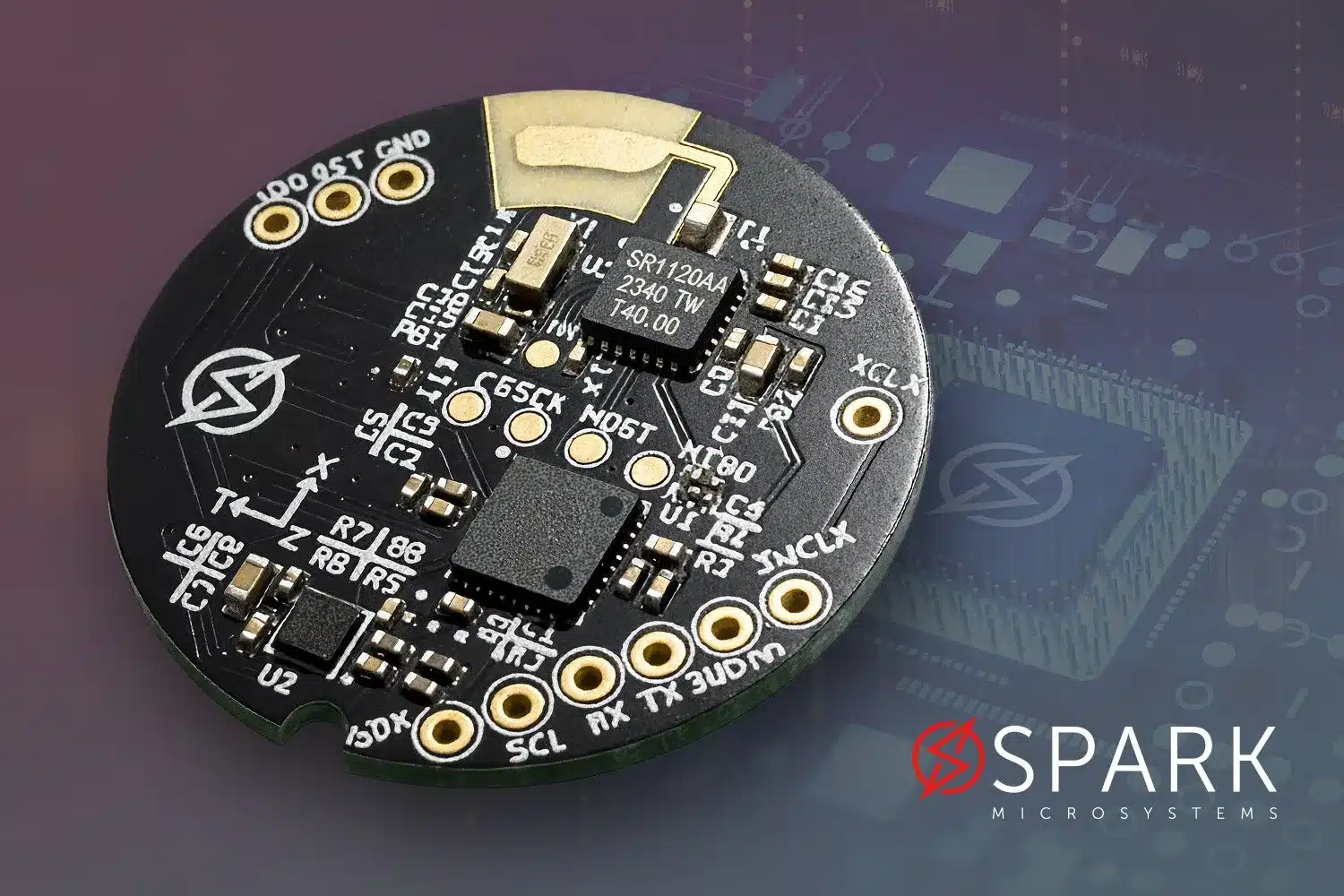
The presence detection kit helps devices use less power, work in crowded signals, and makes it easier to build and launch connected products quickly.
SPARK Microsystems has announced a new presence detection kit (PDK) that enables designers to overcome the limitations of legacy wireless connectivity for next-generation smart devices with advanced presence detection capabilities.

Presence-aware IoT devices used in healthcare, industry, construction, access control, and other applications are often limited by high power consumption and battery life issues associated with Bluetooth and Wi-Fi platforms. These platforms also face heavy interference in crowded environments with multiple active devices and overlapping signals, which affects reliability and performance. Conventional UWB technology used for presence detection also has challenges related to power efficiency and cost. SPARK’s LE-UWB™ innovation addresses these limitations.
With the new PDK, developers can quickly implement SPARK LE-UWB connectivity to achieve improved power efficiency, longer battery life, and stronger signal performance, while reducing development complexity and cost to speed up time to market.
The kit supports unidirectional and bidirectional communication, ultra-low power beaconing with customizable detection zones, and line-of-sight Time of Flight (ToF) calculation for accurate proximity and distance measurement. Compared to Bluetooth/BLE beaconing, SPARK LE-UWB technology uses more than 10 times less power. Compared to conventional UWB systems, it delivers over 20 times higher power efficiency.
“The demand for presence detection solutions for people, assets, and equipment is growing rapidly. Deployment costs and maintenance related to battery replacement, along with interference resilience and solution flexibility, have become key differentiators in an increasingly competitive market,” said Alberto Prud’homme, Product Manager, SPARK Microsystems. “A new approach is needed to achieve low power, robust and interference-resilient presence detection, leveraging development efficiencies that eliminate guesswork and speed design cycles. SPARK’s new PDK is the perfect starting point to accelerate the creation of next-generation, context-aware connected devices.”
Click here for original announcement.