
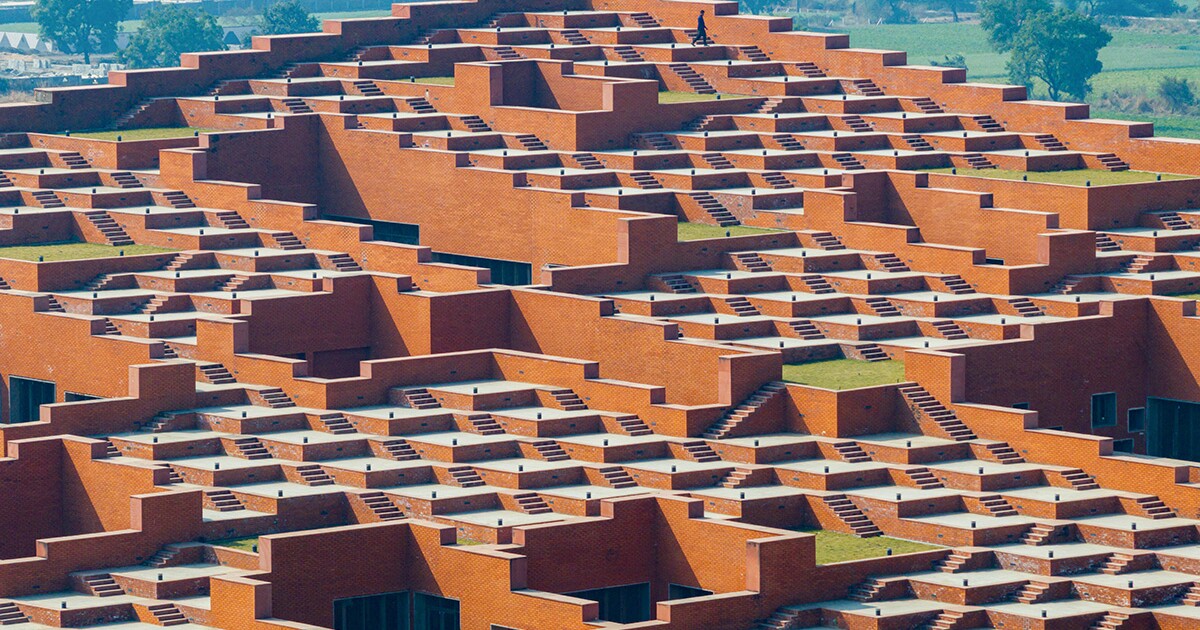
Indian studio Sanjay Puri Architects dreamed up plans for a university that are quite unlike the usual imposing structures that immediately come to mind. It’s a marvel from every angle, and especially so when you look at the roof.
Prestige University, located in the central India city of Indore, features a stunning five-story building that contains seminar halls, an auditorium, a library, offices, and a cafeteria. Above this 92-ft (28-m) structure is a walkable roof comprised of 463 stepped platforms. These can each be used as social spaces for students and faculty to convene; the entire thing can serve as an open-air auditorium for as many as 9,000 spectators.
The roughly 97,000-sq-ft terrace is stepped up diagonally from the building’s northern point; its many platforms are interspersed with naturally lit landscaped courtyards.

Vinay Panjwani / Sanjay Puri Architects
The design is inspired by India’s stepwells, a type of storage tank with corridors of stairs that led down to the water level so people access fresh water easily even when their reserves ran low during dry periods. They were said to be found across western India, and were functional between the 7th to the 19th century.

They also served as spaces for social gatherings and religious ceremonies. In that vein, the studio notes that Prestige University has already used the roofscape to host lectures, games, and a flag hoisting on India’s Independence Day.

Vinay Panjwani / Sanjay Puri Architects
It’s not often you see rooftops used quite so innovatively. The only other one that presently comes to mind is the CopenHill waste-to-energy plant by Bjarke Ingels Group in Copenhagen; atop the building is a ski slope, a hiking track, a timed slalom course, all on the angled rooftop that has a bend in it halfway through.

CopenHill A/S
Beyond the auditorium roof, the studio employed other clever features to keep the building cool in Indore’s hot climate, which sees temperatures of 86 °F – 104 °F (30 °C – 40 °C) for most of the year. The stepped design itself reduces the amount of vertical circulation required to cool the building.

Vinay Panjwani / Sanjay Puri Architects
A continuous diagonal indoor street that runs through the entire ground floor complements the shaded courtyards and allows for natural ventilation within the internal spaces. Plus, perforated glass fiber reinforced concrete screens envelop the eastern, western and southern elevations of the building to combat heat gain. There’s also a shallow pool at the base of the main building that helps passively cool the interior.

Vinay Panjwani / Sanjay Puri Architects
The 32-acre campus is designed for 3,000 students. The ground floor houses shared spaces including a 700-seat cafeteria, the aforementioned courtyards, and an indoor auditorium. The library is located on the first floor, with a bridge spanning the length of the corridor below. Forty five classrooms are spread across the second and third floors, while faculty office and administrative facilities are on the fourth floor.

Vinay Panjwani / Sanjay Puri Architects
The building is immediately recognizable with clay brick cladding covering the structure’s concrete and fly ash bricks. The interiors feature exposed concrete and Indian sandstone-lined floors. For the 34-year-old studio, which has numerous celebrated projects under its belt, this might just be its most innovative work yet.
Source: Sanjay Puri Architects