
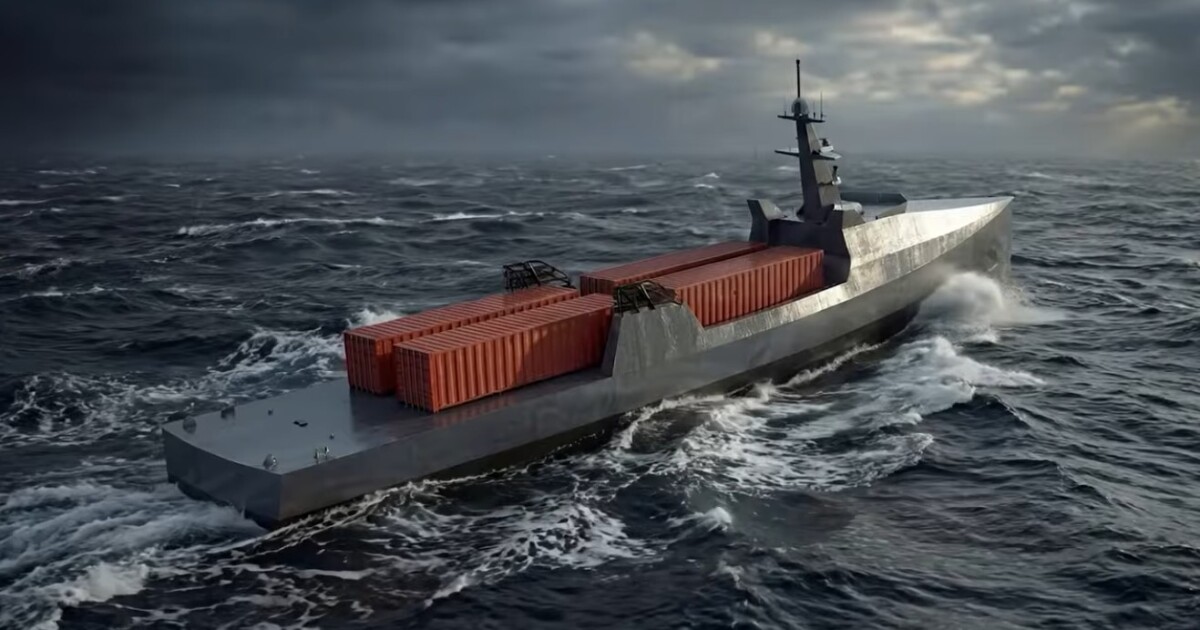
A new naval autonomous ship project isn’t much to write home about these days, but the new Liberty Class being developed by Blue Water Autonomy in partnership with Damen Shipyards stands out because it’s designed to be built quickly and in large numbers.
Major naval powers are looking toward a future of hybrid fleets, where conventional ships operate in tandem with autonomous vessels that act as force multipliers, freeing crewed craft for more complex missions. It’s a bold concept, but it depends on having enough autonomous ships available to make a meaningful difference.
Given how large autonomous ships are becoming, they risk facing the same shipbuilding bottlenecks that conventional vessels already encounter in Western shipyards. Producing one or two hulls a year simply won’t cut the mustard. To address this, Blue Water Autonomy is developing its Liberty Class autonomous ship for the US Navy’s Modular Attack Surface Craft (MASC) program, combining an autonomous variant of an existing commercial design with high-speed, high-volume production methods.
Liberty Class
Based on the commercial Damen Stan Patrol 6009 hull, the Liberty Class shares the same “axe bow” design, which allows it to pierce waves rather than slam into them, improving seakeeping and stability in rough seas. It measures 190 ft (58 m) in length, has a beam of 30 ft (9 m), and displaces 770 tonnes. Maximum speed is 25 knots (29 mph, 46 km/h), range is 10,000 nautical miles (11,500 miles, 18,500 km), and it can carry four standard 40-ft containers with a combined weight of up to 150 tonnes.
This design commonality allows for a significant departure from traditional naval procurement and production. By licensing the Stan Patrol 6009 hull – which shares its axe-bow design with around 300 vessels already afloat – the Liberty Class benefits from a pre-validated platform, potentially saving years of hull development and testing. It also enables greater use of off-the-shelf components.
The Liberty Class is being built at Conrad Shipyard in Louisiana using automated panel lines with integrated robotic assembly systems, along with robotic welding procedures. According to Blue Water, these production lines can build multiple ships simultaneously and launch between 10 and 20 vessels per year.
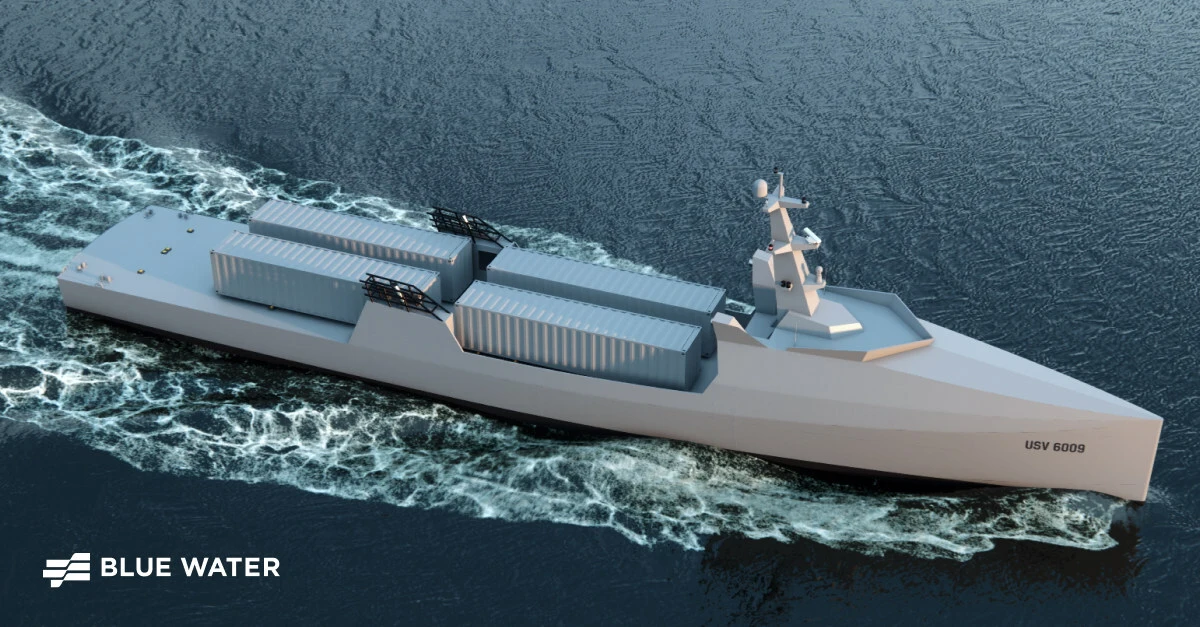
Blue Water Autonomy
Where the Liberty Class diverges most significantly from its conventional predecessor is below decks, where it has been effectively “de-manned.” The internal layout eliminates the need for heating, ventilation, and air conditioning (HVAC) systems for crewed spaces, along with crew quarters, workspaces, plumbing, gangways, and other safety systems required for inhabited areas. This enables more efficient layouts and faster installation of mechanical and electrical systems.
The result is an autonomous attack and logistics vessel capable of operating for up to three months without human intervention. Because the Liberty Class was developed using private capital, it has avoided some of the bureaucratic delays typical of defense programs, with the first vessel scheduled to launch in March 2026 – less than two years after development began.
“The Liberty class reflects our focus on building autonomous ships that are designed from the start for long-duration operations and repeat production,” said Rylan Hamilton, CEO of Blue Water Autonomy. “By adapting a proven hull and re-engineering it for unmanned operations, we’re delivering a vessel that can operate for extended periods without crew while being produced at a pace the Navy urgently needs. This is a modern take on an old idea: building capable ships quickly and at scale.”
Source: Blue Water Autonomy