
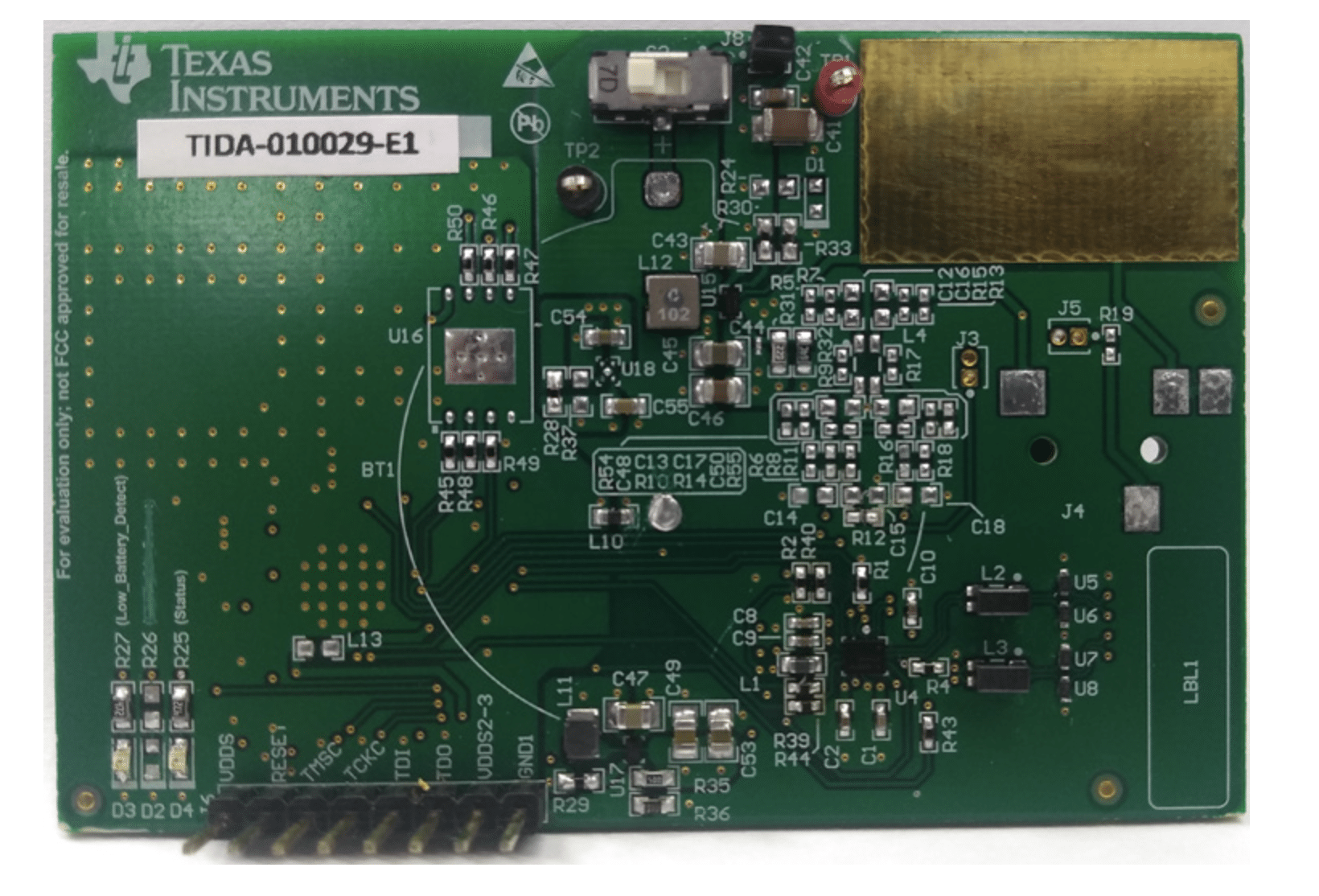
See your heart rate and blood oxygen anytime with a small wearable. It uses multiple sensors and sends data wirelessly, lasting long on a single battery.
Wearable and portable devices for continuous health monitoring need accurate heart-rate and blood-oxygen measurements while keeping size and power consumption low. Integrating multi-wavelength optical sensing, low-power wireless communication, and long battery life into a compact design is challenging.
The TIDA-010029 reference design from Texas Instruments (TI) addresses these challenges by enabling reliable peripheral capillary oxygen (SpO2) measurement and multi-sensor, multi-wavelength optical heart-rate monitoring (HRM) in a wearable form factor. The design supports multiple LEDs and photodiodes, allowing phase-shifted signal acquisition to improve the quality and accuracy of photoplethysmography (PPG) signals. Measured data can be transmitted wirelessly to remote systems, while a single coin-cell battery can provide up to 30 days of operation. The design provides raw data for calculating heart rate, SpO2, and related physiological parameters, and includes basic indicators for battery and wireless connectivity status.

Photoplethysmography is an optical technique that measures blood volume changes in the microvascular bed of tissue. The method works by illuminating the skin and subcutaneous tissue with light and detecting the transmitted or reflected signal with a photodiode. Changes in light absorption correspond to blood flow, which allows the calculation of heart rate. PPG also provides insights into blood circulation and can be used to infer information related to blood pressure. The single-point contact nature of PPG makes it ideal for wearable devices, enabling continuous monitoring without cumbersome sensors. For reflective sensors, green light is often preferred for heart-rate measurements because it penetrates tissue less than higher-wavelength light, producing stronger reflected signals. Using multiple photodiodes or arranging LEDs strategically around the sensor improves signal fidelity and accuracy.
Measuring SpO2 requires red and infrared light to detect the absorption difference between oxygenated and deoxygenated hemoglobin. Accurate measurement relies on proper conversion of light signals into electrical signals. Deoxygenated hemoglobin absorbs more red light and allows more infrared light to pass, while oxygenated hemoglobin does the opposite. These optical differences allow the device to calculate blood oxygen levels in real time. For wearable applications, achieving this requires careful LED and sensor alignment, low-noise signal acquisition, and precise timing control for multi-wavelength measurements.
Wireless data transmission is essential for portable and wearable devices, enabling continuous monitoring without restricting user movement. Using low-power wireless protocols ensures data reaches remote systems efficiently while extending battery life. The compact design of this reference enables integration into devices such as pulse oximeters, fitness and activity trackers, multiparameter patient monitors, and medical sensor patches. It can also serve as a foundation for more complex systems that integrate additional physiological measurements such as ECG, temperature, and blood pressure. Beyond healthcare, multi-wavelength optical sensing can be applied in other fields, including food quality analysis, air particle monitoring, and environmental sensing, wherever non-contact or minimally invasive measurement is beneficial.
TI has tested this reference design. It comes with a bill of materials (BOM), schematics, assembly drawing, printed circuit board (PCB) layout, and more. The company’s website has additional data about the reference design. To read more about this reference design, click here.