
This series is a collaboration between Dr. Ali and MuslimMatters, bringing Quranic wisdom to the questions Muslim families are navigating.
There is a conversation Muslim parents dread — and usually handle badly.
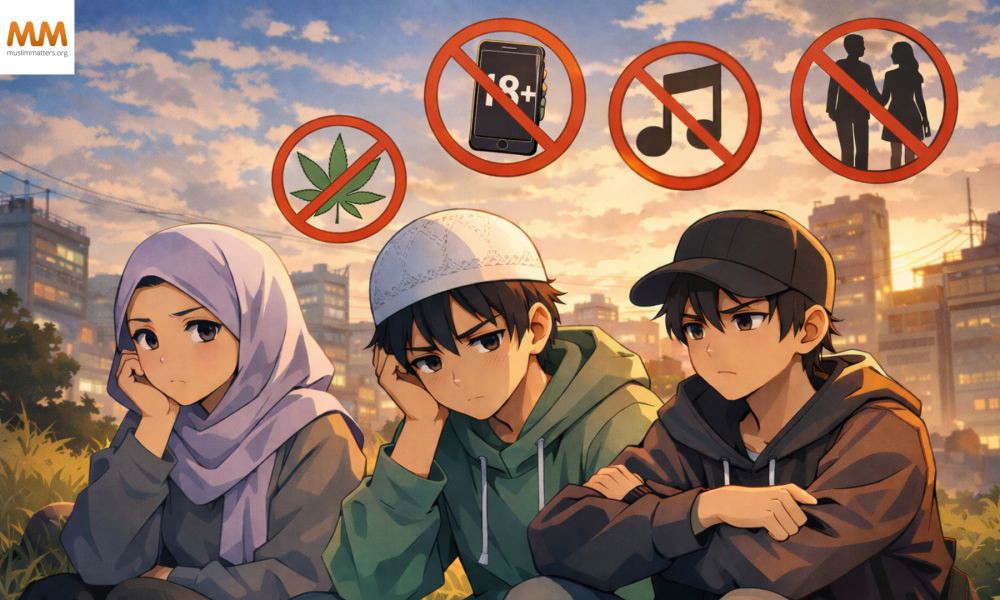
Their teenager looks at them and says, directly or indirectly: “Islam feels like a burden. Everything fun is haram. Why would I want to live this way?”
Keep supporting MuslimMatters for the sake of Allah
Alhamdulillah, we’re at over 850 supporters. Help us get to 900 supporters this month. All it takes is a small gift from a reader like you to keep us going, for just $2 / month.
The Prophet (SAW) has taught us the best of deeds are those that done consistently, even if they are small.
Click here to support MuslimMatters with a monthly donation of $2 per month. Set it and collect blessings from Allah (swt) for the khayr you’re supporting without thinking about it.
Most parents respond with one of two things: a lecture about what is forbidden and why, or an appeal to fear — of Allah’s punishment, of Hellfire, of what will happen if they stray.
Neither works. Not for long. Not for teenagers who have access to everything and are being told that everything is off-limits.
This piece is for the parent who wants to give their teenager something better than fear and prohibition. Something true, something compelling, and something that actually holds up across a lifetime.
First: Take the question seriously
When your teenager says Islam feels like a burden, they are not being dramatic or faithless. They are expressing something real — a genuine tension between the culture they are immersed in and the values they have been raised with.
That tension is not a sign that something has gone wrong. It is a sign that they are paying attention to both worlds. The question is whether Islam gives them a compelling enough answer to the culture’s offer.
If the only answer you have is “because it’s haram” or “because Allah said so” — while true, it is not sufficient for a teenager who is watching their non-Muslim peers apparently thriving and having the time of their lives. They need to understand not just the prohibition but the wisdom. Not just the rule but the reality it protects them from.
The Quran itself invites this kind of engagement. Allah says:
“So share these stories, so perhaps they will reflect.” [7:176]
The invitation to reflection — tafakkur — is built into the way Allah presents His guidance. He doesn’t just command. He explains. He shows. He tells stories that demonstrate the reality of what He is warning against.
Your teenager deserves the same approach.
The story of Bal’am — what the Quran actually says about following desire
In Surat al-A’raf, Allah tells a story that most Muslims have never heard in full — and it is one of the most devastating portraits of what the pursuit of desire actually produces.
Bal’am was a man of extraordinary spiritual gifts. He knew Allah’s Greatest Name. His du’a was accepted. He had been given knowledge and closeness to Allah that most human beings never experience.
And then his people came to him with promises of wealth and pleasure, asking him to use his gifts against the servants of Allah. He knew it was wrong — he said so himself. But they kept pushing. The promises got bigger. And eventually he crossed the line.
Allah took away everything He had given him. And He described what happened next with an image that is profound in its precision:
“His example is that of a dog: if you chase it away, it pants, and if you leave it, it still pants.” [7:176]
The panting dog. Whether you give the desire what it wants or deny it — it pants either way. It is never satisfied. It never rests. It never stops wanting more.
This is not a religious metaphor. It is a description of what neuroscience now confirms about addiction and the pursuit of haram pleasure: the brain’s reward system downregulates in response to repeated stimulation, requiring more intensity, more frequency, more novelty to produce the same effect. The desire that seemed like it would satisfy — never does. And in chasing it, something is lost that cannot easily be recovered.
Bal’am had everything spiritually — and traded it for the pleasures of this world. And Allah recorded what he became.
Share this story with your teenager. Read the ayaat together. Let the Quran make the argument.
The question of slavery — reframing the whole conversation
One of the most powerful reframes available to Muslim parents is one that comes directly from the Islamic tradition — and it completely dismantles the “everything is haram” frame.
During the early Muslim encounter with the Persian Empire, a companion named Rib’ee ibn ‘Aamir was sent to meet Rustum — the great Persian general — in his palace, decorated with every luxury the ancient world could offer. Rib’ee arrived wearing a patched robe, riding an old horse.
Rustum asked him, “what brings you here?”
Rib’ee replied with words that deserve to be written in gold, “Allah sent us to take people from the servitude of others, to the servitude of the True Lord, and from the narrowness of this world to the vastness of the hereafter, and from the tyranny of religions to the justice of Islam.”
The reframe your teenager needs is this: the choice is not between freedom and restriction. The choice is between masters. Every human being serves something — desire, status, social approval, addiction, fear. The question is not whether you will be a slave. It is what you will be a slave to.
Islam does not restrict freedom. It offers the only genuine freedom available — freedom from every lesser master, in exchange for the service of the One whose service is, paradoxically, the most liberating thing a human being can do.
When your teenager understands this — really understands it, not as a slogan but as a description of reality — the “everything is haram” frame dissolves. Because haram is not Allah arbitrarily restricting fun. It is Allah protecting you from masters that will consume you.
What the good life actually looks like — hayatan tayyibah
The single most important thing you can give your teenager on this topic is not a list of prohibitions. It is a vision of what obedience to Allah actually produces.
Allah says:
“Whoever does good, whether male or female, and is a believer — We will surely give them a good life.” [An-Nahl 16:97]
Hayatan tayyibah. A good life. Not just paradise in the hereafter — a good life here, in this world, now.
The scholars explain that hayatan tayyibah includes qana’ah — contentment, the capacity to be genuinely satisfied with what you have. It includes tuma’neenah — peace of heart, the stillness that the panting dog never finds. It includes the ability to enjoy the halal pleasures Allah has permitted without the diminishing returns that come from haram.
Here is something worth telling your teenager directly: the people who live their lives in genuine obedience to Allah — not perfectly, but sincerely — are, on the whole, among the most content human beings you will ever encounter. Not the richest. Not the most exciting lives on paper. But genuinely, durably content in a way that the pursuit of desire simply does not produce.
And the people who chased everything they wanted — and got most of it — are sometimes among the most frightened, most restless, most regretful people at the end of their lives. The panting never stopped. And now there is no time left in their lives.
Hayatan tayyibah is not abstract. It is visible in people. Help your teenager find someone who has it.
Why the ER story matters for parents
In tonight’s video, I shared the story of a young Muslim woman who came into my ER after being beaten and assaulted — the direct consequence of years of choices that began with “Islam felt like a burden.”
Her last words to him were: “I would give everything to go back and do it all over differently.”
This is not a scare tactic. It is a testimony. And it deserves to be heard by every Muslim teenager who is standing at a fork in the road, deciding whether Islam’s guidance is worth following.
The road that looked like freedom led to an ICU far from anyone who loved her. The road that looked like restriction — the one her brother had tried to show her — leads somewhere else entirely.
Your teenager needs to hear that testimony. Not as a threat. As a truth that was purchased at enormous cost.
Practical guidance for parents
Don’t lead with prohibition. Lead with vision. Before you tell your teenager what Islam says no to, tell them what it says yes to. The good life. The contentment. The freedom from lesser masters. The promise of hayatan tayyibah.
Find living examples. Abstract promises are less compelling than visible reality. Who in your community — or in your family’s history — embodies the good life that obedience to Allah produces? Introduce your teenager to that person. Create opportunities for them to spend time together.
Tell your own story honestly. Did you face similar temptations? What did you choose? What did that cost or give you? Teenagers are moved by honesty far more than by authority.
Read Surat al-A’raf 7:175-176 together. Read the story of Bal’am. Read the tafsir. Let the Quran make the argument in its own voice.
Distinguish between haram and culture. Some of what Muslim parents present as Islamic restriction is actually cultural preference. Be honest about the difference. When everything is treated as equally forbidden, teenagers lose the ability to distinguish between the things that genuinely matter and the things that don’t. That loss of discernment is dangerous.
Warning signs that this has moved beyond normal teenage questioning
Normal teenage questioning of religious restrictions is developmentally expected and not cause for alarm. But the following indicate that something more serious may be happening:
- Complete rejection of Islamic identity — not questioning specific rules but rejecting the entire framework.
- Active pursuit of haram in ways that are dangerous — substance use, sexual activity with associated risks, situations involving physical safety.
- Withdrawal from all Muslim community and family connection simultaneously.
- Expressions of hopelessness about their future within Islam — “I could never be a good Muslim anyway.”
If several of these are present, the conversation needed is deeper than a discussion of haram and halal. A trusted scholar, counselor, or Muslim mental health professional should be involved.
Discussion questions for families
For teens:
- When you think about Islam’s restrictions, what feels hardest? What do you think those restrictions are actually protecting you from?
- What do you think the story of Bal’am is saying about what desire does to a person over time?
- Is there someone in your life whose contentment and peace you genuinely admire? What do you think produces that?
For parents:
- Did you ever feel like Islam was a burden when you were young? What changed?
- Have you given your teenager a compelling vision of what the good life looks like — or mostly a list of what’s forbidden?
- Who in your community embodies hayatan tayyibah in a visible way? How can you create opportunities for your teenager to spend time with that person?
For discussion together:
- What does it mean that we are all slaves — and that the only question is what we serve?
- Read An-Nahl 16:97 together. What does hayatan tayyibah — the good life — mean to each of you?
- What would it look like for our family to pursue the good life together?
The bottom line
Your teenager does not need a longer list of prohibitions. They need a compelling vision of what obedience to Allah actually produces — in this life, before the hereafter, in the texture of daily living.
They need to understand that Islam is not a cage. It is a declaration of freedom from every master that would consume them.
And they need to see that freedom in someone’s actual life — including, if possible, yours.
The good life is real. It is visible. It accumulates quietly across a lifetime of sincere obedience.
Help your teenager find it before the road that looked like freedom leads somewhere it cannot come back from.
Continue the Journey
This is Night 19 of Dr. Ali’s 30-part Ramadan series, “30 Nights with the Quran: Stories for the Seeking Soul.”
Tomorrow, insha Allah: Night 20 — I’m Addicted and I Can’t Stop: Dealing with Guilt and Shame
For daily extended reflections with journaling prompts, personal stories, and deeper resources, join Dr. Ali’s email community:
Related:
Why Do Bad Things Happen to Good People? | Night 18 with the Qur’an
30 Nights with the Qur’an: A Ramadan Series for Muslim Teens