
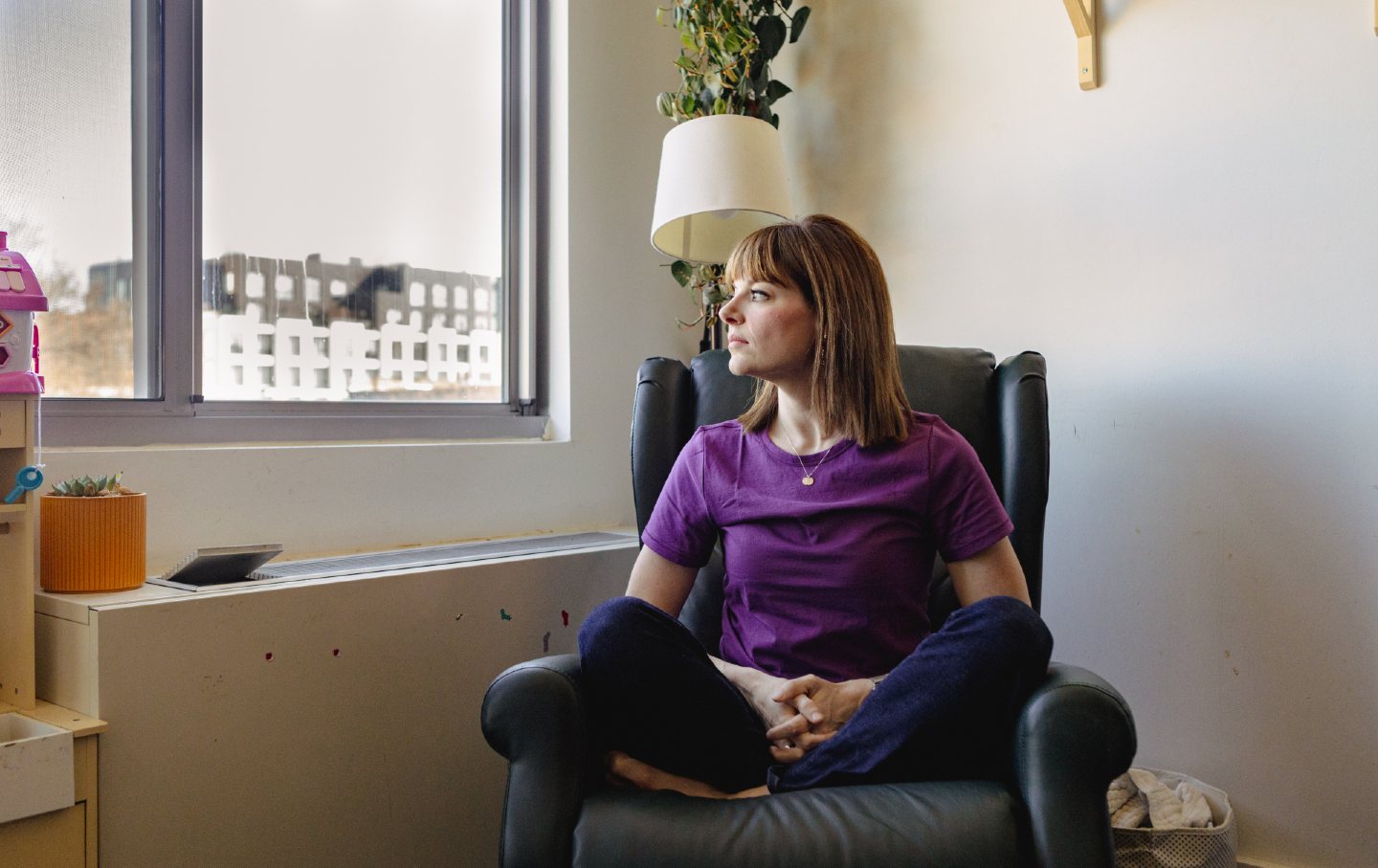
Like 36 percent of American households, Run For Something (RFS) founder Amanda Litman and her family are renters. This makes her relatable to many younger Americans, who are living in a world where buying a home is increasingly difficult.
Indeed, only about 39 percent of Americans 35 and under own homes, according to the 2022 census. Meanwhile, 75 percent of Americans in the 55-to-64 age range are homeowners; and that number jumps to 79 percent for those who are 65 and over. It’s not that younger Americans don’t want to be homeowners—a 2024 CNN poll found that while 86 percent of renters want to buy homes, 54 percent believe they will never be able to afford to do so.
Litman is one of those skeptical renters. “I don’t think I’m ever gonna buy a home,” she tells me as we sit at her apartment dining table. But even as the number of renters has increased, politicians have continued to shape housing policy around the interests of buyers rather than renters.
That disconnect between aging policymakers and young Americans is why Litman and RFS, an organization dedicated to getting more young progressives to run for down-ballot positions, are pushing for renters to run for office this cycle.
But mobilizing renters is only one aspect of Litman’s strategy for shaping the new Democratic Party. The candidates we need, according to Litman, must generally “have a very clear understanding of the problems people face—an understanding of what it means to try to survive and thrive right now.”
Since its founding in 2017, RFS has recruited over 200,000 young people, born in 1985 or later, to run in local races, all with the hopes of identifying and developing a promising pool of Democratic candidates with aspirations for higher offices. Amid ballooning frustrations with a geriatric Democratic establishment, RFS has experienced a surge of interest. The 80,000 sign-ups it received in 2025 alone exceeded RFS’s total recruitment numbers from Trump’s entire first term. And the candidates are only getting younger.
This year, RFS is championing dozens of Gen-Z candidates in races across the country. In state House races, it has endorsed candidates like 29-year-old Samuel Vilchez Santiago, who, after coming to Florida as a Venezuelan asylum-seeker, became his high school’s valedictorian and an immigrant rights advocate. RFS candidate Bobby Gronert, a socialist and University of Wisconsin–Madison sophomore, is running for city council on a platform focused on affordability.
As young as these candidates may be, Litman and RFS believe their authenticity and ability to navigate the modern media landscape has primed them for success. At a moment where Americans are seeking change, it may finally be Gen-Z’s time to step up to the plate.
“The [Democratic] party has so much potential,” Litman tells me. “When these are the people in charge, it’s going to be good.”
The Nation spoke to Litman about the value of Gen-Z candidates, the future of the Democratic Party, and what today’s voters really want. This interview has been edited for length and clarity.
Heather Chen: You’ve been working for a long time on getting younger, more progressive people into electoral politics. Last year, Run For Something saw its biggest recruitment surge ever. Why do you think so many younger people are deciding to run for office right now?
Amanda Litman: I think it’s a few things. First, we’ve been around for a while—we built infrastructure. When there’s a moment where people are pissed and want to do something, there’s somewhere they can go. You don’t need it until you need it and then you’re really glad it’s there.
Second, people have seen over the last 10 years that the only place where we are making good progress is locally. They want to do something concrete that they can see that they can feel. There’s incredible urgency to solve the problems wherever you can.
Third, the thing that we heard differently in 2025, different from 2017, 2018, was “I’m done waiting my turn. I’m sick of being told to get to the back of the line.” There’s more of a frustration with the Democratic Party this time around than there was the first couple years, because we’re seeing how the Democratic Party is failing to meet the moment.
Lastly, new models for inspiration have appeared over the last 10 years. We’ve seen younger people like AOC, Maxwell Frost, Zohran Mamdani, and Jon Ossoff who are running and winning. Run For Something has helped elect more than 1650 young politicians. They are showing what the future could look like.
HC: Run For Something’s website says it’s “recruiting and supporting young progressives.” How would you or RFS define progressive, and why do you find it important for RFS to support candidates who fit that political orientation?
AL: We define progressive a little differently than a lot of people, partly because we work in all 50 states and in all different kinds of places. So, we have to be able to have a model that is tight on values and flexible on policy, knowing that acknowledges that the kind of person who can win in rural Pennsylvania, Maryland, or Texas, is going to be different than those who we can help elect in New York, Miami, or LA. But as long as they are generally rowing in the right direction or the same direction, there can be a lot of variation there.
In 2025, we helped elect Kelsea Bond to the Atlanta City Council. They were a renter, union organizer, and tenant activist, running on developing greener and more walkable spaces in their city. On the same night, we turned a red seat blue when we helped elect a sports journalist named Andrew Harbaugh to Common Council in Clarion County, Pennsylvania. He was a former Republican who left the party after January 6th.
If you have a model where everyone is generally pro-choice, pro-equality, pro-tolerance, pro–working families, pro–affordable healthcare, pro-labor, pro–immigrant rights, pro–climate justice—you can have variation between them, especially if you want to try and win everywhere, which we do, that’s what we need. Most people do not self-identify as, “I’m a progressive, I’m a moderate.” No, they’re like, “I have problems. I want politicians to solve them.” If you can do that, it almost doesn’t matter what your ideology is, but within a range, there’s a lot of different ways that can be understood.
HC: Recently, you made a statement about how voters are drawn to effective communicators. How does Run For Something train candidates to become better communicators?
People usually treat the candidate as a fixed variable. There’s a reason that so much of the internal party debates are about messaging, policies, ads, or tactics. They assume those are the things you can change, whereas who the candidate is, you cannot.
What we have been arguing for the last 10 years is that, actually, if you work downstream enough, you can change who runs in the first place. A better, more engaging candidate makes everything else easier and more efficient and more effective.
Today, you want people who can communicate in a way that makes sense for 2026 and beyond. Now, does that mean good on camera, telegenic, and able to communicate? Yes. But you don’t have to be hot to do that. There’s all kinds of, like, compelling people who are not “conventionally attractive.”
We have a bunch of different programming that we do to support candidates depending on how much one-on-one help they need. Do you need to be media-prepped or -trained? We can do that. If you have a compelling story, but you don’t know how to edit video, we can help you with that too.
HC: A follow up—how has social media changed what counts as an effective communicator and are you seeing that Gen Z candidates are naturally better at this?
AL: Successful presidential candidates, for example, tend to be well suited to the media environment that is prominent in the time they’re running. Bill Clinton, really good at TV. Obama, really good at giving a speech and then having that translate into a long press conference and being able to reach people en masse. Trump is really good at the media of the moment. He’s a racist bigot, but pretty funny and compelling to watch, even if you hate what he’s saying.
Right now, the way that people consume information is online, not local news. It’s TikTok, it’s your For You Page, it’s Snapchat, it’s YouTube. Campaigns in 2026 that are reliant on just, like, “We’re gonna raise a bunch of money and then spend it all on TV ads, or even, like, digital ads”—that’s not going to reach people who are not consuming that media anymore. A lot of the places people consume information, you can’t pay to reach them. So a candidate needs to be good at meeting the medium from which people get information.
Gen Z is really good at that because they grew up online. You’ve been thinking since you were a teenager, “How are my friends gonna look at my wall and think about me?” Whether that was intentional or not, you have a fluency there. You are enough of a consumer to be a producer. And the candidates, and this is true, sort of, of any age, but especially Gen Z candidates, you’ve put the reps in. You’ve got the muscle built. And that doesn’t necessarily mean that they are good at editing video, but they speak the language such that a staffer doesn’t have to explain to them why they need social media.
HC: As more Gen-Z candidates with public digital footprints run for office, is the expectation that they have a “clean” past becoming outdated?
AL: This is something we’re gonna have to work through in real time because we’re not used to people having grown up in public. Like, imagine if you could read Chuck Schumer’s high school diaries. I’m sure he said some stupid shit. The fact is that most people who are interested in running for office have had some part of their coming of age or their ideological journey online, meaning that there is a paper trail. And it’s pretty easy to find. I do think there are things that are disqualifying. But, there’s also context. Were they 11, 16,or 26 when they made that potentially problematic post? What was going on in their life at the time? How did they learn? How have they changed?
We work with successful candidates who have gone to jail, who were opioid addicts and homeless. They talk about their experience and reflect on how they have grown. At the end of the day, I think voters don’t care.
I’m sure if you found my 14-year-old Xanga, it would also be bad. I do think that, especially as activists, as people in politics, you want people to change. You want people to grow. That’s the whole point of persuasion politics—you want people to come to your side. If they started somewhere else and said some shit that they no longer believe, that’s good. That means that they have grown and our efforts have worked.
HC: In New York City Mayor Zohran Mamdani has achieved rising approval numbers in his first few months. But we’ve also seen some establishment Democrats argue that Mamdani’s brand of leftism can’t be replicated elsewhere in the country. How do you respond to that critique, and what do you think Democratic candidates should be taking away from both his campaign and the way he’s handling himself in office?
AL: I find that argument so exhausting, because who is arguing that you want an exact replica of Zohran Mamdani in Kansas City? No one is saying that. That’s a straw man argument that’s just meant to punch left.
What we are saying is you want candidates who genuinely reflect the place they’re running, who love the place they’re running to lead—because Mamdani loves New York, and it comes through—who are willing to keep the campaigns localized, who have a strong value system and who can connect and communicate the way people get information now.
Don’t you want more candidates who could shoot the shit with people on the street and make it interesting? The fact that Mamdani can do that and that he functions as an influencer—and I do not say that derisively—allows him to have influence. It means people listen and follow him, and he can move people to action. That’s so powerful.
HC: In the 2024 election, we saw that there was a lot of voter fatigue with the Democratic Party, particularly at the top of the ballot. With these down-ballot races, how does RFS go about convincing voters who are disillusioned with the Democratic Party?
AL: Trump won over some younger voters, but he did not win them over forever. You are already seeing his approval rating plummet with young people. He basically rented them. He did not buy them. And they have been returned. Now, they are not being returned to the Democratic Party—they are being returned to the ether, to the void, to the unknown. I think that is both the challenge and the opportunity that we, as a party, have.
Popular
“swipe left below to view more authors”Swipe →
Run For Something candidates—the people running for city council, for state legislatures, for school board, for library board—can promise stuff that you will be able to experience and feel the results of.
In 2026, we are thinking about how our local candidates can gin up turnout for the rest of the ticket. In a district where we want to flip the house, or senator, or governor, how can the school board candidates get people excited? They can knock doors. They can make videos, they can do calls, they can show up all over the place in a way that the top of the ticket’s not gonna be able to.
HC: What do you think are the biggest challenges grassroots campaigns are facing right now? And how does Run For Something help its candidates take on these challenges?
AL: So there’s a couple things—some structural stuff, like, a lot of these offices don’t pay. Most of our candidates do not quit their jobs to run for office, but if you’re running for Congress, you tend to have to. That’s really hard. It keeps working people out. It keeps people without access to wealth, or wealthy families, or partners out.
Second, there’s some other financial stuff around campaigns—you need nice clothes, a car, gas, transportation, you have to rent an office.
The bigger thing a lot of grassroots candidates experience is they’ve never done this before. So we try to help candidates navigate the running process, all the logistics. Figuring out how to get on the ballot, write a campaign plan, how to figure out how much money you need to spend, how to figure out how many voters you need to reach—that kind of stuff is not rocket science. There’s a how-to manual. We wrote it. I wrote it. And, like, you can do this. Dumber people than you have done this. If you know who you are and what you believe and what you want to accomplish, everything else is logistics, and we can help you with logistics.
The final thing I would point out is that we are at a tipping point for the Democratic Party. Despite any organizational challenges, this is a year of generational change. Even if the new leaders don’t win, they’re changing what it means to be a Democrat. And that’s a good thing.
More from The Nation
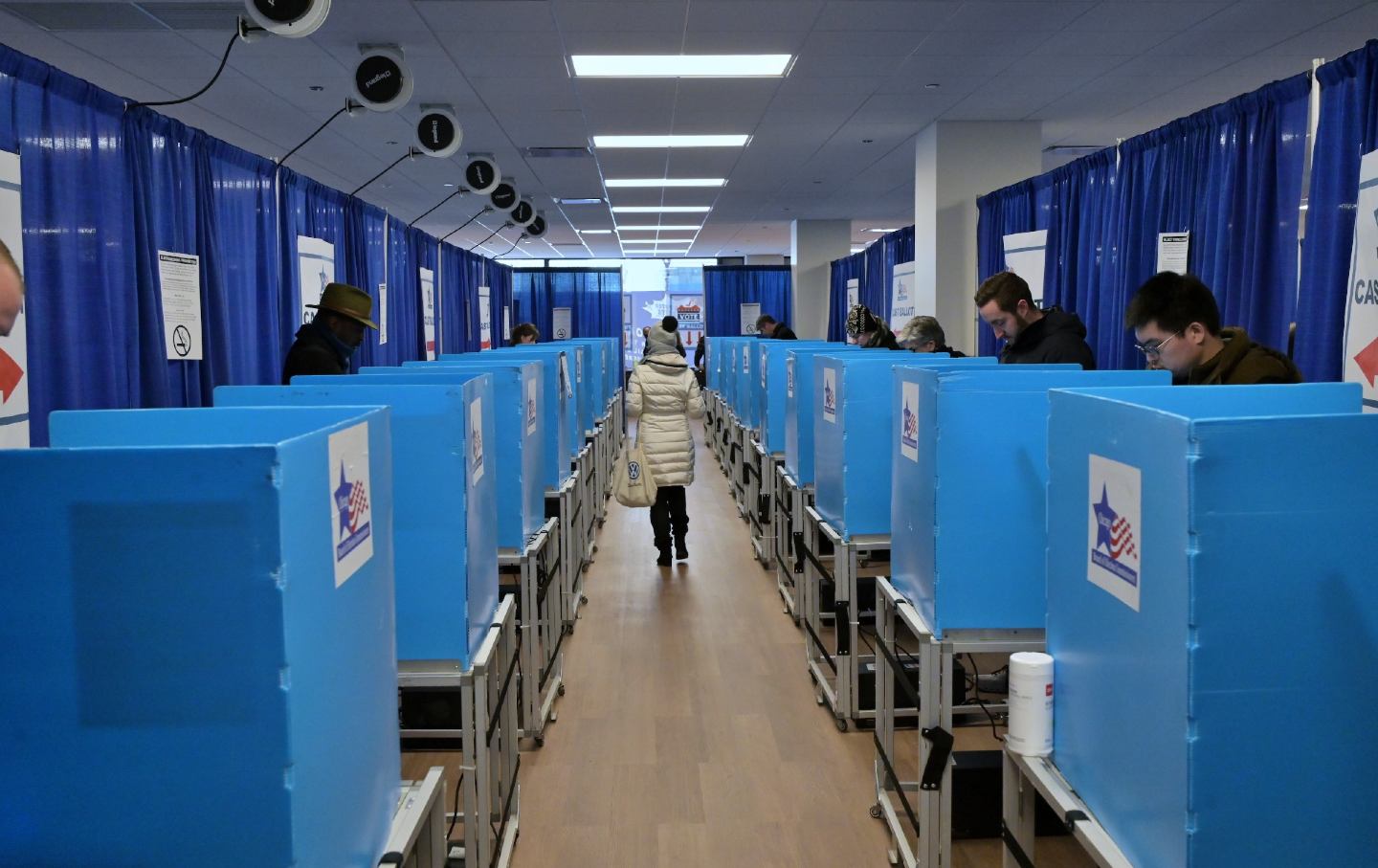
The so called SAVE America Act is nothing short of Jim Crow 2026.
Rep. Gwen Moore
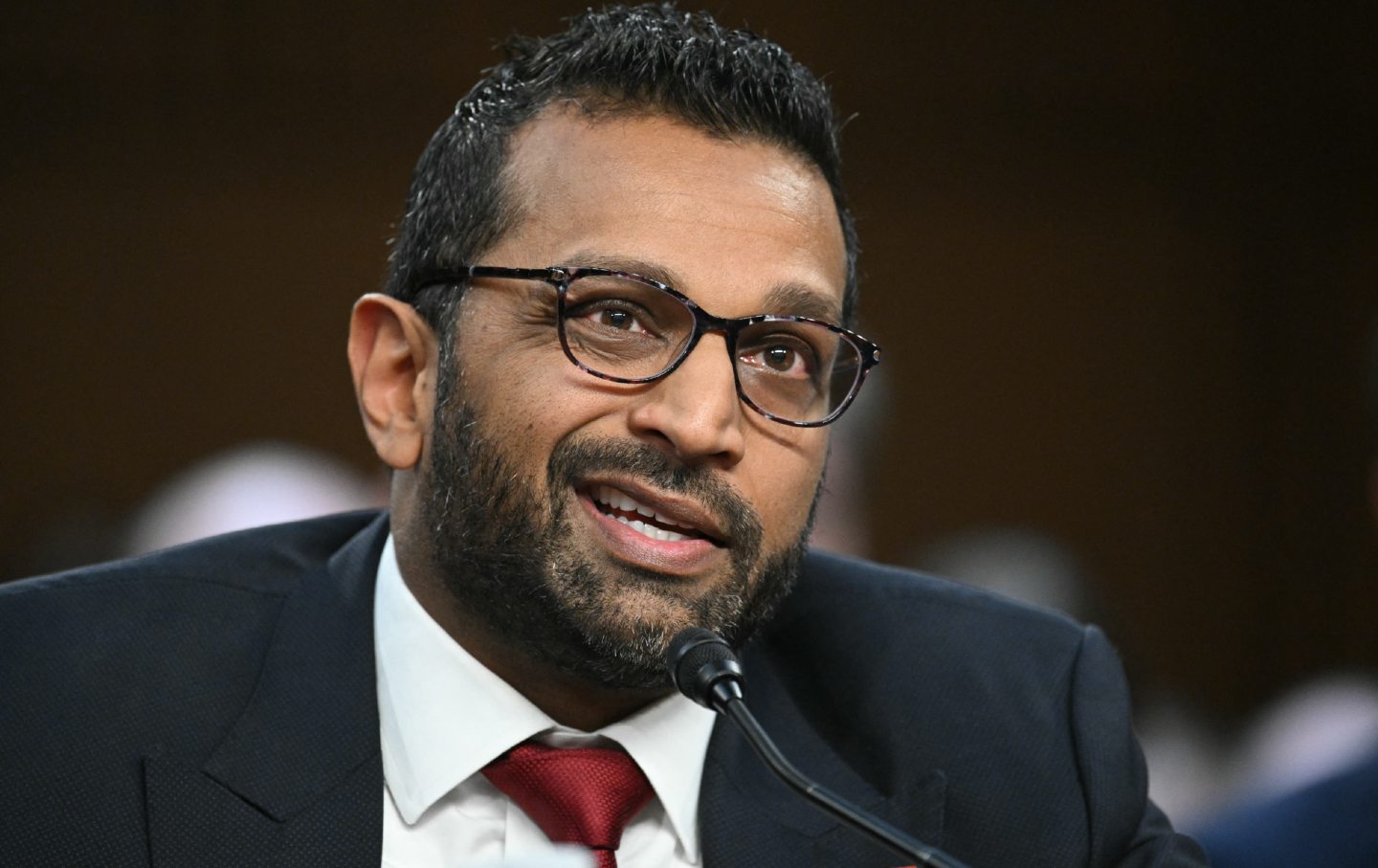
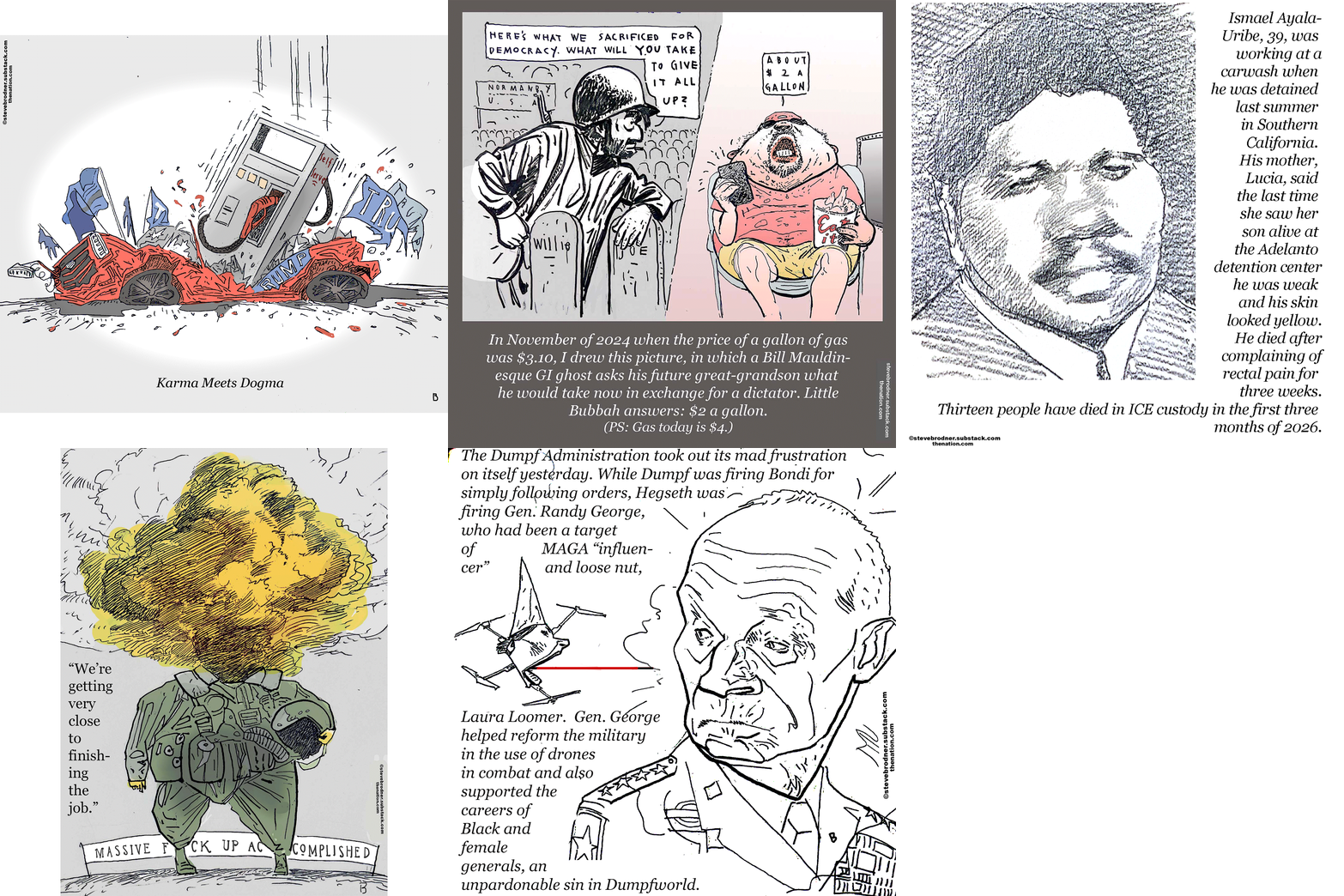
The president has surrounded himself with cronies and sycophants. But even they keep failing to meet the level of servility he demands.
Chris Lehmann