
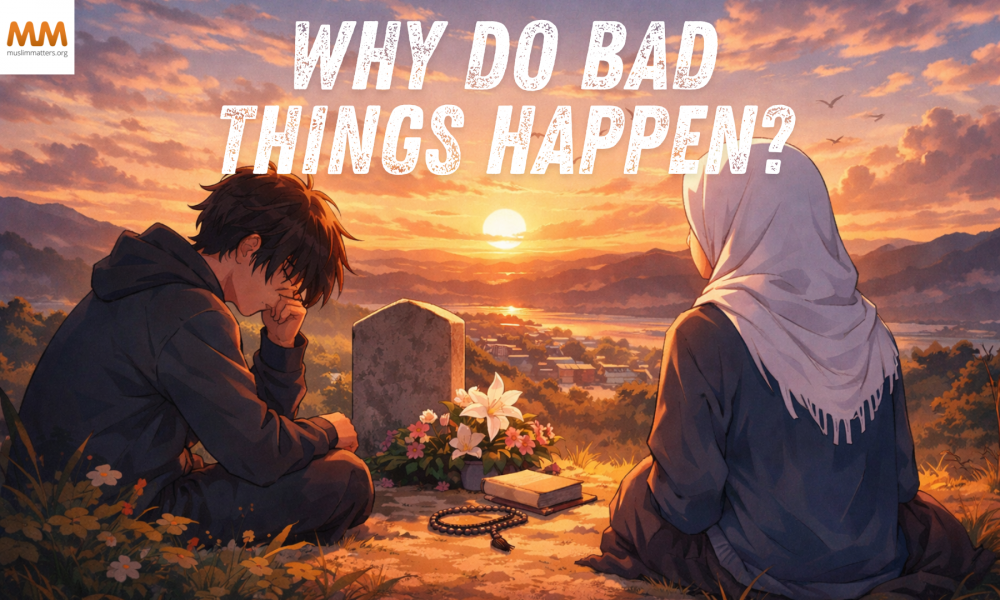
This series is a collaboration between Dr. Ali and MuslimMatters, bringing Quranic wisdom to the questions Muslim families are navigating.
When Your Teen Experiences Loss
There is a specific kind of silence that falls over Muslim families after a catastrophic loss.
The body is barely in the ground. The relatives are reciting Quran in the corner. And somewhere in that house is a teenager who is not crying, not praying, not participating in the rituals of grief.
Keep supporting MuslimMatters for the sake of Allah
Alhamdulillah, we’re at over 850 supporters. Help us get to 900 supporters this month. All it takes is a small gift from a reader like you to keep us going, for just $2 / month.
The Prophet (SAW) has taught us the best of deeds are those that done consistently, even if they are small.
Click here to support MuslimMatters with a monthly donation of $2 per month. Set it and collect blessings from Allah (swt) for the khayr you’re supporting without thinking about it.
They are alone with something they don’t know what to do with.
Not necessarily rejecting Allah. Not necessarily losing their faith. Just — overwhelmed by pain so large it has no container. And no one has told them where to take it.
This piece is for the parent who wants to give their teenager that direction.
First: Understand what your teen is actually experiencing
Grief in adolescence is neurologically and developmentally different from grief in adults.
The adolescent brain — specifically the prefrontal cortex, responsible for emotional regulation and long-term perspective — is still developing. This means that when a teenager experiences catastrophic loss, the emotional intensity is higher, the capacity to self-regulate is lower, and the ability to hold contradictory truths simultaneously is genuinely harder than it will be in adulthood.
This is not weakness. It is neurodevelopment.
Additionally, adolescence is already the period in which young people are constructing their own framework for understanding the world. A major loss during this period doesn’t just cause grief — it can disrupt the entire framework a teenager has been building. When a teen says “I don’t understand how Allah could let this happen,” they are often not making a theological argument. They are expressing that the world no longer makes sense. They need help finding a direction — toward Allah, not away from Him — and to be walked in that direction.
What the Quran actually shows us about grief
The story of Prophet Yaqub ﷺ is the Quran’s most extended, most humanly raw portrait of grief. And it corrects several common misunderstandings about what Islamic grief is supposed to look like.
Yaqub lost his beloved son Yusuf — or believed he had. And then years later his second son, Binyamin, was also taken. The Quran records that his eyes turned white from weeping. That he wept until he lost his sight. That his sons told him he was going to destroy himself with grief.
And Yaqub said:
“I only pour out my suffering and my grief to Allah, and I know from Allah what you do not know.” [Yusuf 12:86]
The classical scholars — Ibn Kathir, al-Tabari, al-Qurtubi — are unanimous in their understanding of this statement. Yaqub is not expressing anger at Allah or at His decree. He is directing his grief to Allah, in the manner of a servant who seeks relief and mercy from the Lord he trusts completely. He didn’t go to anyone else with that pain. He brought it before Allah alone.
And alongside his grief he held something deeper: I know from Allah what you do not know. Not certainty about the outcome. Just trust — rooted in his knowledge of who Allah is, and anchored by the hope of Yusuf’s dream — that everything happening had a purpose enveloped in mercy, even what he could not yet see.
Two things in Yaqub’s response deserve careful attention for parents:
First — he did not suppress his grief or perform acceptance he did not feel. He acknowledged the pain fully. He named it. He brought it to Allah raw and unfiltered.
Second — he did not take that pain anywhere else. Illa Allah — to Allah, alone. Not to bitterness. Not to resentment. Not away from the One who could actually carry it.
This is the model you want to give your teenager. Not: pretend it doesn’t hurt. But: bring everything you’re carrying — honestly, fully — to Allah.
Why bad things happen: the answer that actually satisfies
Abstract theological explanations of suffering rarely land with grieving teenagers. But narrative does. And the Quran gives us one of the most powerful narratives ever told about divine wisdom — one that Muslims encounter every Friday in Surat al-Kahf.
The story of Musa and Khidr.
Musa ﷺ — one of the mightiest messengers of Allah, armed with complete knowledge of divine law and justice — traveled with Khidr ﷺ, a prophet acting on direct divine instruction. And he witnessed three things he could not remain silent about:
A poor family’s boat — their livelihood — was deliberately damaged. Khidr ﷺ put a hole in it just as they reached the other shore.
A child was killed. Playing innocently. Without apparent reason.
A wall in a town that had refused them hospitality was rebuilt for free.
Musa’s objections were entirely reasonable from where he stood. Two apparent wrongs and one senseless act of generosity toward people who deserved only condemnation. He applied his full knowledge of right and wrong — yet, he was wrong.
Then Khidr explained what Musa could not see:
The damaged boat protected it from a king who was seizing every seaworthy vessel by force. That poor family lost a few days of work — but kept their livelihood. Some reports even say Khidr overpaid the rent to help cover the repairs.
The child who died was headed toward a life of oppression toward his own parents and to society at large. He was taken in mercy — for them and for him. His parents were given another child. And that boy, now with Ibrahim ﷺ in Jannah, plays with other children, waiting until the Day of Judgment where he will be allowed to intercede for his parents, so that all of them enter together.
The wall protected the inheritance of two orphaned boys whose righteous father had hidden his life savings beneath it. Had it collapsed, their inheritance would have been taken illegitimately. It stood long enough for those boys to grow up and claim what was theirs.
Three apparent wrongs. Three profound mercies — invisible from inside the story, fully visible only from where Allah stands.
This is the answer to “why do bad things happen to good people” that satisfies — not because it removes the pain, but because it gives the pain a context. We are Musa, inside the story, seeing only what we can see. Allah sees the whole picture.
Allah says in Surat al-A’raf:
“My mercy encompasses everything.” [7:156]
And the Prophet ﷺ taught us to say: “All good is in Your Hands, and evil is never attributed to You.”
Evil in Islam is like darkness — the absence of light. All that flows from Allah is good, even when we cannot see the goodness from inside our pain. Yusuf was removed from a life of bullying and poverty into a grand purpose: the salvation of a civilization, the repentance of his brothers, and the reunion that restored his father’s sight. Yaqub could not see any of that from inside his grief. But it was already in motion.
Your teenager cannot see the end of their story from inside their pain. But Allah can. That is what I know from Allah what you do not know means — not special information, but trust in a mercy that encompasses everything.
When you share the Musa and Khidr story with your grieving teenager, you are giving them a Quranic framework for understanding why their limited vantage point is not the whole picture. Read Surat al-Kahf together. Let the words of Allah do the work.
The most important question: where does the pain go?
When a teenager is in the grip of grief, the pain has to go somewhere. The question is where.
It can go toward Allah — in du’a, in tears poured out in salah, in honest supplication, in the act of returning to Him even when returning is hard. This is the direction of Yaqub. This is what protects and eventually heals the heart.
Or it can go away from Allah — into numbness, into withdrawal from prayer and community, into bitterness that gradually hardens the heart and creates distance from the only real source of relief.
The issue is never the existence of pain. Allah created human emotions and knows what is in the heart. The issue is direction.
Your role as a parent is not to rush your teenager to acceptance or to deliver a theology lecture in the middle of their grief. It is to help them find the direction — toward Allah, not away — and to walk with them in that direction. To say, with your presence and your words: bring it to Him. All of it. He can hold it.
What sabr actually means
There is a misunderstanding of sabr that causes real harm when applied to grieving teenagers.
Sabr is not the performance of calm. It is not emotional suppression. The Prophet ﷺ said: “Patience is at the first strike of calamity.” (Bukhari) The scholars explain carefully: what is being praised is the response at the moment of loss — turning toward Allah rather than away, not saying what displeases Allah. It does not mean to feel nothing.
The Prophet ﷺ himself wept at the death of his son Ibrahim. He said: “The eye weeps and the heart grieves, and we say only what pleases our Lord.” (Bukhari) Tears are not failure. Grief is not un-Islamic.
Yaqub wept for years. The Quran records it without criticism and calls him patient and righteous in the same story.
When you communicate to your teenager that their tears or their questions are un-Islamic, you are not teaching them sabr. You are teaching them that their real internal state is shameful and must be hidden — from you, and from Allah. That is the opposite of Yaqub’s model.
Real sabr guards the tongue and the heart’s orientation. It has room for tears. It looks like a father weeping until he loses his sight, still saying — I know from Allah what you do not know.
Warning signs that grief requires professional support
Normal grief — even prolonged, intense grief — does not require clinical intervention. But the following indicate that professional support is needed:
- Any expression of suicidal ideation — direct or indirect. Take this seriously without exception and without delay.
- Prolonged functional impairment — inability to attend school, eat, sleep, or maintain basic self-care for more than a few weeks.
- Complete social withdrawal — isolation from all friends and family simultaneously.
- Self-harm of any kind.
- Substance use to manage the pain.
If several of these are present, seek professional support — ideally from a Muslim mental health provider who understands both clinical practice and Islamic framework. Khalil Center (khalilcenter.com) is a strong starting point. If your teen is in crisis, call or text 988.
What to say — and what not to say
Don’t say:
- “Stop crying — this is Allah’s will.” This conflates acceptance of qadar with suppression of grief. They are not the same.
- “You need to be strong for the family.” This instructs them to perform for others rather than grieve honestly before Allah.
- “Everything happens for a reason.” True in Islamic understanding, but experienced as dismissive in acute grief.
- “They’re in a better place.” Insha Allah, true — but not what a teenager in fresh grief needs in the first moments.
- “You shouldn’t question Allah.” Honest confusion brought to Allah is not the problem. Help them bring the questions to Him — don’t shut them down.
Do say:
- “This is devastating. I’m so sorry.”
- “You don’t have to have it figured out right now.”
- “It’s okay to cry. The Prophet ﷺ cried too.”
- “Yaqub ﷺ wept until he lost his sight. Allah still called him patient and righteous.”
- “Bring it to Allah — all of it. You don’t have to clean it up first.”
- “No one else can carry this with you the way He can. Bring it to Him.”
“I’m not going anywhere. Take whatever time you need.”
Discussion questions for families
For teens:
- When something painful happens, where does the feeling go? What is your instinct?
- What does the Musa and Khidr story teach you about what you can and cannot see from inside your own situation?
- Is there something you’re carrying right now that you haven’t brought to Allah yet?
For parents:
- How did your family handle grief when you were growing up? What did that teach you about expressing pain?
- Have you ever suppressed your own grief to appear strong? What did that cost you?
- How can you make your home a place where your teenager can grieve honestly — and be directed toward Allah in that grief?
For discussion together:
- What does ashku bathhi wa huzni ila Allah — I pour out my suffering and my grief to Allah — mean to you personally?
- Read the Musa and Khidr story together from Surat al-Kahf. Which of the three examples speaks most to you, and why?
- Is there a loss our family has experienced that we haven’t fully brought to Allah together?
The bottom line
Your teenager’s grief is not a threat to their faith. It is an opportunity — perhaps the most significant one they will have in their young life — to discover that Allah is large enough to hold everything they are carrying.
Your job is not to rush them to acceptance or to correct their theology in the middle of their pain. Your job is to point them in the right direction — toward Allah, not away from Him. To say, with your words and your presence: bring it to Him. All of it. He can hold it.
Yaqub couldn’t see what Allah could see. He poured out his grief before Allah in the darkness. And then Yusuf walked through the door.
Help your teenager find their way to that same door.
Continue the Journey
This is Night 18 of Dr. Ali’s 30-part Ramadan series, “30 Nights with the Quran: Stories for the Seeking Soul.”
Tomorrow, insha Allah: Night 19 — When Islam Feels Like a Burden: Why does it feel like everything cool is haram?
For daily extended reflections with journaling prompts, personal stories, and deeper resources, join Dr. Ali’s email community:
Related:
Is Depression a Lack of Faith? A Guide for Muslim Parents | Night 17 with the Qur’an
30 Nights with the Qur’an: A Ramadan Series for Muslim Teens