
Activism
/
StudentNation
/
March 11, 2026
Amid repression from the Trump administration, students nationwide are forming alliances with faculty groups, unions, and alumni to protect undocumented and international students.
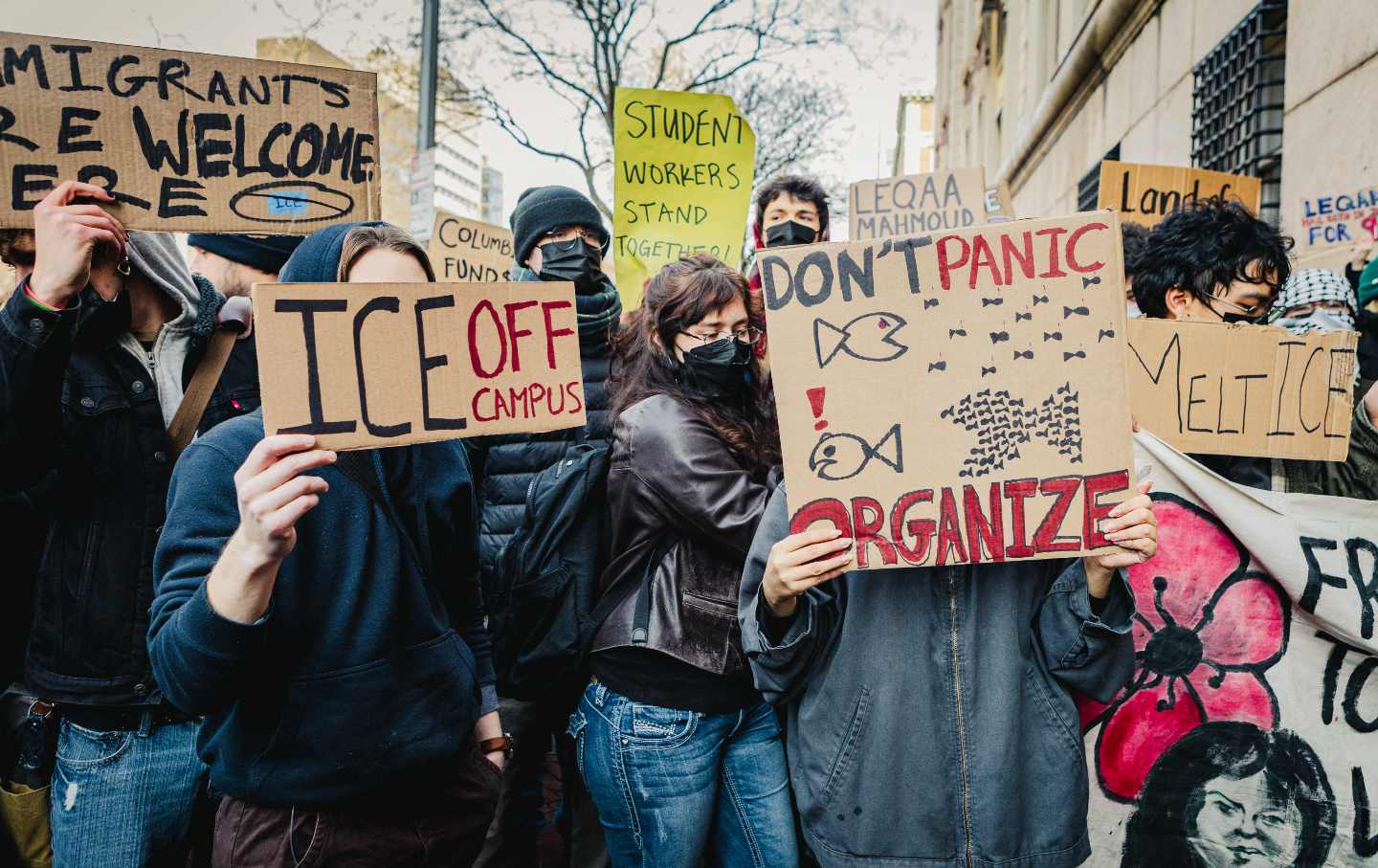
Columbia students rally outside of the campus gates in response to Department of Homeland Security officers detaining undergraduate student Ellie Aghayeva.
(Heather Chen)
At Columbia University, most students don’t have classes on Fridays, making Thursday nights when the party starts. But on one particular Thursday last month—February 26—the atmosphere felt different on campus. In the basement of Pupin Hall, where Columbia scientists conducted research as part of the Manhattan Project some 87 years ago, dozens of students piled into a lecture hall for an 8 pm emergency teach-in about the Department of Homeland Security on campus.
Around 10 hours earlier, the Columbia community had been notified by e-mail that federal agents from the Department of Homeland Security had entered a university residence under the false pretenses of searching for a missing child and instead arrested an international student, Ellie Aghayeva. Activists on campus mobilized quickly. By noon, just two hours after Aghayeva’s detention was confirmed by Columbia, hundreds of community members had gathered outside the university’s gates to protest. That evening’s teach-in had been organized by a coalition of activist and affinity groups, many of them coming together for the first time, to help inform and mobilize students who wanted to get more involved after the protest.
At the demonstration, organizers set out three demands: first, that Columbia become a sanctuary campus; second, that it stop working with President Donald Trump’s administration; and third, that all students detained by DHS be released. On February 26, shortly after Mayor Zohran Mamdani spoke to President Donald Trump at the White House, Aghayeva was released.
While Aghayeva’s detainment catapulted Columbia back into the national spotlight, the scene of campus communities banding together to resist Immigrations and Customs Enforcement has played out over and over again in the last two months. The Nation spoke with 19 individuals—students, faculty, alumni, union organizers, and community activists—involved in continued efforts to get ICE off campuses.
At some schools, like Columbia, Brown University, and the University of North Carolina at Chapel Hill, organizers are looking to restrict the sharing of personal data with the federal government, which could be used to target anti-ICE activists or noncitizen students and faculty.
Many also demand rhetorical support—statements from their University administrators championing the rights of immigrant students, and condemning the federal government’s actions.
Current Issue

As Jackson Schnabel, a student organizer at Georgetown describes it, the university teaches them to protect the most vulnerable in their communities, to care for one another. “It’s the reason that a lot of students, including myself, came to Georgetown,” Schnabel said. “We just really want to make sure that Georgetown is extending these values to everything that it’s doing, in the same way that they’re trying to push us to be the best people we can be.”
The movement to defend noncitizen students started long before the Trump administration began its immigration crackdown in January 2025. In the 1990s, a large wave of undocumented immigrants settled in places like New York City. As undocumented youth came of age in the late 2000s, they learned that there were no legal pathways for them to attend college.
As Lehman College professor Alyshia Gálvez explained to The Nation, some undocumented youth began to mobilize around this issue. While Lehman, which is a part of the City University of New York, opened enrollment to undocumented youth in the early 2000s, many young people in New York were still falling through the cracks, unaware of the opportunities available for undocumented youth and worried about their ability to gain employment after graduation due to their immigration status. As a result, organizers advocated for the DREAM Act, which would provide undocumented youth a path to permanent residency in the United States.
Gálvez supported the student movement as part of the Dream Act Faculty Alliance (DAFA). The tri-state area campaign worked to identify policies at member Universities that either facilitated or blocked undocumented students from enrolling. Then, in 2012, President Barack Obama passed his executive order, Deferred Action for Childhood Arrivals (DACA), which provided undocumented youth a pathway for employment and deferrals from deportation. The movement of undocumented youth began to splinter after that—with DACA in place, some felt that their goals had been achieved, while other groups like the National Immigrant Youth Alliance chose to mobilize against deportation and detentions. Others, as Gálvez put it, “retired” from their activism. Some of them had already dedicated a decade of their lives to activism, and they were looking to start lives with their families, or explore the world beyond college.
After Donald Trump entered the presidential office in 2017, he moved to repeal DACA, emphasizing its vulnerabilities as an executive order. Barnard Professor Nara Milanich, a former DAFA member, recalled taking action after Trump won the presidential election. She and a fellow Columbia staffer immediately petitioned the university administration with a series of demands aimed at protecting undocumented students at Columbia—and the university complied with some of them, an indication of its willingness to publicly defend and protect its undocumented community. When the federal government came after undocumented immigrants during Trump’s first presidency, many colleges across the country, including Columbia, publicly declared their support for DACA.
Today, however, activists are working in a much more repressive environment, where the courts and the university administrators are more unsympathetic, ICE has become more violent, and the federal government’s deportation dragnet has widened. As Milanich noted, student organizing for undocumented youth has become quieter and quieter over time. And now, under Trump 2.0, the focus has shifted toward preventing the outright abduction of international students, many of whom have legal status through green cards or visas. “All of a sudden, we’re talking about a completely different student population,” Milanich said.
This current environment has changed the types of demands on the table, many of which now focus on protecting international students who are green card or visa holders. At Columbia, the student workers union is currently negotiating a new contract with the university. One of its central demands is free legal support for international student workers and reimbursements for immigration-related fees, which are likely to rise due to new immigration policies. Johnson Dalmieda, a bargaining committee member for the union, says that many of these demands came about after several Columbia students were detained by ICE or forced to flee the country in 2025. One of those students, Ranjani Srinivasan, is a member of the student workers union.
And it’s not just international students who are at risk. Faculty members and scholars with legal status, like Brown assistant professor Dr. Rasha Alawieh, have been deported over their political opinions. According to Brown professor Denise Davis, international faculty members, especially those whose countries of origin have been placed on Trump’s indefinite visa ban list, have expressed worries about their ability to renew their legal status. Davis, a member of the Brown American Association of University Professors, said that faculty members have expressed “feeling very alone.” To her knowledge, the university has not offered legal support.
While much of the public attention around ICE on campuses has pivoted toward the targeting of international students and scholars, some campus campaigns are still trying to center the demands of undocumented student organizers, even as their activism has moved outside of the public eye. Davis pointed to the efforts of Brown Rise Up (BRU), an anti-authoritarian student movement, which is currently bringing together student, faculty, and alumni forces to coordinate anti-ICE actions. She says that BRU has been adamant about ensuring that undocumented student organizers are consulted about the group’s collective demands, which include a limit on information sharing with the Department of Homeland Security, mandatory training and written guidance for Campus Security regarding ICE, clear signage that indicates ICE cannot enter private spaces without a judicial warrant, and other policies.
Other organizers are also turning their attention to how their campuses are tied to ICE. Georgetown’s chapter of the Sunrise Movement, a national youth climate activism group that has pivoted toward anti-ICE efforts, is preparing to launch a campaign demanding that its basketball team stop using the charter company Global Crossing Airlines, which has been one of the Trump administration’s primary contractors for deportation flights.
“The same seats that are being occupied by our basketball players are being filled the next day by people in shackles—torn from their families and their communities, sent to completely unfamiliar countries,” Schnabel said. He highlighted a GlobalX plane with the tail number N837VA, which detained Georgetown postdoctoral researcher Badar Khan Suri was taken aboard in March 2025. Just a few months earlier, the men’s basketball team had flown on that very plane.
At all of these campuses, organizers are mobilizing against great odds, with some having to confront outwardly hostile university administrations. Throughout January and February, the University of Minnesota Police Department arrested dozens of individuals—including UMN students—at nonviolent demonstrations outside of a local Hilton hotel, which is located on UMN property and allegedly housed ICE officers.
“There’s been a very intense effort on the part of the administration to speak in vague terms, to not speak directly to the issues at hand and the way in which they impact the mission of the university,” UMN professor William Jones told The Nation. He pointed to an instance in which a music professor was prevented from performing at a UMN vigil for Alex Pretti and escorted out of a building for wearing a sign that said “ICE Out.”
At Columbia, organizers are operating in an environment where, according to civil rights groups like the ACLU, the university has chilled speech. “We’re just encountering nothing but obstruction and petty interference from the university. And it really has chilled debate and discourse, which, I guess, was the point,” Columbia professor Michael Thaddeus told The Nation.
For Toby Posel, a senior at UNC Chapel Hill who founded TransparUNCy, an organization dedicated to bolstering institutional transparency, another issue is apathy: “The unfortunate reality is that for many people, until this kind of fascist violence is literally in your backyard, it is merely an abstraction.”
Popular
“swipe left below to view more authors”Swipe →
While some student organizers have been disheartened, Posel says it has only made the organizing work more important.
At the same time, fear has dominated the atmosphere on many campuses. “There’s just so much fear in communities that a lot of times students aren’t reaching out to faculty or don’t know who they can trust,” said Jenna Ortega, president of the Inter Faculty Organization, an independent union representing seven campuses across Minnesota.
Brown is also contending with a community that is still recovering from the December shooting that left two undergraduate students dead. BRU organizer Simon Aron described an environment where “people are just scared and overwhelmed.”
But even through the fear, over 1500 Brown students participated in a walkout last month. The key to success? Campus alliances. “It was a real effort across affinity groups and organizing spaces, and that was really beautiful,” Aron said.
“This is a new moment where unity’s being recovered,” Emory professor Robert Birdwell told The Nation. “In previous generations, students and grad students have really pushed for transformation, and faculty and staff have joined them. This is super important because the strategy of the Trump administration has been ‘isolate and conquer,’ but if we have what the American Association of University Professors calls ‘wall to wall’ solidarity across campus, that strategy is impossible,” Birdwell said.
At Columbia, organizers are beginning to see a reinvigoration of campus activism. Leel Dias, a Sunrise Columbia organizer, pointed to the energy and alliance he saw after Aghayeva’s arrest. Faculty and students also joined forces earlier last month on February 5 for an ICE Off Campus demonstration. The protest ended with a diverse group of university affiliates blockading Broadway, the street outside of Columbia, to demand a sanctuary campus. The NYPD arrested 12 individuals.
“That was a meaningful moment for us to be trusted by students, to be involved in their action, and to take such risks together,” an anonymous organizer with CU Stands Up, told The Nation. The organizer, who is a staff member at Columbia, requested anonymity because of concerns about employment-based retaliation.
Despite the odds, campus organizers still feel hopeful about winning their demands. Schnabel pointed to another airline, Avelo, cutting ties with ICE following outside pressure. “We know that doing this works, and having that success story can really motivate people,” he said.
For Aron, effective campus organizing will require Brown’s administration to take “that leap of faith” by directly opposing the federal government. “That is a really scary thing for an administration to do,” Aron said. “But I think we’re in an unprecedented time where these institutions have to take a side.”
Even before February 28, the reasons for Donald Trump’s imploding approval rating were abundantly clear: untrammeled corruption and personal enrichment to the tune of billions of dollars during an affordability crisis, a foreign policy guided only by his own derelict sense of morality, and the deployment of a murderous campaign of occupation, detention, and deportation on American streets.
Now an undeclared, unauthorized, unpopular, and unconstitutional war of aggression against Iran has spread like wildfire through the region and into Europe. A new “forever war”—with an ever-increasing likelihood of American troops on the ground—may very well be upon us.
As we’ve seen over and over, this administration uses lies, misdirection, and attempts to flood the zone to justify its abuses of power at home and abroad. Just as Trump, Marco Rubio, and Pete Hegseth offer erratic and contradictory rationales for the attacks on Iran, the administration is also spreading the lie that the upcoming midterm elections are under threat from noncitizens on voter rolls. When these lies go unchecked, they become the basis for further authoritarian encroachment and war.
In these dark times, independent journalism is uniquely able to uncover the falsehoods that threaten our republic—and civilians around the world—and shine a bright light on the truth.
The Nation’s experienced team of writers, editors, and fact-checkers understands the scale of what we’re up against and the urgency with which we have to act. That’s why we’re publishing critical reporting and analysis of the war on Iran, ICE violence at home, new forms of voter suppression emerging in the courts, and much more.
But this journalism is possible only with your support.
This March, The Nation needs to raise $50,000 to ensure that we have the resources for reporting and analysis that sets the record straight and empowers people of conscience to organize. Will you donate today?
More from The Nation
Th actress’s revived Committee for the First Amendment is taking aim at industry mergers as well as threats to the freedom of expression.
Ben Schwartz
The iconic civil rights leader, who has died at 84, made anti-war and pro-diplomacy politics central to his presidential bids and his lifelong activism.
Obituary
/
John Nichols
Now it’s time to abolish the agency and impeach Kristi Noem.
John Nichols
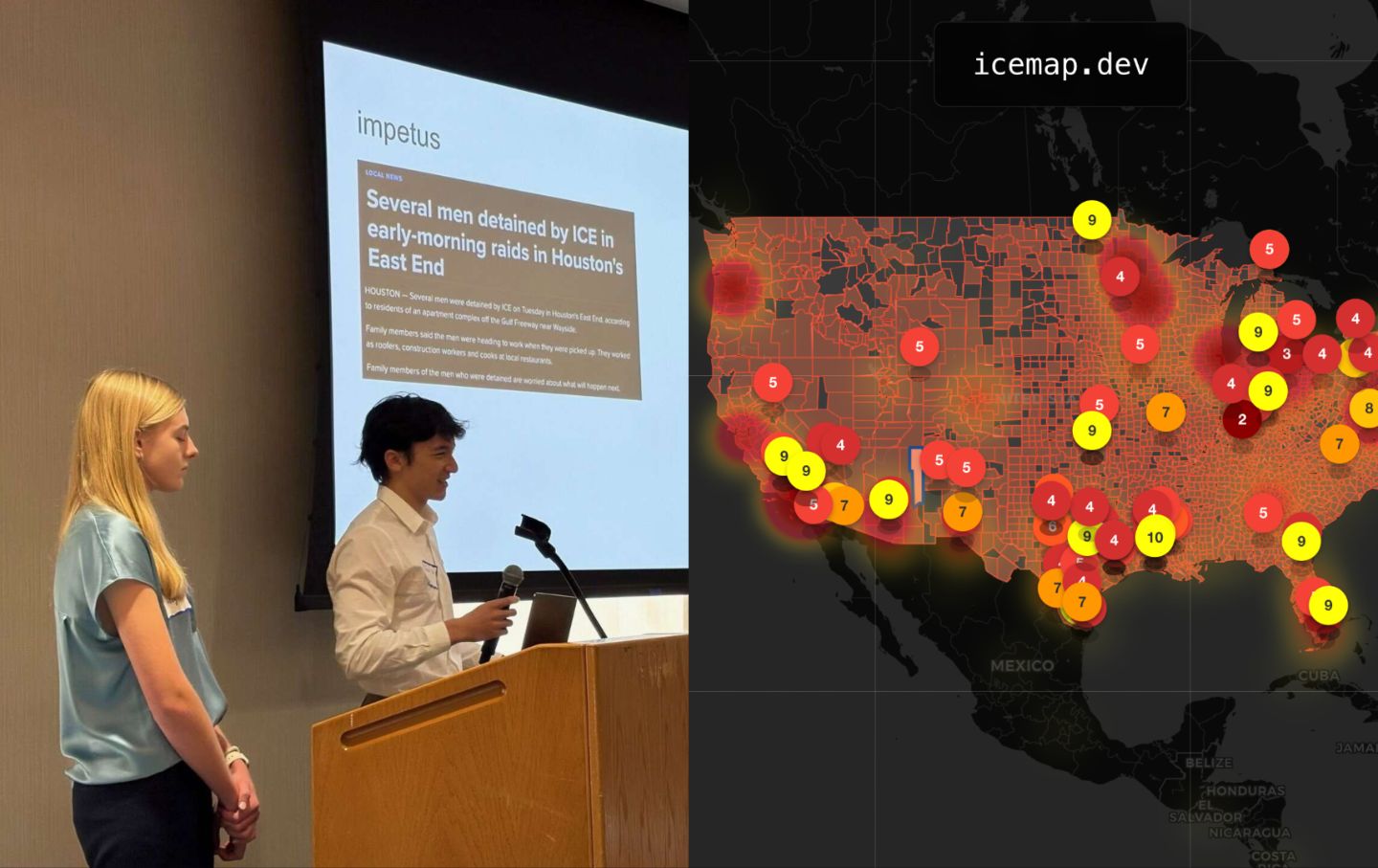
With ICE Map, Rice University students Jack Vu and Abby Manuel hope to help communities understand where immigration enforcement activity is happening and how it unfolds in real t…
StudentNation
/
Arman Amin
Young organizers from around the country gathered at Haley Farm to study past social movements and train in the tactics of nonviolent resistance and grassroots organizing.
Rev. Dr. Liz Theoharis and Sam Theoharis