
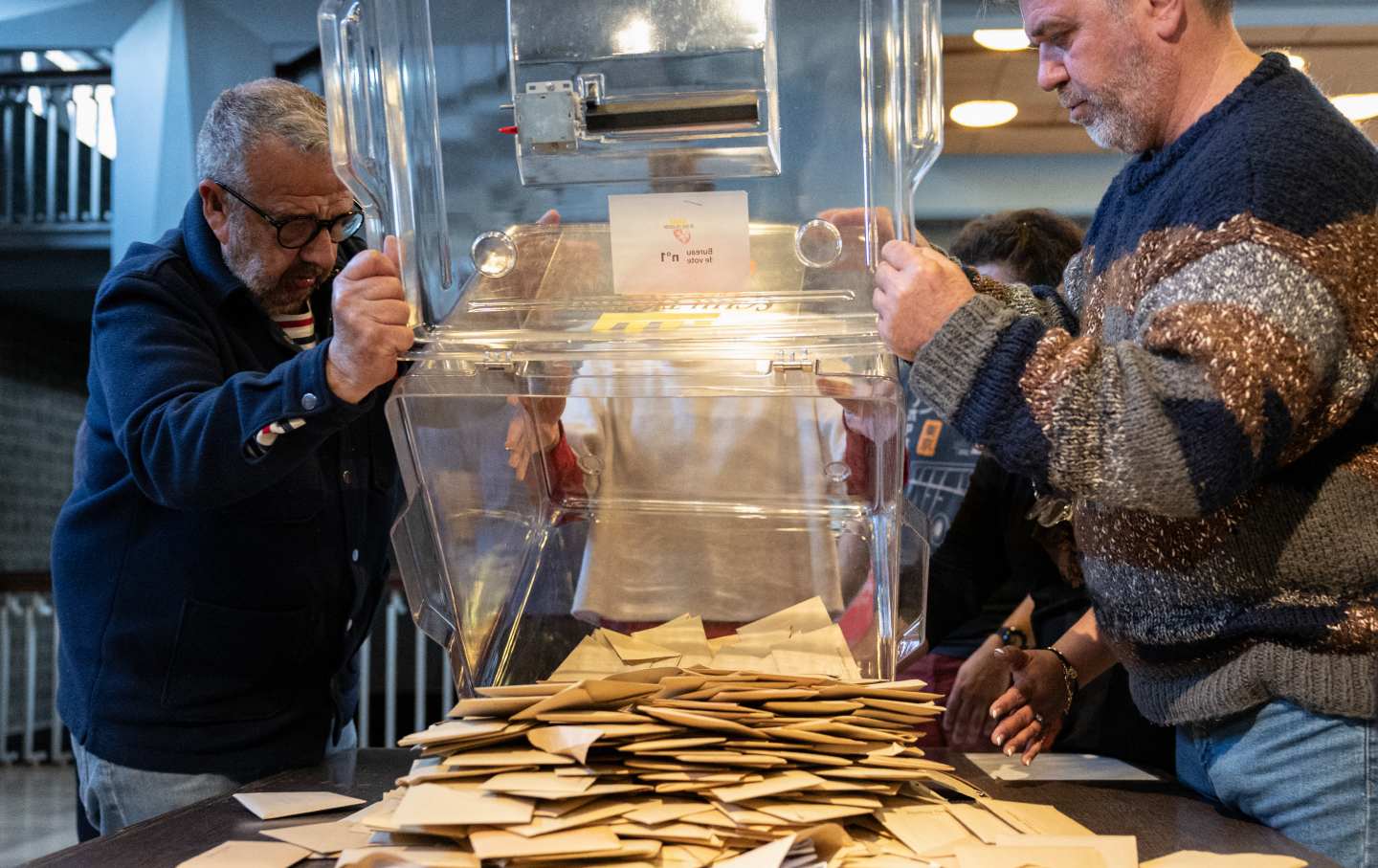
The French left managed to hold on to key cities, but the far right and mainstream right also won key victories—and the intra-left bickering shows no signs of subsiding.
Officials empty a ballot box while taking part in the counting process during the second round of France’s 2026 municipal elections at a polling station in Schiltigheim, eastern France, on March 22, 2026.
(Romeo Boetzle / AFP via Getty Images)
Marseille—If you’re on the left, one way of looking at France’s municipal elections is to say they could’ve have gone worse.
Nearly two years after joining forces to create the New Popular Front alliance, France Unbowed (La France Insoumise, LFI), the Socialist Party, the Communist Party, and the Greens are once again divided. The far right leads polls ahead of next year’s presidential election. Conservative billionaires are rapidly transforming the media landscape. Last month’s killing of far-right activist Quentin Deranque during a street brawl with antifascists in Lyon threatened to cast a shadow on the left just before voters went to the polls.
And yet, left-wing mayoral tickets managed to hold on to scores of major cities, including the country’s three biggest metropolises of Paris, Marseille, and Lyon, each of which appeared to hang in the balance at late stages in the campaign. The working-class Parisian suburb of St-Denis saw the election of a new progressive mayor who speaks proudly of his immigrant roots. Left-wing tickets even managed to flip a handful of cities, including St-Etienne, Nimes, Amiens, and Pau. Municipalities set everything from housing policies to cultural programming and funding levels for elementary schools—and left-wing governance can bring direct improvements to millions of people’s lives.
But just beneath the surface, the signs are alarming. Marine Le Pen’s National Rally (Rassemblement National, RN) and its allies continue to gain traction nationwide. While they often struggle to distinguish themselves from the RN on the national level, candidates from the mainstream-right Republicans (Les Républicains, LR) performed remarkably well in small-town France. And left-wing parties also lost scores of winnable races—results that are likely to fuel a self-destructive three-way battle between a moderate wing of the Socialist Party; a bloc made up of more left-leaning Socialists, Communists, and Greens; and the populists of Jean-Luc Mélenchon’s La France Insoumise.
Brown and Blue Victories
Current Issue

The National Rally lost nearly all of its most high-profile targets, showing its continued struggles to compete in large cities. But Le Pen’s party comfortably defended a handful of midsize cities and multiplied by six the number of mayoralties it holds nationwide. These 70 victories, according to the party’s own count, didn’t arrive just in a pair of historically favorable regions: the deindustrialized former mining basin of the north and large swaths of Provence that include the swanky Riviera. But the RN also conquered city halls in comparably less sympathetic pockets of the country like central France, southwestern France, and even Alsace, a region where the oldest voters have memories of being annexed by Nazi Germany and where a moderate right has long prevailed. The RN’s cherry on top? In Nice, France’s fifth-largest city and a haven for retirees, RN-backed Éric Ciotti won over droves of radicalizing conservatives, making the frequent online comparisons to Florida sadly apt.
These victories—and even the near-misses in big cities like Marseille and Toulon—will strengthen the National Rally for years to come. The electoral college of France’s Senate is overwhelmingly made up of municipal councillors, which means the 3,000-plus RN officials who were just elected will likely pave the way for Le Pen’s party to make inroads in the upper house of France’s Parliament later this year. And while it’s become something of a cliché, it nonetheless holds true: The more towns the RN conquers, the less toxic the party’s image becomes. The RN has assembled a broad coalition stretching from disaffected working-class voters to wealthier middle-class conservatives, and it shows no signs of fading.
At the same time, France’s traditional right performed resiliently. Municipal elections are the bread-and-butter of Les Républicains, and French voters in thousands of towns revealed that they’re willing to keep electing conservatives on the local level. Despite some high-profile losses, LR and its allies defended cities like Toulouse, Le Havre, and Reims. And while many on the French left were delighted to witness another municipal belly flop from the party of Emmanuel Macron—an unpopular lame duck whose behind-the-scenes maneuvering on behalf of conservative candidate Rachida Dati in Paris came up embarrassingly short—the results also showed that many Macron voters have no problem shifting to the traditional right as they see fit. The president’s own political project may be up in flames, but his voters will keep voting for right-wing candidates.
Civil War on the Left
For left-wing parties, the mixed bag of election results is all but guaranteed to fuel a fratricidal war that has now become an entrenched part of contemporary French political life. As the 2027 presidential election approaches, rival camps are each trying to spin the results in their favor, suggesting that they—and they alone—have the winning strategy.
Predictably, Mélenchon has pronounced the results a resounding “success” for La France Insoumise, with prominent LFI MPs celebrating “a historic breakthrough” and padding themselves on the back for being “the dynamic force” of the campaign.” It’s true that LFI candidates won a few victories. It’s also true that the party elected significant numbers of city councillors for the first time since its founding in 2016. Shares of voters in working-class suburbs and young people in city centers admire the party’s radical tone and defense of multicultural France—and these advances are especially impressive given the hostile media environment.
But Mélenchon’s triumphalist tone doesn’t withstand serious scrutiny. Winning just one of France’s 40 largest cities is not a resounding success for any party—and especially not for a hyper-centralized one led by a man who has theorized urban areas as the key to his movement’s success and declared “urban political consciousness” to be an “advanced form of political consciousness.” LFI bombed in France’s two largest cities: In the key target of Marseille, MP Sebastien Delogu withdrew his candidacy after receiving just 12 percent of votes in the first round. And in the capital, MP Sophia Chikirou (a former Socialist who heads to trial in May for alleged fraud during her management of an LFI-friendly media start-up in 2018 and who remains under separate investigation over the financing of Mélenchon’s 2017 presidential campaign) chose to maintain her list in the second round but then won just 8 percent of votes. There’s an awkward reality behind many of LFI’s local successes: LFI municipal councilors were often elected thanks to alliances forged with other left-wing parties. That includes the Greens, Communists, and even the Socialists, the latter of which has eight times as many mayors as Mélenchon’s party, according to Le Monde’s analysis of towns with over 3,500 inhabitants.
Popular
“swipe left below to view more authors”Swipe →
By the same token, some of the most hard-line anti-LFI voices on the left and center-left are turning their ire toward Mélenchon’s party, arguing that second-round deals with LFI cost them victories by scaring away moderate voters in places like Toulouse, Clermont-Ferrand, and Brest. But this claim doesn’t hold up to scrutiny either. In fact, broad left-wing alliances in the second round proved essential to victories in places like Lyon, Nantes, and Tours. If progressives had listened to critics like Raphaël Glucksmann, a center-left presidential hopeful who urged candidates to categorically rule out local alliances with LFI, the left would’ve won far fewer towns than it did.
If all the mudslinging can be hard to parse outside of France, it’s nearly as confusing to many left-wing voters within France. Polls show that the vast majority of New Popular Front voters themselves favor alliances between LFI and the Socialist Party, making the constant fighting all the more off-putting. Given France’s perilous political juncture, it is also irresponsible. While left-wing politicians have clearly determined that their most loyal voters have a high tolerance for intra-left quarrels, they seem to be discounting the message it sends to the types of people they’re trying to win over: Would you trust these people?
Politicians who claim to be rivals but then accept short-term deals with each other only to return to bickering the moment elections are over? Most French voters, who do not follow the twists and turns of the ongoing psychodrama on the left, would be forgiven for thinking something similar to Logan Roy’s quip about his squabbling children in the TV series Succession: These are not serious people.
In the end, the results underscore what was already evident before the campaign: There is no hegemonic force on the French left today. Neither moderate Socialists nor LFI hard-liners can make that claim with any real credibility. And while left-wing candidates rack up votes in large urban areas, they continue to struggle in more midsize cities and smaller towns. Parties who write off working-class and middle-class voters outside of large urban areas do so at their own peril.
It is obvious to suggest that the left should set aside its differences and join forces for the 2027 presidential election—if anything, progressive voters in France seem to be crying out for a campaign that combines calls for basic reforms with a radical critique of the status quo. But the reality is that such a united ticket remains unlikely. Ignoring calls to participate in a united left-wing primary, Mélenchon and Glucksmann are both gearing up for campaigns of their own and will likely cherry-pick data points from the latest elections to bolster their respective bids. In private, many left-wing politicians and party insiders concede that the upcoming presidential race is already a lost cause and are waiting for the inevitable political reshuffle after the election ends. Of course, this is a luxury for professional politicians. The French population will suffer the costs of their ineptitude.
Even before February 28, the reasons for Donald Trump’s imploding approval rating were abundantly clear: untrammeled corruption and personal enrichment to the tune of billions of dollars during an affordability crisis, a foreign policy guided only by his own derelict sense of morality, and the deployment of a murderous campaign of occupation, detention, and deportation on American streets.
Now an undeclared, unauthorized, unpopular, and unconstitutional war of aggression against Iran has spread like wildfire through the region and into Europe. A new “forever war”—with an ever-increasing likelihood of American troops on the ground—may very well be upon us.
As we’ve seen over and over, this administration uses lies, misdirection, and attempts to flood the zone to justify its abuses of power at home and abroad. Just as Trump, Marco Rubio, and Pete Hegseth offer erratic and contradictory rationales for the attacks on Iran, the administration is also spreading the lie that the upcoming midterm elections are under threat from noncitizens on voter rolls. When these lies go unchecked, they become the basis for further authoritarian encroachment and war.
In these dark times, independent journalism is uniquely able to uncover the falsehoods that threaten our republic—and civilians around the world—and shine a bright light on the truth.
The Nation’s experienced team of writers, editors, and fact-checkers understands the scale of what we’re up against and the urgency with which we have to act. That’s why we’re publishing critical reporting and analysis of the war on Iran, ICE violence at home, new forms of voter suppression emerging in the courts, and much more.
But this journalism is possible only with your support.
This March, The Nation needs to raise $50,000 to ensure that we have the resources for reporting and analysis that sets the record straight and empowers people of conscience to organize. Will you donate today?