
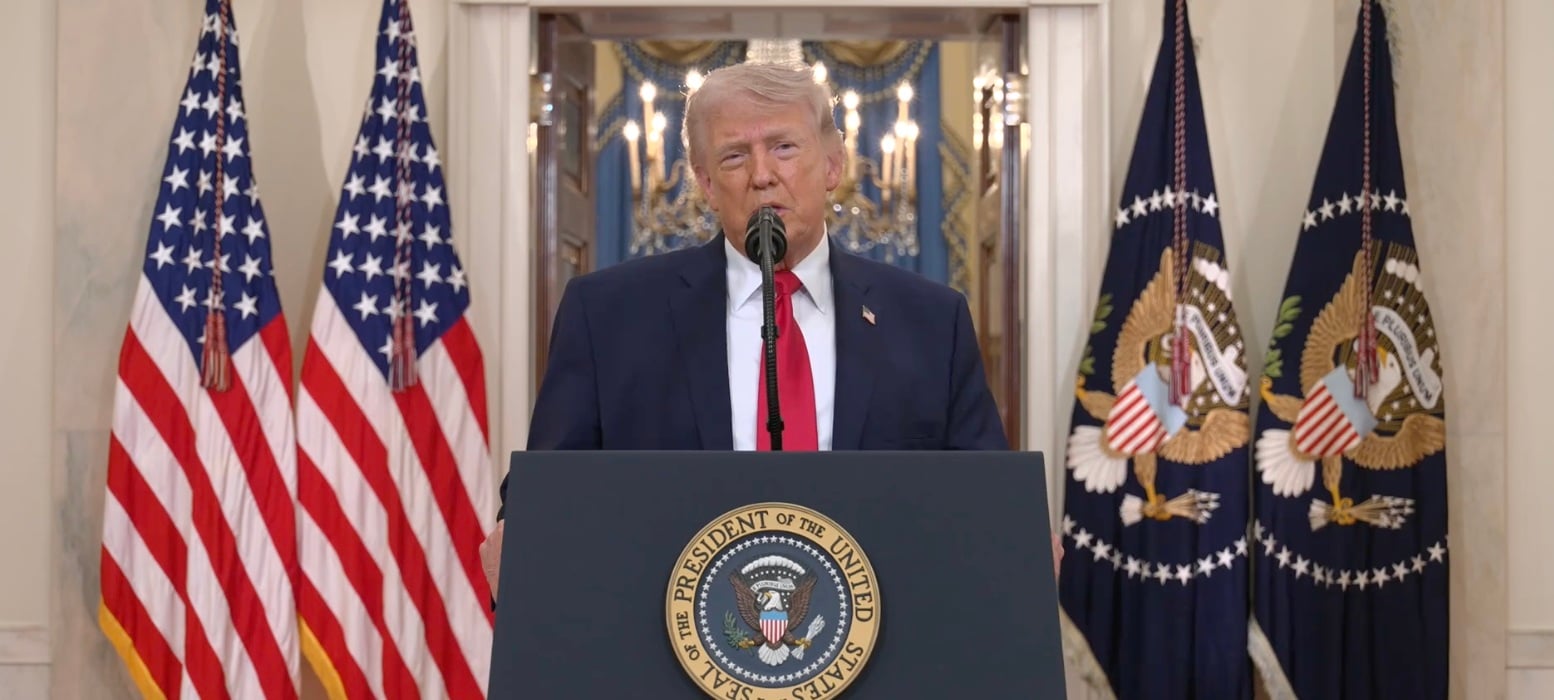
Trump said the U.S. is hitting Iran “extremely hard over the next two to three weeks”.
United States President Donald Trump thanked Qatar and other allies in the Middle East as he delivered his first primetime address to the nation since the U.S. and Israel began their joint war on Iran on February 28.
“I want to thank our allies in the Middle East – Israel, Saudi Arabia, Qatar, the UAE, and Bahrain. They’ve been great and we will not let them fail in any way shape or form,” Trump said from the White House on Thursday (Qatar time).
Trump’s address came during the fifth week of the war, dubbed as “Operation Epic Fury”, that has led to major regional escalation.
Iran has since targeted countries in the region, including Qatar, under claims that its retaliations are primarily against U.S. interests—a claim that has been rejected globally.
Trump claimed that his country’s forces “have delivered swift, decisive, overwhelming victories on the battlefield” and that the U.S. “winning bigger than ever before” while highlighting the killing of major leaders.
The first day of the war saw a U.S.–Israeli strike kill Iran’s Supreme Leader Ayatollah Ali Khamenei, and days later on March 17, Ali Larijani, the secretary of Iran’s Supreme National Security Council and a key figure in Tehran’s wartime leadership, was also killed in another Israeli airstrike
Trump claimed Iran’s ability to launch missiles and drones “is dramatically curtailed and their weapons factories and rocket launchers are being blown to pieces”, vowing to continue the war until its “objectives are fully achieved”.
“We are going to hit them extremely hard over the next two to three weeks. We are going to take them back to the stone ages where they belong,” he said.
During his first term in 2018 as the President of the United States, Trump unilaterally withdrew from the 2015 nuclear deal, known as the Joint Comprehensive Plan of Action (JCPOA)—signed under his predecessor President Barack Obama’s administration.
He introduced crippling sanctions on Iran, triggering major tensions since withdrawing from the accord, despite Iran’s compliance under the monitoring of the International Atomic Energy Agency.
Trump, in his latest address, argued that the withdrawal from the JCPOA saved the region and Israel and “would have led to a colossal arsenal of massive nuclear weapons for Iran”.
“It would have been a different world. There would have been no Middle East and no Israel right now,” Trump claimed.
Iran’s closure of the Strait of Hormuz since the early days of the war has been another major concern, given its vital position in global trade.
Located between Oman and Iran, the Strait is one of the world’s most critical routes for crude oil shipments. However, Iran maintains that the strait was not completely closed but barred to American and allied ships, while others are allowed to pass.
Trump called on countries relying on the Strait, especially when importing oil from the Gulf, to “build up some delayed courage” in order to reclaim it.
“[They] should have done it before, should have done it with us, as we asked. Go to the strait and just take it, protect it,” he said.
Acknowledging the economic impact of the war on oil prices, Trump said the “short-term increase has been entirely the result of the Iranian regime launching deranged terror attacks against commercial oil tankers in neighbouring countries”.
As he concluded his speech, Trump warned of strikes on Iran’s power plants if no deal is signed.
“If during this period of time, no deal is made, we have our eyes on key targets. If no deal is reached we are going to hit every one of their electric generating plants very hard, and probably simultaneously,” Trump said.