
Freight companies that build their online presence using Webflow website builders consistently generate stronger lead pipelines compared to those using outdated or plugin-heavy platforms. The core reason is simple: Webflow gives transportation businesses complete control over design, page performance, and SEO without the technical debt that holds most logistics websites back.
If your freight company is struggling to turn website visitors into actual inquiries, the platform you build on is more important than most operators realize.
What Makes a Freight Website Actually Generate Leads
Most freight companies treat their website as a digital brochure. That mindset is exactly why so many logistics sites underperform. A lead-generating freight website needs three things working in parallel: fast load times, clear service positioning, and conversion-focused design.
According to Google PageSpeed Insights data, a one-second delay in mobile page load can reduce conversions by up to 20%. That single metric explains why platform choice is a business decision, not just a design preference. The American Trucking Associations reports that the freight industry moves over 70% of all domestic tonnage in the United States, meaning competition for shipper attention online is intense and growing.
Freight buyers, whether they are shippers, supply chain managers, or procurement leads, make fast judgments. If your site loads slowly or looks visually inconsistent, bounce rates climb and inquiry forms stay empty.
How Webflow Website Builder Helps Freight Companies Attract More Qualified Leads
The core advantage of Webflow website builder for freight companies is the combination of visual design flexibility and clean, semantic code output. Unlike WordPress or Wix, Webflow generates production-ready HTML, CSS, and JavaScript without plugins that bloat page performance. For freight businesses, this translates directly into faster pages, stronger Google Core Web Vitals scores, and improved organic rankings for high-intent search terms.
Beyond speed, Webflow’s CMS lets freight companies publish case studies, service area pages, and industry-specific landing pages without developer dependency. A freight company targeting the automotive shipping corridor between Detroit and Chicago can spin up a dedicated service page in hours, not weeks. That content velocity is a measurable competitive edge in regional freight markets.
Webflow also supports advanced SEO configurations natively. Custom meta titles, canonical tags, structured data, and 301 redirects are all manageable without touching code. For freight companies investing in organic search as a primary lead channel, this level of control matters significantly.
Webflow vs. WordPress vs. Wix for Freight and Logistics Websites
| Feature |
Webflow |
WordPress | Wix |
| Avg. Google PageSpeed Score |
85–95 |
55–75 |
60–78 |
| SEO Control |
Full native |
Plugin-dependent |
Limited |
| Design Flexibility |
High |
Moderate |
Low |
| Developer Dependency |
Low |
High |
Very Low |
| CMS for Service Pages |
Built-in |
Plugin-required |
Basic |
| Hosting Infrastructure |
Enterprise CDN |
Self-managed |
Shared |
|
Schema/Structured Data |
Native support | Plugin-required |
Not supported |
For freight companies that need scalable, performance-first websites without maintaining a complex backend, Webflow produces objectively stronger results across every metric that directly influences lead generation.
Still weighing your options? Get a deeper breakdown in our Webflow vs WordPress guide before you commit to a platform
The Role of Broader Digital Infrastructure in Freight Lead Generation
A well-built website is only part of the equation. Freight companies operating at scale need their digital presence connected to their broader operations. Integrating the right IT solutions for transportation into your website strategy means your site does not operate in isolation. It feeds into CRMs, quoting tools, load board integrations, and customer portals.
Webflow’s open API and native integrations with platforms like HubSpot, Zapier, and Typeform make this ecosystem easier to build without rebuilding your site every time your operations change. A Webflow site with a properly connected CRM turns a contact form submission into a tracked, attributed lead in seconds.
That closed loop between website and sales pipeline is where freight companies that invest in digital infrastructure separate themselves from competitors who treat their site as a static asset.
Challenges Freight Companies Face When Rebuilding Their Website
Rebuilding a freight company website is not without friction. The most common challenges include content migration, preserving SEO equity during the transition, and internal stakeholder alignment.
Content migration from legacy platforms is messy when your current site has years of indexed pages carrying backlinks and ranking history. Any platform migration requires careful redirect mapping to avoid losing organic traffic. Webflow’s built-in redirect manager simplifies execution, but the strategic planning must happen before a single page goes live.
Internal alignment is often the harder problem. Sales teams want lead forms on every page. Marketing wants storytelling and brand space. Operations want a rate calculator or freight quoting tool. Aligning these goals into a coherent site structure requires a proper discovery phase before design begins.
Budget expectations also need to be realistic. A high-performance Webflow build done properly is not a low-cost project. Freight companies that want to hire web development talent capable of producing conversion-focused Webflow sites should budget separately for strategy, design, development, and post-launch optimization.
Already on another platform? Here is how to migrate your existing website to Webflow without losing SEO equity or traffic.
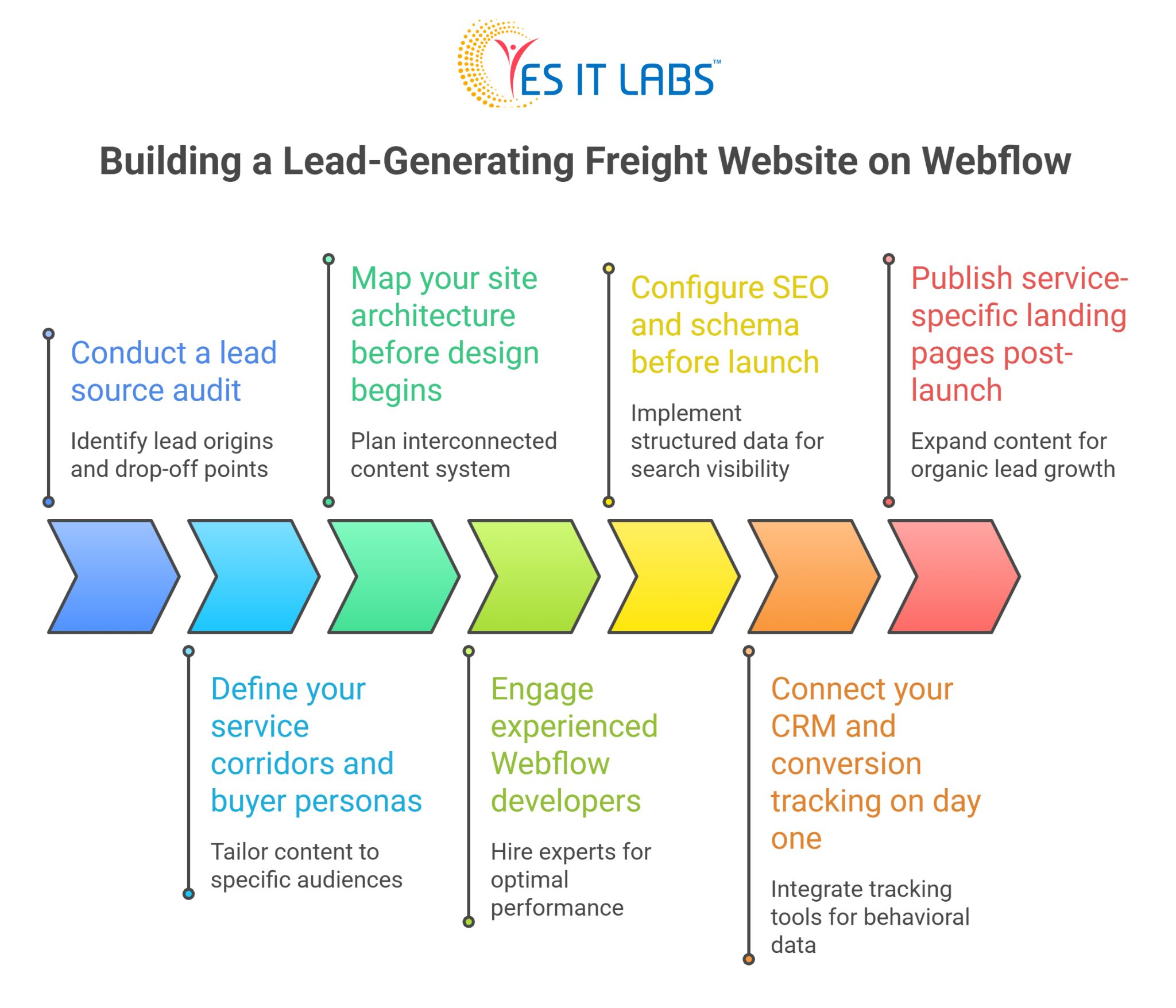
How to Build a Lead-Generating Freight Website on Webflow: Step-by-Step
1. Conduct a lead source audit
Identify where your current leads originate, which pages they visit before converting, and where drop-off occurs in your inquiry process. This data shapes every subsequent decision.
2. Define your service corridors and buyer personas
A freight company serving Gulf Coast petrochemical shippers has a fundamentally different audience than one focused on last-mile retail delivery in the Northeast. Your site should speak directly to that specific buyer.
3. Map your site architecture before design begins
Plan your service pages, coverage area pages, and industry vertical pages as a connected content system, not as isolated pages. Google’s Natural Language API can help identify the entities and topics your target buyers associate with your services.
4. Engage experienced Webflow developers
If your team lacks in-house Webflow expertise, hire webflow developers who have direct B2B or service-industry Webflow experience. Developers new to the platform frequently underestimate its CMS logic and build sites that look polished but underperform in search.
Learn exactly what to look for before you bring someone on board. Read our guide on how to hire the best Webflow developers.
5. Configure SEO and schema before launch
Implement JSON-LD structured data for your FAQ section, service pages, and any HowTo content. This signals content structure to Google and improves eligibility for rich snippet placements in search results.
6. Connect your CRM and conversion tracking on day one
Webflow integrates cleanly with HubSpot, Google Tag Manager, and Hotjar. Launch with heatmaps and session recordings active so you have behavioral data from the first week of traffic.
7. Publish service-specific landing pages post-launch
Use Webflow’s CMS to build out coverage area and industry vertical pages systematically after launch. This ongoing content expansion is what compounds organic lead volume over six to twelve months.
FAQ: Webflow Website Builder for Freight Companies
Why is Webflow a better choice than WordPress for freight company websites?
Webflow produces faster pages, cleaner code, and requires no plugin maintenance, which are all factors that directly improve Google PageSpeed Insights scores and Core Web Vitals performance.
WordPress can match Webflow’s output with expert configuration, but that requires ongoing developer involvement that most freight companies cannot sustain internally. For teams that want performance without constant maintenance overhead, Webflow is the more practical long-term platform.
How does a better website directly increase freight leads?
A better website reduces friction at every stage of the buyer journey. Faster load times lower bounce rates. Clear service pages improve search visibility for high-intent queries.
Optimized inquiry forms increase submission rates. Research across B2B industries shows that improving landing page user experience can increase conversion rates by 200% or more. When these elements work together, the same traffic volume produces significantly more qualified inquiries.
What should freight companies look for when hiring a Webflow developer?
Look for developers with a portfolio of B2B or logistics-sector Webflow projects specifically. Ask about their process for SEO configuration, CMS architecture, and third-party integrations. A strong Webflow developer will ask about your lead generation goals before discussing visual design. Technical execution matters, but strategic thinking separates high-performing Webflow builds from those that simply look good.
How long does a proper Webflow freight website build take?
A well-scoped Webflow build for a freight company typically takes six to ten weeks from strategy to launch. This timeline covers discovery, wireframing, design, development, content migration, QA, and SEO configuration including schema markup. Compressed timelines usually result in sites that miss conversion opportunities because the strategy phase was sacrificed for speed.
Can Webflow support the complex service pages freight companies need?
Yes. Webflow’s CMS supports dynamic content collections that allow freight companies to build templated structures for service pages, geographic coverage areas, industry verticals, and case studies. Once the template is configured, adding new pages requires no developer involvement, giving marketing teams full publishing control without writing code.
Conclusion
Freight companies that invest in a properly built Webflow website are not simply upgrading their visual presence. They are building a compounding lead generation asset. The combination of page performance, native SEO control, CMS scalability, and integration flexibility makes Webflow one of the most practical platforms for freight businesses serious about growing their digital pipeline.
The freight companies winning new contracts through organic search and referral traffic are not doing anything mysterious. They built better websites, on stronger platforms, with clearer strategy behind every decision. That is a repeatable formula, and Webflow provides a proven foundation to execute it.