

A face-swapping illusion can unlock childhood memories
By making people feel as if they inhabit a younger version of their own face, researchers can bring childhood memories into sharper focus
Anastasiia Sienotova/Getty Images
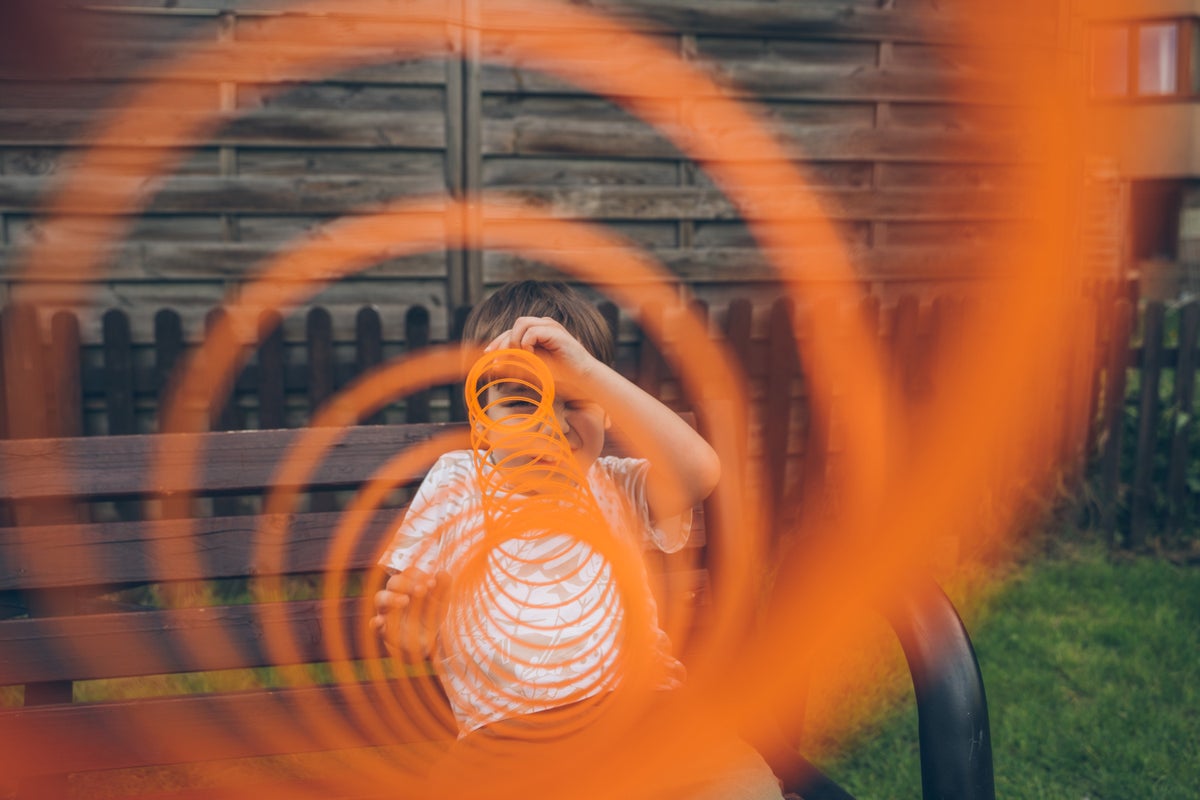
One of the frustrations of getting older is that some early memories seem to dim and fade with time. The details of cherished, sun-drenched days spent at the seaside as a child seem to dissolve away, like sea foam on the beach, as the years pass. Might there be a way to recover them?
Scientists call these recollections of distinct events and experiences from our own lives “autobiographical episodic memory.” It enables us to mentally time-travel to the events of our past, allowing us to experience sensory details of things that we’ve seen, heard, tasted, touched, and smelled and the emotions that we felt at those times. But what of the body we used to inhabit? In every past (and present) moment, our brain receives a rich, continuous set of multisensory signals from our body—including those tied to bodily states. Our memories of the past should also encode the type of body we had at different ages, when different memories were laid down—though there has been surprisingly little research on this so far.
As neuroscientists, we wondered whether we could use this brain-body connection to jog long-lost memories—by getting people “back inside” the bodies they had at younger ages. In a unique experiment, we found that temporarily changing one’s perceived body affects access to memories from specific periods in life. We showed that a subtle illusion, in which participants viewed a childlike version of their own face that moved in synchrony with their own, as in a mirror reflection, could enhance people’s recollection of early memories.
On supporting science journalism
If you’re enjoying this article, consider supporting our award-winning journalism by subscribing. By purchasing a subscription you are helping to ensure the future of impactful stories about the discoveries and ideas shaping our world today.
The brain is constantly monitoring the body. Specialized brain regions create maps of the body’s position, form and physical state—including all of its sensory inputs. Neuroscientists call this mental representation the bodily self. For a long time, scientists assumed that this representation was relatively unchanging. But findings over the past few decades show that the bodily self is surprisingly malleable. The brain constantly updates this self-representation in response to what a person sees, feels and hears.
Scientists can purposefully shift someone’s representation of their body by creating scenarios that “trick” the brain with mismatched sensory information. In the classic rubber hand illusion, for example, a person sees a rubber hand being touched and, in synchrony, feels their own hand being touched, causing them to feel the fake hand is part of their body. Newer techniques using virtual reality push this even further. In the so-called full-body illusion experiments, participants can feel as though they are inhabiting and owning an entirely different body. And in the enfacement illusion, people can momentarily experience another face as their own.
Together, these alterations reveal that our sense of bodily self is not rigid but can be reshaped, at least for a short time, by changing the information the brain receives.
In our study, we took advantage of this to make people feel younger. We invited 50 healthy adults to participate in an online experiment in which we used an enfacement illusion to generate a sense of ownership of a younger version of their face. Participants saw a real-time video display of their own face on a screen. Half of our participants saw their face in a totally unaltered way. But the other half, thanks to an image filter, saw a younger, childlike version of themselves. When participants moved their head from side to side while watching the synchronized video display, they tended to experience a strong illusion that the younger face was their own.
After moving their head and observing the display, participants had to recall childhood or recent memories in as much detail as possible. We then asked people a series of structured questions about these recollections (the “autobiographical memory interview”). After gathering responses, we asked two raters, who did not know which specific conditions participants had experienced before sharing memories, to score the responses using a numeric scale that quantified how rich and vivid these recollections were. Although we cannot know how accurate these memories might have been, this interview technique still offered us a robust way to compare the vividness of people’s remembrances.
We found that people recalled significantly more details of childhood memories after viewing a younger face than they did after viewing their unaltered appearance. Participants retrieved richer, more vivid details, including recollections of specific places, emotions and sensory perceptions. This effect was specifically found for childhood memories and not for recent ones, suggesting the illusion taps into a deep connection between body representations and memories anchored in the past.
The findings point to a fascinating idea that the brain doesn’t just store information tied to past events as raw sensations but also anchors them to memories of the body that people had when those events occurred. Since altering body perception can enhance access to older memories, it can be argued that the bodily self isn’t just a backdrop but instead is foundational to how memories are encoded and organized in the brain.
The results don’t just demonstrate a cool memory trick. On a fundamental level, they suggest a deep entwining of the body and our sense of self—that the changes our bodies undergo over time are not separate from our mental evolution. Future research may explore strategies to support people with challenges in accessing memories, such as people living with dementia or brain injury. If the brain links early memories to body representations, targeted illusions or sensory interventions could one day assist with therapeutic memory retrieval.
Memories are not simple isolated data points stored in the brain. They are complex representations connected to how people perceived their own bodies at different periods of life. In reconnecting with the bodies of the past, people may reopen doors to the memories that shaped them.
It’s Time to Stand Up for Science
If you enjoyed this article, I’d like to ask for your support. Scientific American has served as an advocate for science and industry for 180 years, and right now may be the most critical moment in that two-century history.
I’ve been a Scientific American subscriber since I was 12 years old, and it helped shape the way I look at the world. SciAm always educates and delights me, and inspires a sense of awe for our vast, beautiful universe. I hope it does that for you, too.
If you subscribe to Scientific American, you help ensure that our coverage is centered on meaningful research and discovery; that we have the resources to report on the decisions that threaten labs across the U.S.; and that we support both budding and working scientists at a time when the value of science itself too often goes unrecognized.
In return, you get essential news, captivating podcasts, brilliant infographics, can’t-miss newsletters, must-watch videos, challenging games, and the science world’s best writing and reporting. You can even gift someone a subscription.
There has never been a more important time for us to stand up and show why science matters. I hope you’ll support us in that mission.