
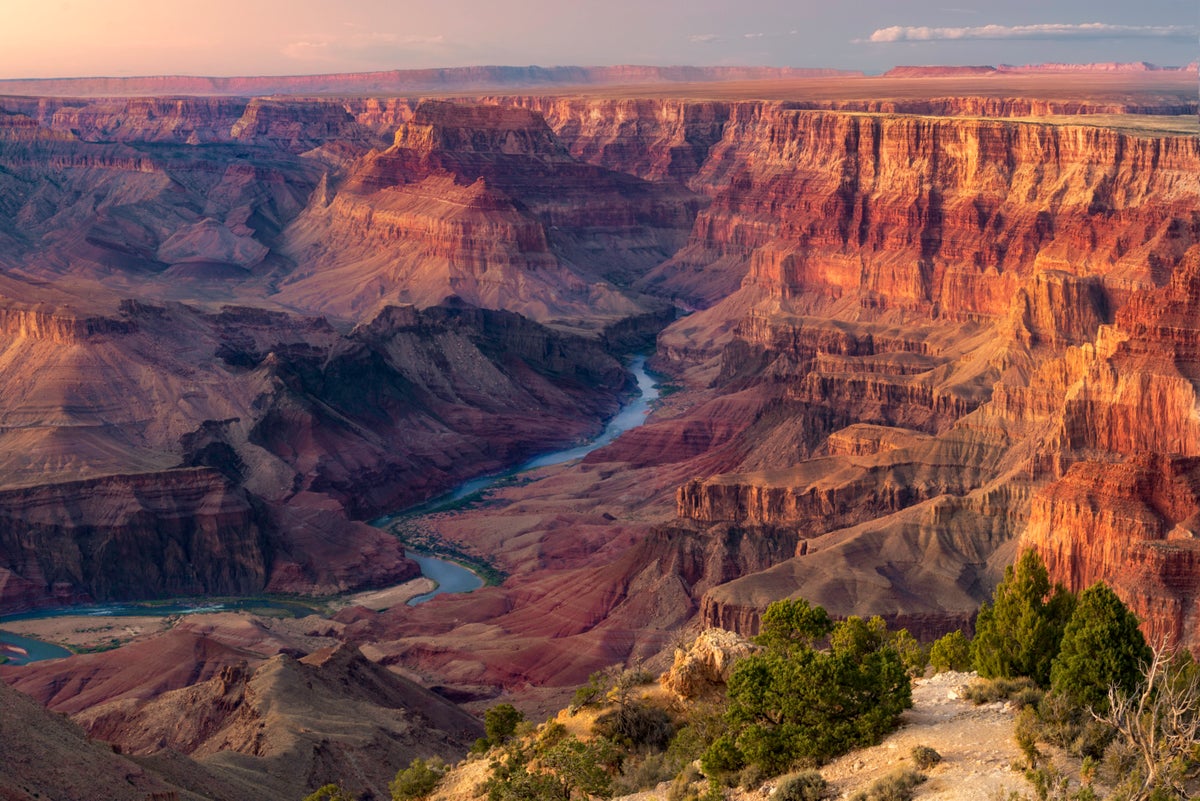

The mystery of how and when the Grand Canyon formed gets a new clue
A new study suggests a proto–Colorado River filled a large basin before spilling westward to set the Grand Canyon’s modern path
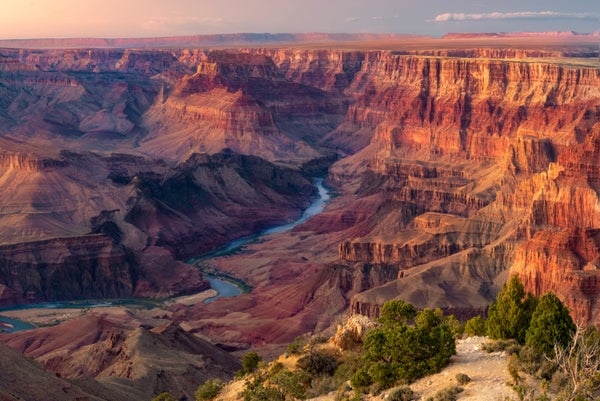
A colorful sunset overlooking the Colorado River deep in the Grand Canyon.
The Grand Canyon draws more scientific attention than just about any stretch of river-carved rock in the world, yet it remains steeped in mystery. After decades of debate, geologists still don’t agree on the most basic facts: How and when did it form?
A paper published today in Science marshals fresh evidence for the old—and controversial—spillover hypothesis. Around 6.6 million years ago, the authors argue, an ancestral Colorado River began draining into northern Arizona’s vast Bidahochi basin. As the basin filled with water, it formed an enormous lake that eventually spilled over its barrier into what would become the Grand Canyon. That established the river’s present-day course, along which it began to sculpt one of the most magnificent landscapes on Earth.
The study got its start when co-author Brian Gootee, a geologist with the Arizona Geological Survey, noticed a resemblance between sand deposits downstream of the Grand Canyon and in the Bidahochi—both contained pink, rounded grains that seemed to have been transported by the same river. By dating durable zircon crystals from the two deposits, researchers confirmed that they both originated in rocks throughout the Colorado River watershed. (A previous analysis found no match between these deposits, possibly because its Bidahochi samples came from a local stream rather than the Colorado River.)
On supporting science journalism
If you’re enjoying this article, consider supporting our award-winning journalism by subscribing. By purchasing a subscription you are helping to ensure the future of impactful stories about the discoveries and ideas shaping our world today.

At Roberts mesa the contrast between the dark red mudstone beds and the tan sand-dominated layers above marks the arrival of Colorado River sediment into the Bidahochi basin 6.6 million years ago.
Brian Gootee and the Arizona Geological Survey
In other words, the Bidahochi once held water from the same river that later surged through Grand Canyon country. What’s more, the Colorado River–derived sand deposit reaches high enough that the authors believe it could have overtopped the Kaibab uplift, a dome of rock separating the Bidahochi from the Grand Canyon. To co-lead author Ryan Crow, a geologist with the U.S. Geological Survey, this suggests an obvious conclusion: “It’s clear that this lake had to have played a role in the formation of the canyon,” he says. It’s not clear, however, whether that process involved catastrophic flooding or only gradual erosion.
The study doesn’t decisively rule out other contributing factors. Geologists have proposed many potential mechanisms for the canyon’s creation: maybe water dissolved a cave network until the roof collapsed, exposing an incipient gulch; maybe a small drainage eroded upstream until it captured the Colorado River, sucking the mighty waterway into its own channel. But Crow argues that, given the available evidence, “spillover of this large lake is perhaps an easier and much simpler and more likely mechanism.”
Not everyone is persuaded. Karl Karlstrom, a geologist at the University of New Mexico, agrees that a proto–Colorado River entered the Bidahochi. But he’s not convinced that this river formed a sizable lake or, if it did, that said lake was the main catalyst in creating the Grand Canyon. “The key details of [the authors’] proposed lake spillover conclusion remain untested,” he says. Moreover, Karlstrom says the study does little to address his own view: long before the Colorado River arrived in the Bidahochi basin, an older “paleocanyon” had already cut a path across the Kaibab uplift. If he’s correct, the river likely couldn’t have pooled to the elevations claimed in the new study—it would’ve flowed right through.
In any case, the new work partly resolves a long-standing conundrum about the Colorado River itself. Geologists broadly agree that it was flowing through western Colorado by 11 million years ago and that it didn’t wind its way to the western edge of the Grand Canyon until 5.6 million years ago. But that timeline left some five million intervening years unaccounted for—where did the river run, if not along its current course? Now that we can place it in the Bidahochi basin 6.6 million years ago, one crucial gap has been filled. “I think that is a major piece in the puzzle,” Crow says, “that will allow us to continue to learn about the history of this continental-scale river system.”
It’s Time to Stand Up for Science
If you enjoyed this article, I’d like to ask for your support. Scientific American has served as an advocate for science and industry for 180 years, and right now may be the most critical moment in that two-century history.
I’ve been a Scientific American subscriber since I was 12 years old, and it helped shape the way I look at the world. SciAm always educates and delights me, and inspires a sense of awe for our vast, beautiful universe. I hope it does that for you, too.
If you subscribe to Scientific American, you help ensure that our coverage is centered on meaningful research and discovery; that we have the resources to report on the decisions that threaten labs across the U.S.; and that we support both budding and working scientists at a time when the value of science itself too often goes unrecognized.
In return, you get essential news, captivating podcasts, brilliant infographics, can’t-miss newsletters, must-watch videos, challenging games, and the science world’s best writing and reporting. You can even gift someone a subscription.
There has never been a more important time for us to stand up and show why science matters. I hope you’ll support us in that mission.