
Editor’s note: The below interview contains spoilers for The Pitt Season 2 finale.
Now that Noah Wyle and R. Scott Gemmill‘s hit HBO medical drama The Pitt has finally reached its Season 2 finale, it feels like both viewers and characters alike can breathe a sigh of relief. Some of that might have to do with the fact that the hospital’s network is finally back online, right as the night shift crew clocks in to relieve the nurses and doctors who have faced any number of stressors — and one of the show’s newest additions is definitely bringing some much-needed “calm, cool, collected, and confident” energy.
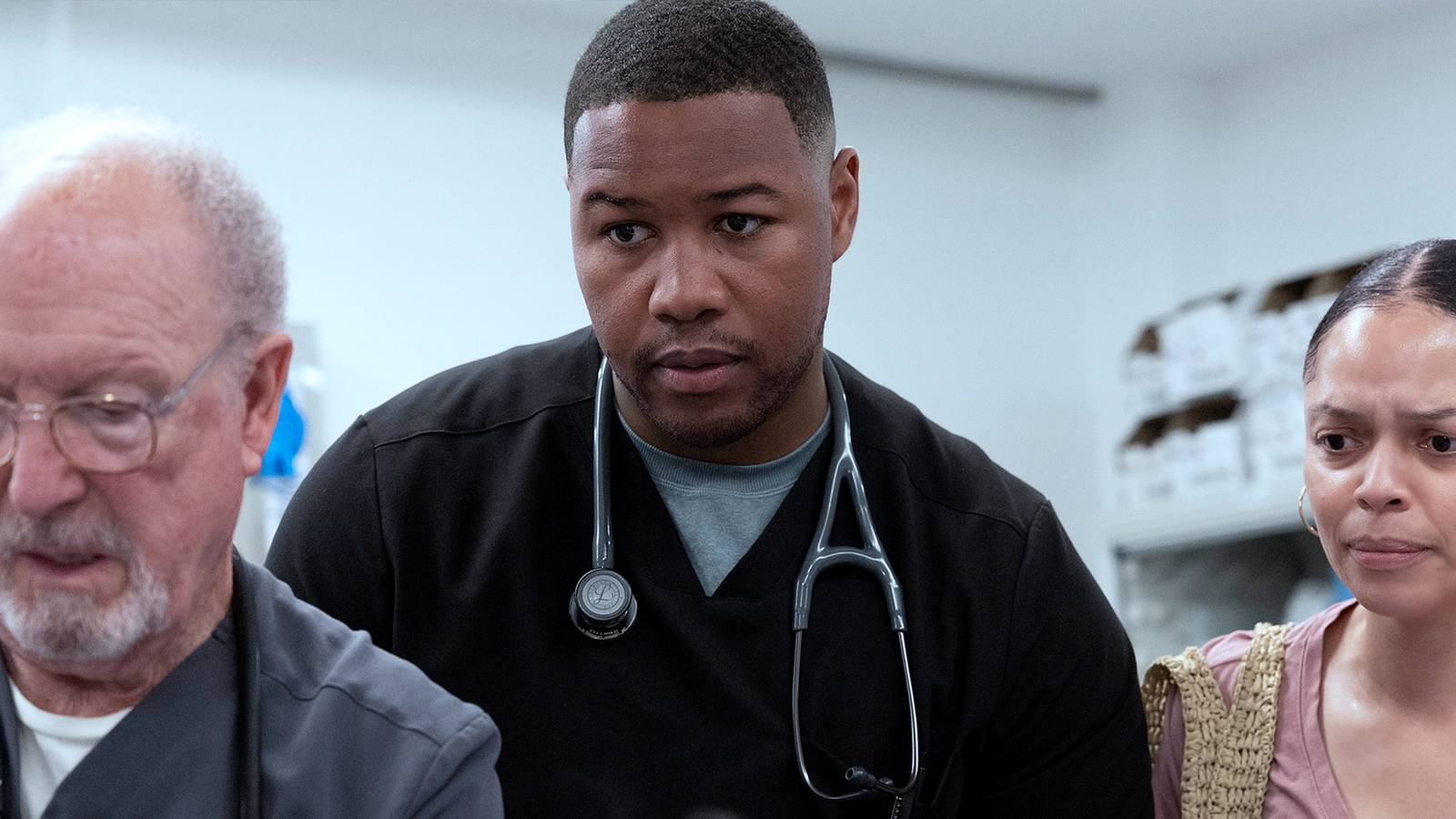
Luke Tennie hadn’t even watched any of his Season 2 episodes when Collider caught up with him to chat about joining The Pitt, but he was excited for everyone — friends and family included — to watch his character, fourth-year resident Dr. Crus Henderson, finally roll into the emergency department of the Pittsburgh Trauma Medical Center. Ahead of the finale’s premiere, Tennie discusses his experience of being on three of the best shows on TV right now — The Pitt, Abbott Elementary, and Shrinking — as well as which nickname gave him the most insight into Crus, the dynamic he established with co-star Patrick Ball, the experience of rehearsing and filming Season 2’s most visceral patient surgery, and more.
COLLIDER: How does it feel to be on three of the best shows on TV right now?
LUKE TENNIE: I mean, good. That’s nice. They’re all good for different reasons. Shrinking is this true union of drama and comedy, [Abbott Elementary]’s this hard comedy titan, and then The Pitt is the freaking Pitt. So, I can’t complain. Not only can I not complain, I can’t even fathom how I’m the guy who won the lottery three times — on the same lot! WB, man. So, I’m hype about it and really grateful.
In The Pitt, it’s not like someone shows up, and you learn their whole backstory in this huge infodump. Were you armed with any backstory for your character? Were you given leeway to make decisions about who this guy is in his off-time?
TENNIE: The most I learned about this dude was the character breakdown and the action lines. “Crus calmly… Crus, with confidence…” That’s pretty much it. So I know he’s calm, cool, collected, and confident. That’s a lot of Cs. He’s somebody who’s got a great ease about him in the ER. That’s an energy I didn’t see in Season 1. Abbot’s kind of got something like that, but he’s also somebody who’s supposed to mirror Robby, so he’s on the razor’s edge, as well.
I think they wanted a cool sort of counter for Langdon’s character, because he’s somebody who’s obviously an exceptional doctor. The goal when a doctor struggles the way Langdon did is to keep that doctor, because you want to keep people in medicine. You don’t want to lose people who can help people maintain their lives. But yeah, with Crus, he’s sort of the opposite of that wiry, as Langdon mentioned, ADHD sort of approach. He’s just the guy who’s always going for customer satisfaction. He wouldn’t be able to get that unless he’s calm, cool, collected, and confident. That’s Crus! Another C. The thing that taught me the most about the dude was his intro. Crus Control. That right there sums up who that guy is. You can relax, because we on Crus Control.

‘The Pitt’s Katherine LaNasa and Patrick Ball Reveal Why Dana and Langdon Are Still Struggling After Season 2’s Time Jump
LaNasa and Ball also discuss Dana’s lingering trauma and Langdon’s post-rehab journey.
I previously spoke with Taylor Dearden about the transition that happens on set when the night crew rolls in. Do you feel like the set experience actually mirrors what your character’s experiencing in terms of coming in and having to start when things have already been cooking for however many hours? Do you use that to fuel the performance, too?
TENNIE: It’s great because on The Pitt, continuity is such an important part of it. You can track how specific this team is throughout the course of the day on The Pitt. You’ll see a couple of flyaways on a couple of heads that you didn’t see at the top of the shift, and that’s intentional because that scene might have been the first scene they shot that day, but they built in the flyaways because canonically in the story, chronologically, it’s been seven hours since the shift started.
We come in, the night shift, and they’re doing us all fresh-faced. That’s the morning for us. It really does feel that way, because you’re meeting the actors, and even the way they tease a little bit of the hair getting loose from the ponytail, it’s subconsciously telling you, even though it’s 8:00 a.m., it’s the end of the day. And then the hospital kind of breathes, you know? It’s like you can tell it’s getting ready to inhale again. It’s trying to catch its breath. Just because of the state of the continuity, that’s so specific that there’s a lot you don’t even have to act. You just react to what’s actually in front of you, which is really nice for an actor. The least amount of acting actually makes your job easier. When you don’t have to act like you’re wearing scrubs because you are wearing scrubs, it’s great. When you don’t have to act like the stethoscope is real, because it is a real stethoscope, it’s great. You can actually just listen for a heartbeat.
The only thing that we ain’t doing for real is cutting people up, because that’s a different show and it’s not on HBO. In our show, we like to make sure everybody’s safe. That’s the only thing that we take very, very seriously regarding actors’ safety. A lot of the stuff that we use, it’ll be a real scalpel; it’ll be dulled, but it’s still a real scalpel. So, if you work it, it’s like a knife. You gotta be careful. There’s a lot you don’t have to act. If you know that the scalpel will tear the prosthetic, then you need to be careful, because the prosthetic imitates real skin, as well. There’s so much that you don’t have to act that the acting that we have to do, that’s really required of us to bridge the gap. We’re so far immersed in reality that by the time we get there, your brain is creating a reality. It’s pretty exciting.
‘The Pitt’s Luke Tennie Reveals the One Season 2 Moment When Crus Loses His Cool
“Oh, shoot, Crus Control ain’t got control? This is serious.”

We’ve been talking about the cool, calm, collected guy that you’re playing, but you are at the center of some pretty high-tension patient scenes in the back half of Season 2. Do you feel any added pressure in the moments when you have to play somebody who not only has to keep his own head on straight, but sometimes has to guide someone else?
TENNIE: One of my favorite moments was when I got told by our lovely director Uta [Briesewitz] that there is a moment where Crus is not calm, and that moment takes place when Langdon identifies a possible C-spine for the paralysis patient. I hope it came across because the first few takes, I was like, “Oh, this is Crus. He’s like, ‘Yo, we’ve got to fix this,’” and he’s locked in. But what happens in that regard is they teed me up in the script, and I didn’t recognize it, so I’m glad I had Uta there to help me.
I was coming out of the elevator with this guy after he just got back from his CAT scan, and Garcia’s leaving. I bump into her on the way out. I’m like, “Oh, the surgeon’s leaving?” I start getting a little nervous. We go in there, and I’m telling Langdon about it. I’m getting a little bit more nervous the more I tell him about it. Then the more he talks to the patient, I’m like, “I’m out of my depth here. This is something a neurosurgeon would need to handle, and I just watched the surgeon leave in the elevator. Now I’m the kid, and my parent went to go get shaving cream, and I’m at the checkout line, and the cashier is looking at me. Everything’s scanned, and I’m like, ‘Yo, I need somebody here who can pay!'” So, that’s kind of what happened in that moment.
When Langdon steps up, it’s really exciting because, instead of the attending physician coming in and being like, “Hey, I can pay,” the attending physician comes in, and he goes, “Hey, one of you has some experience. Get to work.” So we’re all flying by the seat of our pants. That’s when Robby comes in, and he’s the one who’s calm, cool, and collected. I haven’t seen any of it. In that scene, it all comes across as, like, “Oh, shoot, Crus Control ain’t got control? This is serious.” And that was one of the coolest things we got to shoot because the surgery was purely physical. It didn’t involve no scalpels, no ultrasound, no X-rays. It was all just a physical surgery, which is really exciting to play.
In terms of surgery, one scenario that takes a turn for the worse really quickly is the patient with the wild pregnancy who ends up having pre-eclampsia. It really feels like it’s a whole avalanche leading to that emergency C-section. Do you remember how many days of filming it took for that sequence?
TENNIE: It was like a week and a half. To shoot an episode of The Pitt, it’s like two weeks, so like 75% of that episode was that surgery. It was electrifying, man. It was so exciting to see all the moving pieces come together.
It’s weird, but sometimes I feel like the more people you add to a scene, it kind of lessens the percentage one actor has to carry, and we had, I don’t know, everybody in that room. So each one of us has like 5%, as opposed to, say, a two-hander, and each actor has 50%. Or it’s just you onscreen, like a lot of the time it is for Noah [Wyle], and he’s just walking around carrying 100% of the show for this long. It’s really interesting to see that. But that’s the teeniest team win I’ve seen on The Pitt, and the fact that I get to be a part of it is something that I just giggle at the thought of finally being able to see. Oh man, I can’t believe it’s finally this Thursday, man. Everybody’s been hassling me, like, “Yo, where is this Crus we’ve heard so much about? Is he on the way?” Sit tight!
‘The Pitt’s Most Intense Patient Scene Was Rehearsed in the Background of Season 2
“The reason why the rehearsals work is because they take place during shooting…”

Is there a lot of rehearsal involved in a sequence like that? It’s not just high-pressure in terms of energy and tension, but then there are so many bodies in the room.
TENNIE: We didn’t have very long. The reason why the rehearsals work is because they take place during shooting, and that’s it. There will be people down the hall shooting a scene for the show, and we’re in a trauma room acting kind of like background when they’re shooting. When the cameras are off of us, we’re all whispering and working through the sequence, running dialogue, and running the movements, the motions, doing the handoffs.
One of my homies [Xavier Avil], who plays Medic Spratt, he’s this real handsome African American medic. He got the arms that look like Dwayne Johnson on him. You seen him? He and I went to the same college. He said it’s a “chaotic symphony.” Because he was there in Season 1, so he had done a little bit of work on the show before. He had come up with that phrase he used to describe it. Man, there’s nothing more accurate. It’s a chaotic symphony. Shoutout to him. He did a great job. I want to shout out Kacie Rogers, as well, who played my sister in this cool short that we just did, but we also had a couple of scenes on The Pitt. She’s one of the best actors I’ve ever seen. She’s great.
There’s definitely a big emphasis on practical effects and prosthetics, and making a scene feel as real as possible. It just feels like there’s something really tangible about that scene where everybody’s hands are involved, not to mention the baby.
TENNIE: I wish I had the crew list in front of me. I’m not remembering any of our visual department teams’ names, but it is done so well practically, I would venture to say about 5% of computer graphics is needed. That’s probably why they’re able to churn the show out so much. They just try to get it in a camera. Say you have to repeat something a couple of times, like if you have to make an incision, usually the prosthetics will have an incision, and the after effect they’ll do is the scalpel entering the skin but revealing the prosthetic that is already open. It’s like this true marriage — just a tiny amount of visual effects at the top, and then you’re in camera. That’s why it feels real, because usually the first or maybe second thing that you’re seeing is computer graphics, and then you’re just seeing what we did.
For the baby stuff, I don’t know if they used any computer graphics. We’re pulling a baby out of a stomach and setting it on the table. Like, that’s legit. That was some of the coolest visual effects work I’ve ever seen. I’ve seen some creature stuff up close, like for thriller horror movies; it’s different seeing what doctors would see. At the time, when I was doing that scene, we were two weeks out from the birth of our secondborn. Actually, getting close to the end of that episode, after we’d finally wrapped up that scene, I was like, “This baby can come any day now. I hope this baby doesn’t come when they need me in this O.R., because Daddy’s got to go to the O.R..” But it all worked out. There was a day of rest, and then my kiddo came the next day. We had a break on Saturday, she came on Sunday. It was insane.
‘The Pitt’s Luke Tennie Reveals His Wishlist for Season 3
“What does he feel like he can contribute? Where does he want to go?”

Perfect timing! At this point, in terms of Season 3, there’s probably not much you can say or even know. Fans definitely love seeing the night shift crew roll in, and it’s really great to see you get to be a part of that. Do you have anything on your personal wishlist for Crus Control in a third season?
TENNIE: Honestly, character relationships. Something that I think is really cool about Patrick [Ball] is when we were putting together our intro, he’s like, “Well, I’ve been held back, man. So, if you’re a fourth year and I’m a fourth year, I’m supposed to be fifth, so you were coming up under me, and now we’re on the same level.” And I was like, “Oh, this is an actor right here. He’s digging into these character relationships.” I love to hear it. I want to explore that some more.
I want to know, yo, does [Crus] know about Langdon’s issues? The details? Because as we’re learning about stuff on Season 2, it’s like, “Hey, some people feel some type of way. You know about the beef with Santos?” Because I got a little scene with [Isa Briones], I’m familiar with her character. The character relationships are something I’m interested in seeing. Like, what’s this dude up to in terms of what he wants? We know he’s doing an ultrasound fellowship. Why does he want that? What does he feel like he can contribute? Where does he want to go? Does he want to stay here in emergency medicine? Does he want to change? That’s the kind of stuff I want to find out.
Both seasons of The Pitt are available to stream on HBO Max.