
After reciting Tashahhud, Ta‘awwuz and Surah al-Fatihah, His Holiness Hazrat Mirza Masroor Ahmad (aba) recited the following verses of the Holy Qur’an:
‘Say, ‘If Allah had so willed, I should not have recited it to you, nor would He have made it known to you. I have indeed lived among you a whole lifetime before this. Will you not then understand?’ Who is then more unjust than he who forges a lie against Allah or he who treats His Signs as lies? Surely, the guilty shall never prosper.’ (The Holy Qur’an 10:17-18)
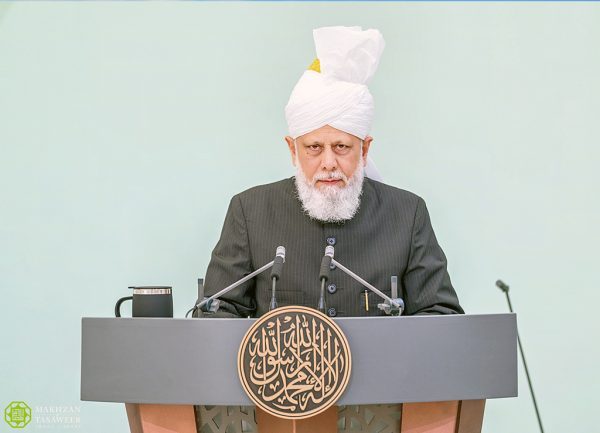
His Holiness (aba) said that in continuation of mentioning various aspects of the life of the Holy Prophet (sa), His Holiness (aba) would today mention the Holy Prophet’s (sa) moral character and truthfulness. His truthfulness was of the highest standard, to the degree that even his enemies attested to his high degree of truthfulness. The above verses attest to the truthfulness of the Holy Prophet (sa), something which God instructed the Holy Prophet (sa) to convey to the people as a proof of his truthfulness. Similarly, it hence became incumbent upon his followers to uphold the highest degree of truthfulness in order to be his true followers.
Enemies of the Holy Prophet (sa) Attest to His Truthfulness
His Holiness (aba) quoted Hazrat Mirza Bashiruddin Mahmud Ahmad (ra), who wrote that once there was a planned gathering in Makkah. The Makkans thought to come together and devise a single response they would all give when people from outside Makkah arrived and asked about the Holy Prophet (sa). One of the Makkans suggested telling people that the Holy Prophet (sa) was a liar. However, another Makkan stood up and said that they could not say this, because no one would accept this. In fact, people would say that Muhammad (sa) grew up among them and was known as the most truthful and trustworthy, to whom they entrusted their trust. Now, when he became older and brought the message of Islam, they called him a liar. This could never be accepted. And how true this attestation of his truthfulness was.
His Holiness (aba) said that when Heraclius was questioning Abu Sufyan about the Holy Prophet (sa) and asked whether the Holy Prophet (sa) ever lied, even Abu Sufyan replied by saying that ‘Till now, he has not told a lie.’ He had to attest to this, and used the words ‘Till now’ only as a ploy to create some form of doubt. Similarly, when the Holy Prophet (sa) gathered the people of Makkah at a mountain and asked them whether they would believe if he told them that there was an army on the other side of the mountain ready to attack them, they unanimously said that indeed they would believe him because they knew him only to be truthful. They accepted this even though they knew it was impossible for an army to be on the other side of the mountain; however, they also knew that the Holy Prophet (sa) had always been truthful and trustworthy and would never tell a lie.
Strength Is Granted to the Truthful
His Holiness (aba) said that thus, a person’s conduct and morals should be such that they leave a positive impression. It is thus that paths for propagating the message of God and His true religion can open up. As the Promised Messiah (as) explained, the fact that the Holy Prophet (sa) had established such lofty standards of morality and truthfulness that he was able to impact and influence, through his character, even the greatest of enemies. Indeed, he was able to overcome them because, as is God’s practice, when there is a dispute between two sides, He grants strength and victory to the side that is most truthful and most morally sound.
His Holiness (aba) quoted the Promised Messiah (as) who said that God attested regarding the Holy Prophet (sa), ‘And thou dost surely possess high moral excellences.’ (The Holy Qur’an, 68:5). This means that the Holy Prophet (sa) possessed all good qualities to the highest degree. Indeed, it means that all such qualities which are naturally found in a person, such as truthfulness, kindness, compassion, loyalty, justice, etc., should be expressed at the right place and the right time, which will then constitute true morality.
Encouraging Others to Follow the Path of Truthfulness
His Holiness (aba) said that the Holy Prophet (sa) was not only truthful himself but enjoined the same to his followers. He said that truthfulness is incumbent because it leads to virtue. One must avoid falsehood because falsehood leads to evil, which leads to the fire. On another occasion, the Holy Prophet (sa) said that there is no instance in which falsehood is permissible, neither in seriousness nor in jest. In fact, a parent should never make a promise to their child which they do not fulfil. People are remembered by their truthfulness or their falsehood.
His Holiness (aba) said that once, a person went to the Holy Prophet (sa) and said that he was having difficulty eschewing habits of drinking alcohol, fornicating, thievery and falsehood. While he wished to adopt virtue, he did not have the strength to leave these habits; so, what was one habit that he could avoid? The Holy Prophet (sa) told him to abandon falsehood. He agreed and departed. Later, when he was offered alcohol, he thought that if he drank it, he would have to tell the Holy Prophet (sa) that he drank it because he had agreed never to lie. Similarly, when he was about to fornicate, he had the same thought of having to tell the truth to the Holy Prophet (sa). Such was also the case when an opportunity to steal came his way. Thus, when he returned to the Holy Prophet (sa), he agreed that indeed, abandoning falsehood brought an end to his other vices as well.
Testimonies to the Highest Degree of His Truthfulness
His Holiness (aba) said that when the Holy Prophet (sa) made his claim to prophethood, Hazrat Abu Bakr (ra) was travelling to Syria. When Hazrat Abu Bakr (ra) was informed of the Holy Prophet’s (sa) claim, he immediately said that if this was the claim which the Holy Prophet (sa) had made, then it would certainly have been true, because the Holy Prophet (sa) was always truthful. He immediately accepted this claim, and upon returning to Makkah, he became the first person to pledge allegiance to the Holy Prophet (sa). This was nothing short of a miracle, because it was solely as a result of the Holy Prophet’s (sa) truthfulness that Hazrat Abu Bakr (ra) accepted Islam right away, without demanding any sign or other proof.
His Holiness (aba) quoted Hazrat Hakim Maulvi Nooruddin (ra), the First Caliph of the Ahmadiyya Muslim Community who said that when the Holy Prophet (sa) went to his wife Hazrat Khadijah (ra) after receiving his first revelation and expressed to her his fear for his life, she supported him, and said that no matter what people might say, God would never disgrace him. This was because he was always kind to his relatives and truthful; he shared in the grief of others, gave to the poor, and was hospitable. This was the testimony of his wife of 15 years. Had he not truly possessed these qualities, then she could not have consoled the Holy Prophet (sa) in this manner.
His Holiness (aba) said that once, a man came across Abu Jahl, the staunchest enemy of the Holy Prophet (sa). This was at a time when, aside from the two men, there was no one else around. At that time, the man asked Abu Jahl what he truly thought about the Holy Prophet (sa) and his claim. Abu Jahl responded that, certainly, he thought that the Holy Prophet (sa) was truthful because he had never told a lie.
His Holiness (aba) said that when the Holy Prophet (sa) arrived in Madinah for the first time, a man saw his face and thought that this was certainly the appearance of someone who is truthful. Then, the first words he heard the Holy Prophet (sa) say were to spread the greeting of peace, feed others, be kind to relatives, offer prayers at night when others are sleeping, and if you do so, you will enter Paradise.
His Holiness (aba) said that the Holy Prophet (sa) advised against even the subtlest of falsehood. Once, when the Holy Prophet (sa) was visiting someone’s home, a mother called her young son over and said that she would give him something. The Holy Prophet (sa) asked what she intended to give him. She replied that she would give him dates. The Holy Prophet (sa) said that had she not given him anything, then this would have been counted as a falsehood on her part. This was the degree to which the Holy Prophet (sa) taught to avoid falsehood.
His Holiness (aba) said that today, it is the duty of every Ahmadi to analyse the standard of their own truthfulness and to do away with any weaknesses. His Holiness (aba) prayed that may Allah enable everyone to do so.
Funeral Prayer
His Holiness (aba) said that he would lead the funeral prayer in absentia of the following member:
Shahida Ahmad
Shahida Ahmad wife of Mirza Naseem Ahmad. She was the great-granddaughter of the Promised Messiah (as). She is survived by four sons. Her sons say she was very loving towards everyone. She was extremely hospitable and wished to expand her home in order to host even more people. She spread her love to all, wealthy or poor. She would find a place in everyone’s heart. She was especially caring toward those facing difficulties and enjoined her children to do the same. She possessed great resolve and determination, something which His Holiness (aba) himself attested to. Her sister says that in a few words, she would describe her with the terms sacrifice, patience, determination and love. She endured her final illness with great patience and without any complaint. She would complete two to three readings of the Holy Qur’an in a single month. She always remained positive and cherished every moment of life. His Holiness (aba) said that he had seen her always maintain a positive attitude, take care of others’ feelings, and never say anything that would injure others’ sentiments. She was among those who carry out virtuous deeds in silence, and they come to be known only when others bring them to light. His Holiness (aba) prayed that may Allah grant her forgiveness and mercy.