
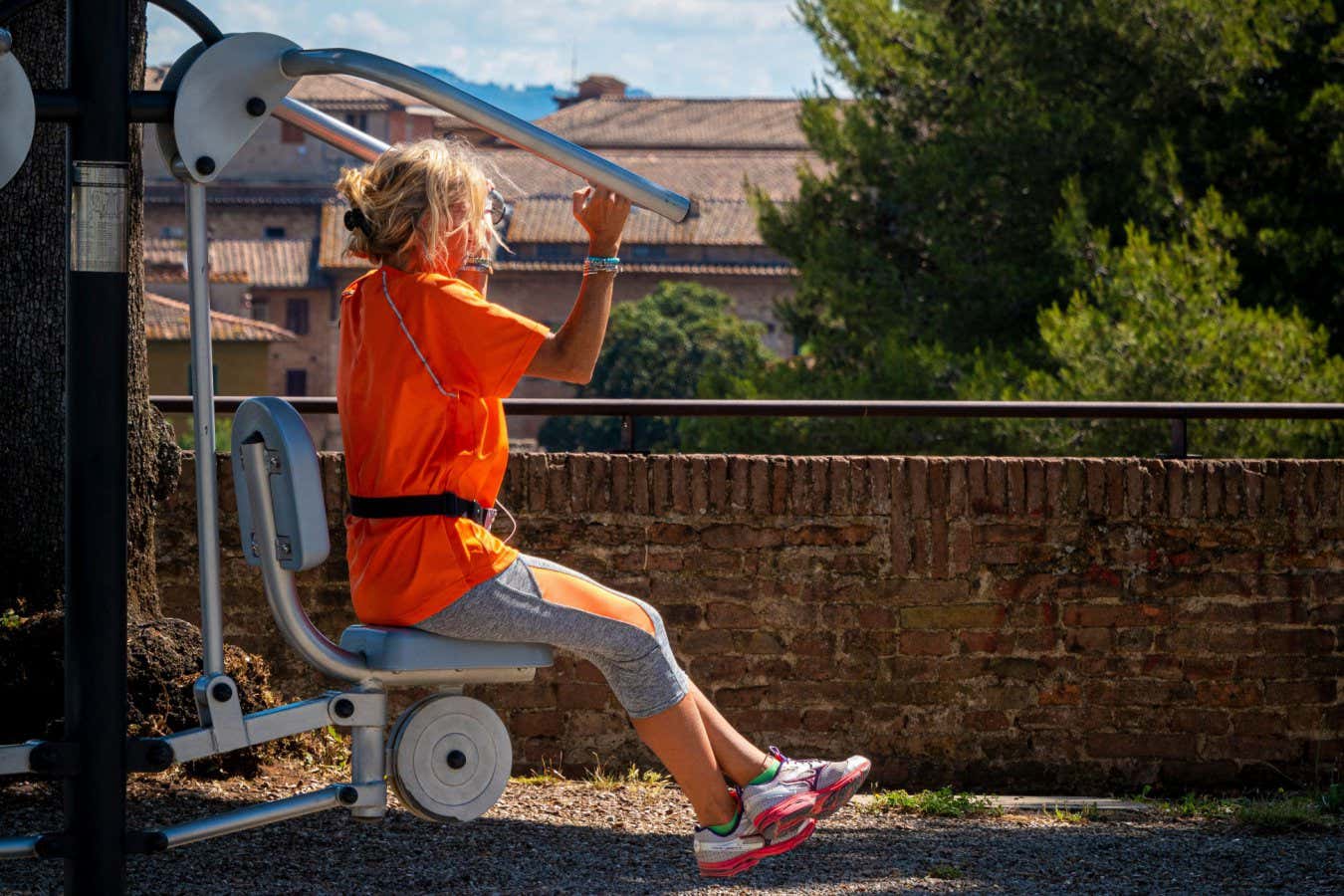

Resistance training has been examined as a possible way to relieve covid-19 symptoms
Bailey-Cooper Photography/Alamy
In the hunt for ways to alleviate long covid – a relatively new condition with no cure, experienced by millions of people worldwide after contracting covid-19 – exercise has been a bright spot. It’s drug-free, it costs nothing and a handful of studies have suggested it boosts long covid recovery. But concern is growing that these studies aren’t robust enough to support exercise as a treatment approach, reigniting a decade-long controversy over the use of exercise in addressing other conditions, such as chronic fatigue syndrome.
“I think there can be no excuse for doing further trials on exercise that don’t make it explicitly clear that if it works, it only works for a subgroup of people and they need to be really carefully defined, and that any results that are presented should not generalise across the entire long covid population,” says Caroline Dalton at Sheffield Hallam University, UK.
One of the highest-profile studies of exercise in long covid was conducted by Colin Berry at the University of Glasgow, UK, and his colleagues. When long covid began to emerge as a post-covid condition in 2020, Berry knew that developing a drug-based treatment for it would take a long time, so he wanted to see if a lifestyle intervention like exercise could help. “It was an open hypothesis,” he says.
So, from 2021 to 2024, Berry and his team asked people with long covid to take part in a three-month resistance training programme, adjusted to their abilities. They found that those who completed the programme could then walk an additional 83 metres on a timed beep test, compared to what they managed at the beginning of the study, versus an extra 47 metres in the control group. The researchers wondered if resistance training rebuilds muscle strength that may have been damaged by covid-19, and concluded in their paper that the intervention may be a “generalizable therapy” for long covid’s physical symptoms, such as fatigue, weakness and impaired mobility.
The study quickly garnered press coverage and was widely discussed on social media. But many scientists have pointed out issues with this trial. Firstly, the difference between the distances walked by the control and exercising groups fell 10 metres short of the minimum threshold for clinical significance chosen by the team at the start of the experiment. “If you don’t achieve the level that’s minimally clinically important, you don’t go around claiming success,” says David Tuller at the University of California, Berkley. In response, Berry says it’s not for us to say whether an individual would benefit from this improved mobility. “I think that’s open to interpretation.”
Secondly, the trial was made up of a diverse group of participants: some had been hospitalised with covid-19 and were still recovering from their hospital stints, while others had had much milder infections. “What you end up with is a mean of the group, and the mean may indicate some equivocal effect,” says Todd Davenport at the University of the Pacific in Stockton, California.
Post-exertional malaise
Perhaps most importantly, the study was patchy in its assessment of one of the most debilitating aspects of long covid: post-exertional malaise. This is a worsening of symptoms, such as extreme fatigue, after exertion that isn’t proportional to the amount of activity that was done. “Post-exertional malaise is the most unifying and profound and debilitating aspect [of long covid],” says Danny Altmann at Imperial College London. “It’s incredibly non-trivial.”
However, post-exertional malaise was only assessed at the end of Berry’s study, when it was seen at similar levels in both the control and exercise groups. Because it wasn’t assessed at the start, it is unclear what effect, if any, the programme had on post-exertional malaise, but there are concerning signs.
The team found that 67 per cent of those who did the exercise programme said they wouldn’t recover within an hour or two of seeing friends or doing activities at the three-month follow-up, compared with 49 per cent in the control group. “So, in a sense, the intervention group is actually doing kind of worse,” says Leonard Jason at DePaul University in Chicago, Illinois, who developed the tool the team used to assess post-exertional malaise.
There have been other hints that exercise might be actively harmful. One 2024 study found that exercise can cause severe muscle damage in people with long-covid-related post-exertional malaise and may negatively affect their mitochondria, which provide cells with energy.
But the study by Berry and his colleagues is far from alone in suggesting that exercise is beneficial for long covid. It was shortly followed by a review of 33 randomised-controlled trials, which concluded that exercise can “significantly improve quality of life” for people with long covid. Yet the review made no mention of post-exertional malaise, which is thought to affect more than 80 per cent of people with the condition.
“The thing that has messed up my life is the post-exertional malaise,” says Margaret O’Hara at the charity Long Covid Support, who has long covid. “So any study which isn’t addressing that is just tinkering around the edges.”
Similarities with chronic fatigue syndrome
This situation is reminiscent of chronic fatigue syndrome, also called myalgic encephalomyelitis (ME/CFS), which may be caused by an infection and commonly involves post-exertional malaise. In 2011, The Lancet published the PACE trial, which concluded that graded exercise therapy – incrementally increasing the duration and intensity of activity from an achievable baseline – moderately improved fatigue and the ability to perform daily tasks in people with ME/CFS.
But that trial has been plagued by criticism ever since. In a letter to The Lancet in 2011, Bart Stouten, an independent statistician, writing with health psychologist Ellen Goudsmit and the then-chairman of the ME Association Neil Riley, pointed out that the researchers behind the trial changed their definition of improvement from its starting protocol to the final paper. Five years later, Tom Kindlon at the Irish ME/CFS Association and his colleagues reanalysed the data according to thresholds specified in the starting protocol and concluded that this change to the definition increased the rate of recovery among those doing the exercise intervention four-fold. “We highlighted that there was minimal or no changes in objective measures, and there was no change in long-term improvement,” says Kindlon.
What’s more, Kindlon, Tuller and their colleagues reported in 2018 that serious adverse events, such as hospitalisation, were twice as high in the graded exercise therapy group as the control one, based on the procedures set out in the PACE trial protocol and data obtained via a freedom of information request. “What we learned from trials of exercise studies in ME is that it’s not a benign intervention,” says Dalton.
When contacted for this article, Peter White – formerly at Queen Mary University of London and one of the lead researchers of the PACE trial, told New Scientist: “All these criticisms are old news, having been made repeatedly over the 15 years since the trial results were published. This is in spite of the fact that we have addressed these criticisms many times.”
However, there is now evidence that exercise causes sustained immune, metabolic and neuromuscular degeneration in people with ME/CFS-related post-exertional malaise. The UK’s National Institute for Health and Care Excellence no longer recommends graded exercise therapy for ME/CFS and says people should manage their energy based on their limits, known as pacing.
A similar approach might now be needed for people with long covid. Davenport and his colleagues have found that people with ME/CFS and long covid experience a similar failure to recover after exertion. “These data suggest we should be as cautious with exercise in long covid as we have come to be in ME/CFS,” says Davenport. “I don’t know how often we need to continue to put our finger on that light socket.”
Untangling the risks and benefits for individual cases
NICE doesn’t recommend graded exercise therapy for long covid, but says other exercise interventions should be investigated. “‘Long covid’ is an umbrella term,” says Dalton. “The question is: who does exercise work for, or does it work for anybody?”
For example, the safety and effectiveness of exercise may depend on the cause of someone’s long covid – for some, it may be brought on by the underlying SARS-CoV-2 virus persisting in their body; for others, it could be the result of their immune system misfiring, their mitochondria becoming dysfunctional or adverse changes to their microbiome. “In order to have any effective studies, they really have to be subtyped by symptoms or subtype the population,” says Tuller.
Studies that cover longer time periods are also crucial, because long covid can ebb and flow. “If I’m in a really bad relapse, if I do any kind of activity, it just keeps making me worse,” says O’Hara. “If you wait a few months, I’ll be a lot better, and if I did an exercise study during that trajectory, it would look like the exercise was working, but I was getting better anyway.”
Mike Ormerod, who has long covid and volunteers at Long Covid Support, says he takes research papers that show the dangers of exercising with post-exertional malaise to all of his medical appointments. “Through our support group, we hear instances of people being advised to do exercise,” says O’Hara. “Most doctors generally believe that exercise is good for you, so they’ll encourage people to be active.”
“The risk is that the message is ‘exercise works for long covid’, and that’s potentially so damaging to the people who have an ME-like phenotype,” says Dalton.
Topics: