
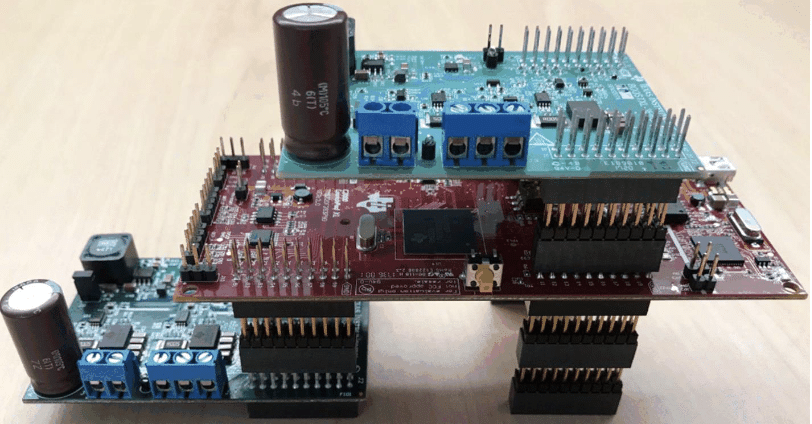
Dual-axis motor control delivers response, speeds, and precision from a single controller using control techniques.
TIDM-02007, a reference design from Texas Instruments (TI) demonstrates a dual-axis motor drive on a single C2000 controller that achieves high bandwidth, low latency, and precise control using Fast Current Loop (FCL) and Software Frequency Response Analyzer (SFRA) technologies. At a PWM carrier frequency of 10 kHz, the system delivers a 5 kHz current loop bandwidth with a 45° phase margin across a wide speed range. This performance can significantly exceed conventional MCU-based approaches, potentially tripling torque response and doubling maximum motor speed without increasing PWM frequency.
The design enables simultaneous control of two motors while maintaining high control bandwidth and fast response. By leveraging parallel processing between the CPU and Control Law Accelerator (CLA), it minimizes the delay between feedback sampling and PWM updates to a few microseconds. This reduction in latency improves modulation index, enhances DC bus utilization, and extends the achievable motor speed range.

A key requirement for high-performance motor drives in applications such as robotics, CNC machinery, servo drive power supply modules, servo drive power stage modules, and vacuum robots is precise control across current, speed, and position loops. The current loop, as the innermost loop, must operate at high bandwidth to support faster outer-loop response. However, in conventional systems, ADC conversion delays and control algorithm execution time typically limit bandwidth to about one-tenth of the sampling frequency.
The Fast Current Loop approach addresses this limitation by tightly reducing the delay between sampling and actuation. In traditional control schemes, this delay can span an entire sampling period, slowing system response. High-performance implementations require latency on the order of a microsecond or less, which is achieved through a combination of fast computation, high-speed ADCs, low-latency control peripherals, and optimized control algorithms.
To ensure accurate current measurement during switching events, the design uses interleaved ADC double sampling between the two motor axes. A fixed 90° phase shift between PWM carriers prevents overlap between sampling and control execution, avoiding back-to-back processing of sampling and field-oriented control. After each ADC conversion, the CPU executes the field-oriented control algorithm and updates PWM signals, ensuring consistent and predictable sample-to-update timing for both motors.
The integrated Software Frequency Response Analyzer tool enables efficient measurement of the system’s frequency response, simplifying tuning of current and speed control loops. The design’s current loop bandwidth and motor operating speed range are experimentally verified, with detailed documentation of test setup, procedures, and measured results.
With its high level of integration and performance, the C2000 series microcontrollers support dual-axis motor drive applications with robust and precise position control. The complete software implementation is available in the C2000Ware MotorControl SDK, facilitating development, validation, and deployment of high-performance motor control systems.
TI has tested this reference design. It comes with a bill of materials (BOM), schematics, assembly drawing, printed circuit board (PCB) layout, and more. The company’s website has additional data about the reference design. To read more about this reference design, click here.