
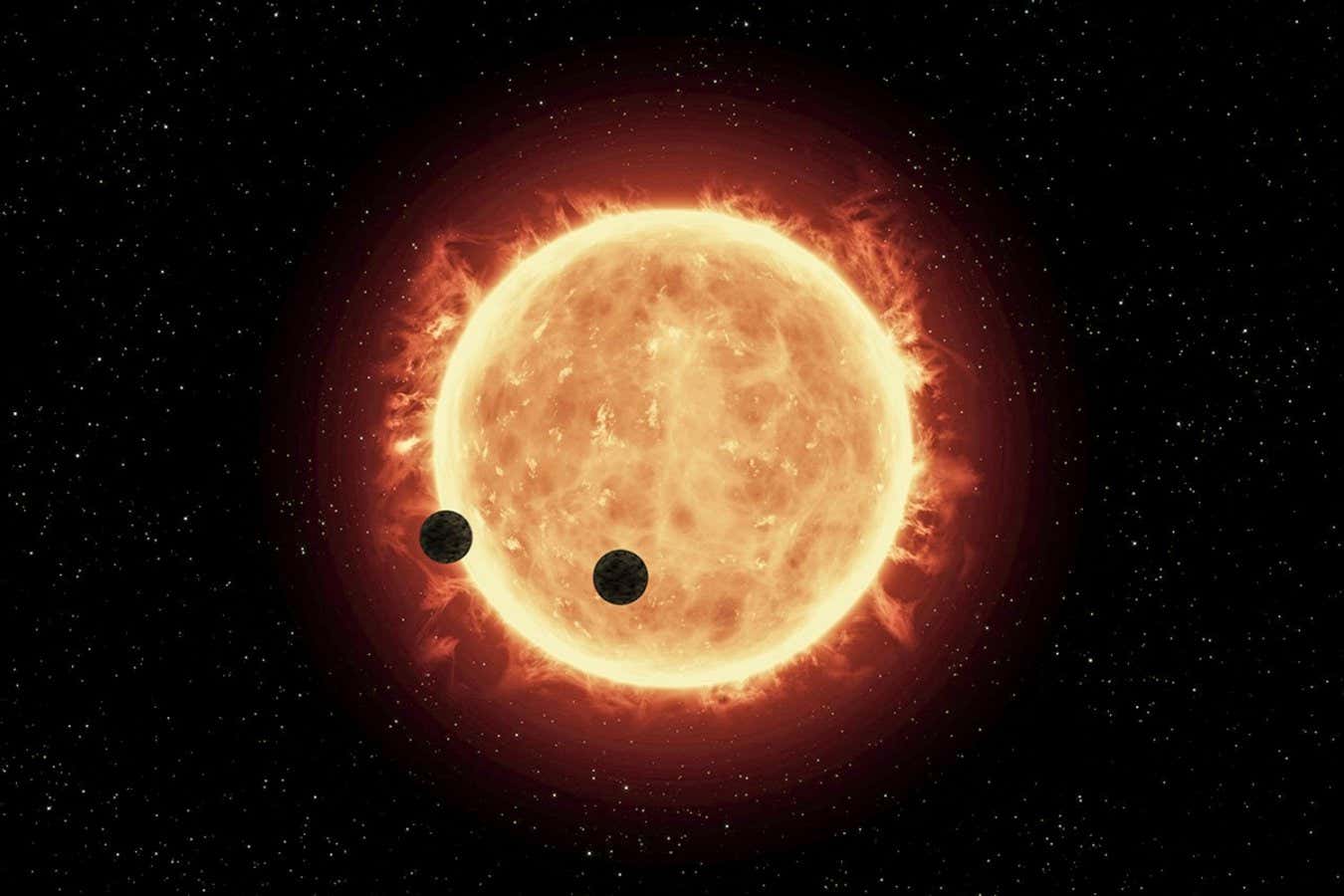

An artist’s impression of a star with two planets transiting across it
NASA, ESA, and G. Bacon (STScI)
Astronomers have identified more than 10,000 candidate planets in data from a NASA telescope, the most ever found in a single haul.
NASA’s Transiting Exoplanet Survey Satellite (TESS) was launched in 2018. It is tasked with looking at stars across the sky for planets in orbit, known as exoplanets. It identifies these exoplanets by looking for brief dips in the brightness of the light reaching Earth from each star – a sign that an exoplanet orbiting the star has passed in front of it.
So far, the telescope has found more than 750 confirmed exoplanets, but it has thousands more candidates awaiting confirmation. There are other telescopes that have found exoplanets, and the total number of exoplanets confirmed by all telescopes now stands at more than 6000.
Joshua Roth at Princeton University and his colleagues have now announced a much bigger number of possible planets by re-analysing the first year of TESS data. By combining images taken by the telescope, the researchers were able to look for planets around stars that are less bright, due to their smaller size or greater distance from Earth, than was previously possible. This revealed 11,554 candidate exoplanets, of which 10,091 have not been identified in previous exoplanet searches.
“There have been predictions that there were thousands of planets still lurking in the TESS data,” says Roth. “It just hadn’t been searched yet.”
The planets extend up to 6800 light-years from Earth towards the centre of our galaxy, double the distance TESS was previously able to search. More than 90 per cent of the new planets are hot Jupiters, gas giant worlds that orbit incredibly close to their star and in just a few days. TESS is particularly suited to finding such worlds. A much smaller fraction are Neptunes and super-Earths.
However, not all of the candidates will turn out to be real planets, with each needing to be independently followed up by other telescopes. Some could be false positives, such as binary stars or other blips in the data. “TESS usually has a false positive rate of 50 per cent,” says Roth. “I would say a maximum of 5000 are real planets”, and possibly just 3000 are, he says.
Even then, the trove would increase the number of known exoplanets in the universe by half. Jessie Christiansen, chief scientist of the NASA Exoplanet Science Institute, says that will be very useful for giving us better information about where and how exoplanets form. “I want as many exoplanets as possible so that I can start slicing and dicing things,” she says. “How are they different? What kinds of different Jupiters do different stars make? These are all questions you can ask when you have a big sample.”
There are many more planets awaiting discovery in the TESS data, including about 8000 other candidate worlds identified in previous studies that still need to be examined. “We were always expecting that thousands would start flooding through at some point,” says Christiansen, with predictions suggesting TESS should find 12,000 to 15,000 confirmed planets in total. “I’ve been waiting for papers like this for a long time now.”
Topics: