

What if ordinary materials could sense heat, pressure, and stress on their own? A new nano-sensor technology could make that possible, without changing how they work.
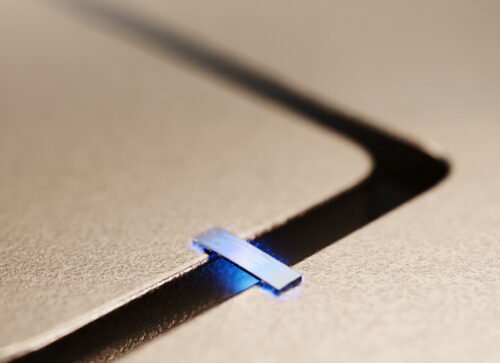
A deep-tech startup from Europe, digid is developing nano-scale sensors that can be printed directly onto almost any material, a technology it says could transform metal, ceramic, polymer, and glass into smart, data-generating systems without altering their core function.

The company says that the technology is a new way to embed sensing directly into physical systems, with applications already being explored across automotive, aerospace, medical diagnostics, and industrial manufacturing.
Unlike conventional MEMS (micro-electro-mechanical systems) sensors, which rely on relatively rigid silicon structures and external integration, digid’s approach uses additively manufactured nano-sensors that can be printed directly onto surfaces. This allows sensing capabilities to be placed exactly at the point of physical interaction, rather than attached as separate hardware.
digid describes this approach as “measure where it matters,” referring to the ability to capture data precisely where stress, heat, or pressure is generated. In a conversation, Dr Konstantin Kloppstech, CTO at digid, revealed, “Our sensors are up to four orders of magnitude smaller than comparable commercial solutions. At this scale, they become effectively invisible to the naked eye and do not interfere with the mechanical or thermal behaviour of the host material.”

This “invisibility” extends beyond size. The company argues that removing bulky sensor hardware enables measurements without altering the system itself, whether in automotive components under stress, semiconductor chips generating heat, or medical devices operating within the human body.
One of the immediate applications being evaluated is the safety of electric vehicle (EV) batteries. The sensors can be embedded directly inside battery cells to monitor temperature in real time and detect early signs of thermal runaway, a key safety concern in EV systems.
In industrial manufacturing, the technology is being tested for structural monitoring of automotive components, including axle alignment systems and load-bearing parts, where embedded sensing could improve maintenance and reliability.
Healthcare and biotechnology represent additional use cases. “The sensors could enable non-invasive monitoring inside bioreactors and diagnostic devices, generating real-time data without disrupting sensitive biological processes,” added Konstantin.
The company is also exploring human-machine interfaces, where embedded sensor arrays in surfaces could distinguish between different types of touch or pressure, potentially enabling more advanced robotic skin and tactile feedback systems.
If successfully scaled beyond pilot stages, the approach could shift sensing from external components to an integrated, invisible layer within materials.