
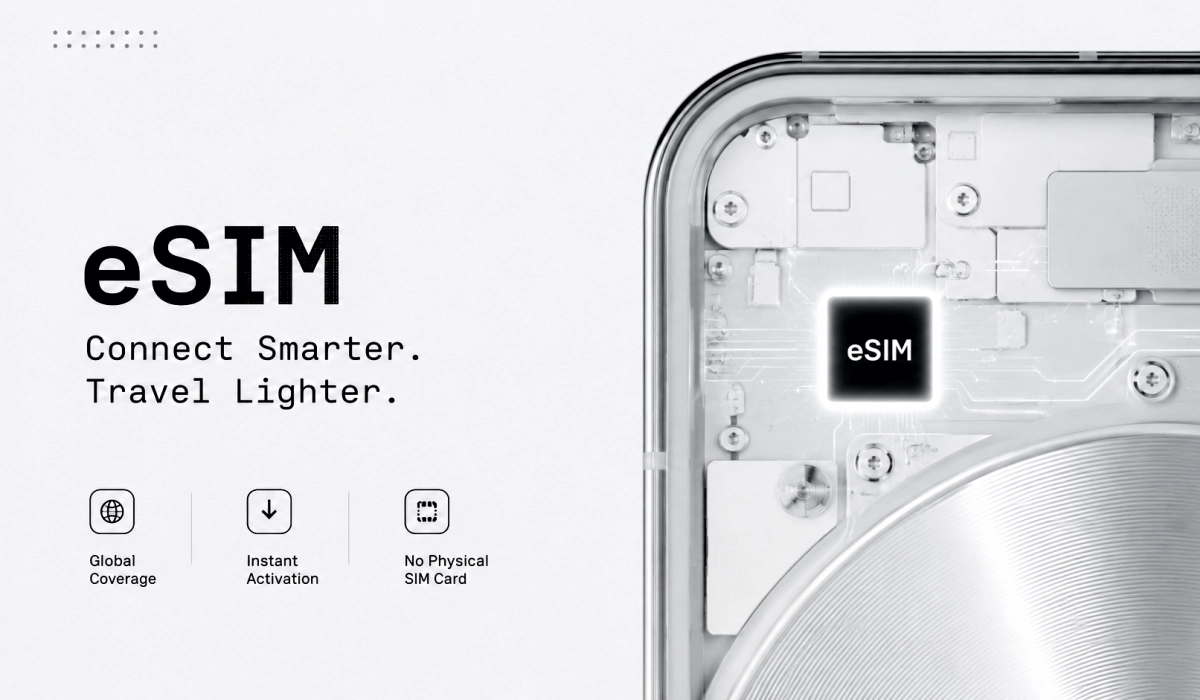
If you’ve bought a flagship smartphone in the last few years, you’ve heard the term eSIM. Some newer iPhones and Android phones have dropped the physical SIM card slot entirely. So what exactly is an eSIM, how does it work, and does it matter for you?
Here’s everything you need to know.
What Is an eSIM?
An eSIM is a built-in, programmable SIM chip soldered directly onto your phone’s motherboard. The “e” stands for embedded. Unlike a traditional SIM card that you physically insert and swap out, an eSIM is already inside your device from the factory.
What makes it useful is that it can be reprogrammed remotely. You can activate a carrier plan on it, delete that plan, and load a completely different carrier plan without ever touching a SIM tray or a tiny plastic card.

How Does eSIM Work?
When you activate an eSIM plan, your carrier downloads a digital profile to the chip over the internet. That profile contains all the same information a physical SIM card would carry: your phone number, your carrier identity, and your account credentials.
The process generally goes like this:
- You sign up for a plan with an eSIM-compatible carrier.
- The carrier sends you a QR code or prompts you through an app.
- You scan the QR code on your phone, or complete activation through the carrier’s app.
- The profile is downloaded to your eSIM chip and you’re connected.
The whole thing can take under two minutes on a good day.
eSIM vs. Physical SIM: What’s the Difference?
| Feature | Physical SIM | eSIM |
|---|---|---|
| Swappable | Yes | No (but reprogrammable) |
| Travel flexibility | Requires buying a local SIM | Switch carriers via QR code |
| Number of active plans | 1 (unless dual SIM) | Up to 2 active at once |
| Setup speed | Instant | Varies by carrier |
| Lost phone risk | SIM can be removed | Tied to device |
The biggest practical difference for most people is travel. Instead of hunting down a local SIM card at an airport kiosk in another country, you can purchase a travel eSIM plan from a provider like Airalo or T-Mobile and activate it before you board.
Which Phones Support eSIM?
Most flagship and mid-range phones sold in the US today support eSIM. Here’s a quick rundown:
Apple: Every iPhone from the iPhone XS and XR (2018) onward supports eSIM. All US models from the iPhone 14 onward are eSIM-only, with no physical SIM slot at all.
Samsung: The Galaxy S21 and newer support eSIM in the US, as do most Galaxy Z Fold and Z Flip models. Note that the Galaxy S20 series, despite having eSIM hardware, did not have eSIM enabled for US models. Check your specific model if you’re on an older Samsung device.
Google: Pixel 4 and later support eSIM broadly across US carriers. The Pixel 3 technically had eSIM capability, but with significant carrier restrictions in the US that made it unreliable for most users. Starting with the Pixel 10 series (excluding the Pixel 10 Pro Fold), US Google phones are eSIM-only with no physical SIM tray.
Other brands: Motorola, OnePlus, and several other brands have added eSIM support to their recent higher-end US models. Check your specific model’s spec sheet if you’re unsure.
Which US Carriers Support eSIM?
All three major US carriers support eSIM:
- T-Mobile: Full eSIM support, including eSIM-only activations
- AT&T: Supports eSIM on compatible devices
- Verizon: Supports eSIM across most postpaid and prepaid plans
Most major MVNOs (Mobile Virtual Network Operators) like Mint Mobile, Visible, and Google Fi also support eSIM.
Can You Have Two Lines on One Phone With eSIM?
Yes, though how it works depends on your device.
On most modern iPhones (iPhone 13 and later), you can run two eSIMs simultaneously, so two phone numbers are active at the same time with no physical SIM card required. On Samsung devices, the typical setup is one active eSIM alongside one physical SIM, rather than two active eSIMs at once. Google Pixel 7 and later support dual eSIM as well.
This is genuinely useful if you want to keep a personal and work number on one device, or if you want a local data SIM and a home carrier SIM active while traveling.
Is eSIM More Secure Than a Physical SIM?
In some ways, yes. With a physical SIM card, someone can pull your SIM out of a stolen phone and use it immediately. With eSIM, the profile is tied to the device. There is no card to yank.
That said, eSIM is not immune to SIM-swapping attacks, where a bad actor convinces your carrier to transfer your number to a device they control. That is a carrier-level social engineering attack, and it affects both physical SIM and eSIM users. Strong carrier account security PIN codes and verification steps reduce that risk.
What Are the Downsides of eSIM?
eSIM is not without drawbacks.
Carrier lock complications. If your phone is carrier-locked, transferring your eSIM profile to another carrier is not possible until it is unlocked. This can be frustrating if you buy a subsidized phone.
Device replacement headaches. Moving a physical SIM to a new phone is a 10-second job. Transferring an eSIM profile requires going through your carrier’s transfer process, which can take longer and occasionally runs into errors.
Not all phones support it. Budget phones and some regional models still ship without eSIM support.
International compatibility. Some carriers in certain countries don’t support eSIM yet. If you’re traveling off the beaten path, you might still need a physical SIM.
Should You Use eSIM?
If your phone and carrier support it, there’s little reason not to use eSIM. The convenience of activating a plan instantly, adding a travel SIM without carrying extra hardware, and running two lines on one device are all real advantages.
If you switch phones frequently or travel internationally to places with limited eSIM carrier support, keeping the option for a physical SIM is still a reasonable preference. Many phones still offer both.
For most US users buying a phone today, eSIM is simply the standard. The better question is no longer whether to use it, but which carrier and plan work best for you.
Disclosure: When you purchase through links on our site, we may earn an affiliate commission.