
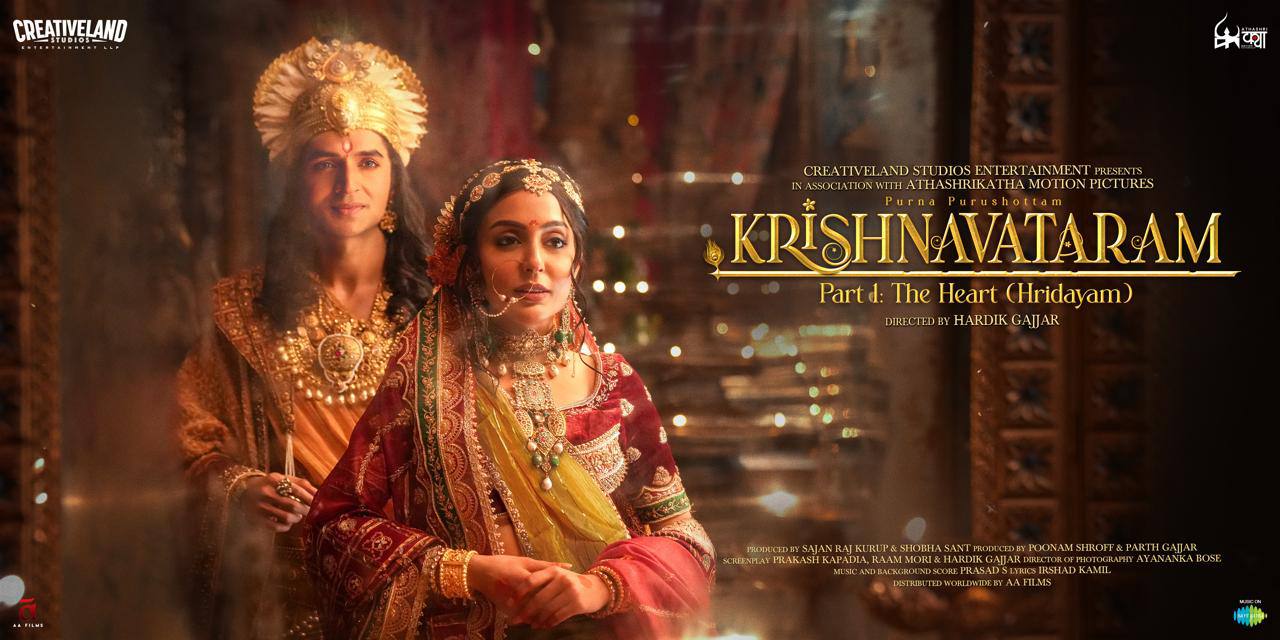
Hardik Gajjar’s Krishnavataram carries the familiar burden of modern mythological cinema, which is to honor sacred memory while still justifying itself as a work of drama, and it does so with conviction and clarity. Adapted from Raam Mori’s Satyabhama and written by Gajjar, Mori, and Prakash Kapadia, the film finds its artistic strength in refusing the obvious route. Rather than treating Krishna’s life as a broad mythological pageant, it narrows its emotional gaze through Satyabhama and discovers a more intimate, layered, and dramatically persuasive entry point into divinity. That choice gives the film a genuine identity. Krishnavataram works best when it allows devotion, longing, and spiritual conflict to shape its world from within.
Krishnavataram: Plot
Krishnavataram is built less as a chronological recounting of divine legend and more as a mythological drama of perception, emotion, and devotion. Its dramatic center lies in Krishna as experienced by the women whose lives are transformed by his presence, especially Satyabhama, whose emotional perspective gives the film both its structure and its distinction. This is the film’s most intelligent narrative move. Krishna is not presented merely as an untouchable symbol of worship, but as a force who is adored, questioned, desired, and spiritually understood through deeply personal relationships. That approach gives the narrative warmth and tension that many reverential retellings lack.
The screenplay is most effective in the way it restores Satyabhama to narrative centrality. Popular mythological storytelling has often reduced her to temperament or ornament, but Krishnavataram gives her a fuller emotional and symbolic life. The adaptation from Mori’s source material insists on her interiority, and this shift changes the texture of the film entirely. Her presence becomes the dramatic key through which the audience enters Krishna’s world. Radha and Rukmini are also written with enough distinction to prevent the story from collapsing into a single emotional register. Together, they create a layered feminine framework that deepens the mythological material rather than merely decorating it.
The film moves with a ceremonial pace that weakens dramatic momentum. Several transitions are shaped for devotional atmosphere rather than narrative progression, and that decision blunts the force of the storytelling. Yet the writing remains committed to the emotional logic of its chosen perspective, and that consistency sustains engagement. What gives the plot its staying power is not surprise in the conventional sense, but the confidence with which it revisits sacred terrain from a lens that feels both respectful and newly attentive. Krishnavataram does not chase reinvention for its own sake. It finds freshness through point of view, and that is a substantial achievement.
Krishnavataram: Performance
The decision to cast a relatively fresh ensemble turns out to be one of the film’s smartest strengths. Mythological cinema benefits from performers who arrive without excessive star baggage, and Krishnavataram uses that advantage well. Siddharth Gupta’s Krishna is marked by calmness rather than showmanship, and that restraint serves the role. He avoids turning the character into a parade of divine mannerisms. Instead, he gives Krishna a composed, serene magnetism that suits the film’s spiritual tone. His best moments come in scenes where silence, gaze, and stillness are allowed to carry the emotional burden.
Sanskruti Jayana has the harder task as Satyabhama because the film depends on her to translate reverence into dramatic feeling. She delivers a performance of considerable poise, balancing pride, hurt, tenderness, and awakening without losing the character’s inner force. Jayana never allows Satyabhama to harden into a static emblem. She gives her vulnerability without diminishing her authority, and that combination is what keeps the film emotionally grounded. It is a performance that gives Krishnavataram its pulse.
Sushmitha Bhat’s Radha brings a quiet ache that enriches the film’s devotional mood, while Nivaashiyni Krishnan lends Rukmini a composed dignity that provides contrast to the stronger emotional currents elsewhere. Both performances are measured and effective, and the film benefits from treating these women as distinct presences rather than interchangeable mythic figures. Jackie Shroff’s special appearance is brief but forceful. He brings immediate authority to the screen, and his presence adds a concentrated dramatic weight that lingers beyond the duration of the role.
Krishnavataram: Analysis
Hardik Gajjar directs Krishnavataram with seriousness and visible commitment to detail, and that commitment gives the film much of its authority. He approaches mythological storytelling not as a camp spectacle or ornamental fantasy, but as a cinematic form that demands texture, visual discipline, and emotional sincerity. The result is a film that feels carefully built rather than merely assembled. Its world is steeped in ritualized beauty, and that beauty is rarely empty. Costumes, production design, and staging are used to support a devotional atmosphere that feels considered and coherent.
The screenplay by Hardik Gajjar, Prakash Kapadia, and Raam Mori is strongest in its insistence on perspective. Instead of straining for novelty through provocation, it finds dramatic purpose in re-centering a neglected voice within familiar mythology. That restraint is commendable. The script understands that reinterpretation can be achieved through emotional emphasis rather than narrative disruption. The writing loses sharpness in several stretches, and the film mistakes solemnity for dramatic accumulation. Even in those weaker passages, the screenplay does not lose sight of its central idea, and that clarity gives the work shape.
Ayananka Bose’s cinematography is among the film’s clearest achievements. The imagery has painterly richness without becoming inert, and the visual compositions consistently reinforce the film’s sacred register. Bose captures both scale and intimacy with assurance. The frames are designed to evoke wonder, but they also preserve emotional access to the characters. This balance is crucial, because a mythological film can easily be swallowed by its own decorative ambition. Krishnavataram avoids that trap and remains visually persuasive throughout.
Prasad S’s music provides the film with much of its emotional continuity. The score is not merely ornamental background but an active extension of the film’s devotional grammar. The compositions heighten spiritual atmosphere and emotional release, especially in sequences where dialogue gives way to visual and musical expression. The choreography is handled with elegance, and the musical passages linger because they are integrated into the film’s tone rather than treated as interruptions. The editing maintains a measured cadence that suits the material, but it lacks sharpness in key stretches and drains several scenes of dramatic force.
Krishnavataram: Verdict
Krishnavataram succeeds because it understands exactly where its power lies. It is not in grandeur alone, but in the emotional and spiritual charge of Satyabhama’s perspective. That choice gives the film shape, purpose, and an identity that separates it from routine mythological spectacle. Hardik Gajjar directs with conviction, Siddharth Gupta brings Krishna a poised stillness, and Sanskruti Jayana delivers the film’s strongest dramatic contribution with a performance that carries both force and feeling.
The film is held back by a pace that repeatedly slows its dramatic grip, yet its artistic intent remains clear and compelling. It reclaims a neglected emotional center within Krishna lore and gives mythological cinema a viewpoint that feels rooted, dignified, and dramatically worthwhile. Krishnavataram is not a monumental reinvention of the genre, but it is a visually accomplished and emotionally sincere work whose perspective gives it lasting value. Its finest achievement lies in proving that reverence and reinterpretation can coexist without diminishing either.
Krishnavataram: Rating
Critics Rating: 4/5
Box Office Rating: 3/5
Stay tuned for Movie reviews, ott reviews, latest bollywood movie reviews, box office movie reviews.
Related