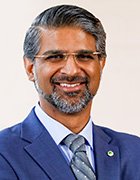
Sustainability and strategy don’t always seem like natural bedfellows in a profit-driven world, but Simon Ninan, global head of strategy at Hitachi Vantara, wants to make it a reality, finding fresh approaches that deliver for customers, products, profit and the planet together.
He says that if you want to see something better tomorrow, you have to start today. And for Ninan, it’s about finding a way through conflicting requirements. His core strategy team aims to combine knowledge, experience and ideas so that “one plus one equals five” and solves sustainability and business challenges together.
“I grew up in Bangalore, India,” he says. “Bangalore has changed a lot. It used to be known as green – now there’s so much traffic, a lot of the greenness is gone. It’s a shame.”
In India, there’s still “incredibly intense” competition for resources as the country races to catch up, but in a “fair” way. Ideas around balancing those issues are often inculcated as you grow up, says Ninan.
Similarly, it seemed to him that the longevity of companies and the “hardiness or value” embedded in their vision can be deeply connected.
Comparisons with the US, where he arrived after studying computer science and engineering, were stark. Growth delivered clear benefits to the population, but at the same time, he saw “a land of excess”, where resources were often wasted.
“I have continued consistently to think about how a little can potentially go a long way. How can we drive better decisions, and avoid innovation for innovation’s sake, technology for technology’s sake?” he says. “It’s about fusing business and technology. And there’s opportunity in that.”
Long-term vision shapes sustainability strategy
Ninan joined Hitachi Vantara in 2019, following seven years as an executive at Japan-headquartered parent Hitachi, and before that at Monitor Deloitte.
At the board and corporate levels, Hitachi has a culture of going beyond short-term strategic planning.
“I have continued to think about how a little can potentially go a long way. How can we drive better decisions, and avoid innovation for innovation’s sake, technology for technology’s sake? It’s about fusing business and technology. And there’s opportunity in that”
Simon Ninan, Hitachi Vantara
That begins by asking how the world might look 30, 50 or even 70 years from today, and planning for “mega-trends”, such as in terms of productivity and artificial intelligence (AI), socio-politics and climate change. The strategic time frame is the next two generations at minimum, including innovating around products and solutions that benefit society at large.
That long-term focus is “very interesting and unique”, says Ninan.
“We also talk about ageing demographics, or changing demographics. Emerging markets, availability of resources, productivity, the digital divide,” Ninan says. “Big hurdles that society will face. Then, working backward as it were, Hitachi asks what we can do today.”
Japanese principles guide collaborative approach
Hitachi founder Namahei Odaira originally tied the company philosophy to the Japanese principles of “wa”, “makoto” and “kaitakusha-seishin”.
At Hitachi, the harmony-related concept of “wa” encourages respect for others’ opinions and promotes open, fair and impartial discussion. In sustainability, this translates into a highly collaborative, cross-functional approach that connects efforts across the full lifecycle of products and operations, and to ensure impacts are understood holistically, says Ninan.
“Makoto” is about sincerity – approaching issues with openness, honesty and respect, “in the spirit of true teamwork”.
“In sustainability, this is reflected in transparency, proactive data collection and reporting, and a commitment to go beyond simply meeting requirements to delivering on the spirit of our goals,” says Ninan.
“Kaitakusha-seishin” may be best translated as “pioneering spirit”. Ninan says that at Hitachi, this emphasises a striving for leadership through pursuing new challenges and higher goals, but building on a commitment to innovation that goes beyond mere compliance, to driving positive impacts for society and the planet. That mission is now being extended to other parts of the world where Hitachi operates.
“I find that really powerful, because it says you can make trade-offs in your bottom line for a bigger goal,” he adds. “It’s very ambitious. We have a double bottom line. Every company tries to make sure it delivers profit, but the double bottom line means it’s not just about the shareholders; it’s about the stakeholders and the value you’re delivering – your customers, your partners, your employees.”
Tackling Scope 3 emissions in datacentres
Today’s sustainability challenges for the team include weighing up the challenges and potential benefits of AI enablement, for example. Also, there’s a need to rethink the value of hybrid cloud data solutions versus the return on investment in data, says Ninan.
The most recent “major strategy refresh” with a medium- to long-term perspective at Hitachi Vantara was three years ago. It involved “extensive embedding” of Hitachi’s sustainability reporting into Hitachi Vantara, with Ninan as one of the executives presiding.
That challenge had become “a huge proposition” with related opportunities around green IT and sustainability. Ninan had noticed that while Scope 1 and Scope 2 emissions were handled quite well, Scope 3 emissions accounting still needed work.
“It didn’t do a really good job of Scope 3. Yet datacentres are a most impactful industry for global sustainability,” he says.
Sustainability is also important because so many datacentre projects are being cancelled. Ninan says that trend will increase, not least because people often don’t want datacentres in their backyard, whether for environmental reasons or otherwise.
“They’re now leery about the effects of AI. They’ve also seen bills go up, and they worry about water resources,” he adds.
Cross-functional teams drive sustainability goals
Ninan’s team includes one other person, plus four entirely focused on product sustainability, helped by another sustainability director and the sustainability lead analyst at Hitachi Digital, which is a centre of excellence shared across multiple Hitachi divisions.
Also, Ninan’s team works bi-weekly with people who have a 20% or so commitment to sustainability in addition to their day jobs in finance, HR, logistics, operations and the like. Formal executive committee governance meetings happen quarterly.
Hitatch Vantara has reported multiple sustainability awards for its tech, including around AI, and high ratings from the likes of EnergyStar and EcoVadis. It launched a sustainability service level agreement (SLA) last year.
Hitachi Vantara’s net-zero target is 2040, following the Science-based Targets Initiative (SBTi) – a “more aggressive” target than its parent’s 2050.
“And we have our state-of-the-art distribution centres, particularly one in the Netherlands, that have launched a whole bunch of new initiatives around logistics, distribution, biodiversity and so on,” he says.
Ninan points out that customers today are more often “buying outcomes”, rather than being 100% focused on product. And he suggests that if more tech companies don’t wake up, poor sustainability can and will hit profits – if it hasn’t already.
IT companies will lose customers and their credibility. In his view, datacentre operators could “make or break” sustainability goals, and it’s crucial for those in the industry to lead the way.
Which is also an opportunity, not just for marketing narratives or even benchmarking, but to drive innovation, he says.
So that’s what Ninan and his cross-functional team does – sponsoring and overseeing strategy and building sustainability together. Not least because it often takes people a long time to appreciate the importance of sustainability.
“I make a lot of noise about that,” he says. “I’ve had to become a real champion for sustainability.”
Bridging US and European sustainability narratives
In the US, especially, narratives on sustainability can differ from those in many other regions and markets. In Europe, sustainability is seen as crucial simply because the planet depends on it.
I’ve had to become a real champion for sustainability Simon Ninan, Hitachi Vantara
However, US arguments typically must be formulated in dollars and cents. In the US, if you can’t make the economics work, if you can’t show how profits will be realised, it’s much more difficult to reach a consensus.
Europe sometimes creates burdensome regulations and reporting requirements in an effort to get everyone on board, but that’s seen as a necessary evil.
“You can’t have that ‘necessary evil’ conversation in the US. They say, ‘Tell me how it’s going to improve my revenue, and profits, and maybe then I’ll pay attention to it’,” says Ninan.
“Then, of course, you have changing political administrations – and you hear they want to deregulate, as a matter of national competitiveness and innovation, with greenness potentially coming in at some future date or time.”
Making the business case for green technology
The challenge – and partly the fun – for Ninan and his team is to keep figuring out how to straddle the different narratives, to explain how sustainability is good for businesses that are governed quarter to quarter by the markets. That includes via outreach, with public relations activities such as podcasts or thought leadership articles also a really interesting part of his job.
“That’s where I talk about Hitachi Vantara products a bit, and that datacentres are about 3% of greenhouse gas emissions globally, of power consumed, and how that’s multiplying with the AI and internet of things revolutions,” says Ninan.
Then his strategy might include pointing out projections for datacentre growth. If datacentre footprints triple in the next five years, as some estimates suggest, that will create problems for businesses.
Power grids can’t handle it. They’re not ready, and resources such as energy and water are lacking. Economies can’t currently sustain that sort of datacentre demand; investment is required to meet the “real value” proposition, which typically boils down to cost savings, he says.
“So, we explain that if you deploy our storage and data solutions in datacentres, because of the proprietary technology, we can optimise how data is moved, stored and processed. We can reduce power consumption in datacentres by 30% to 60% compared to the average,” he says. “Forget the cost of buying the bits. Sure, we’ll do a great job for you there, but we’ll save you longer-term costs.”