
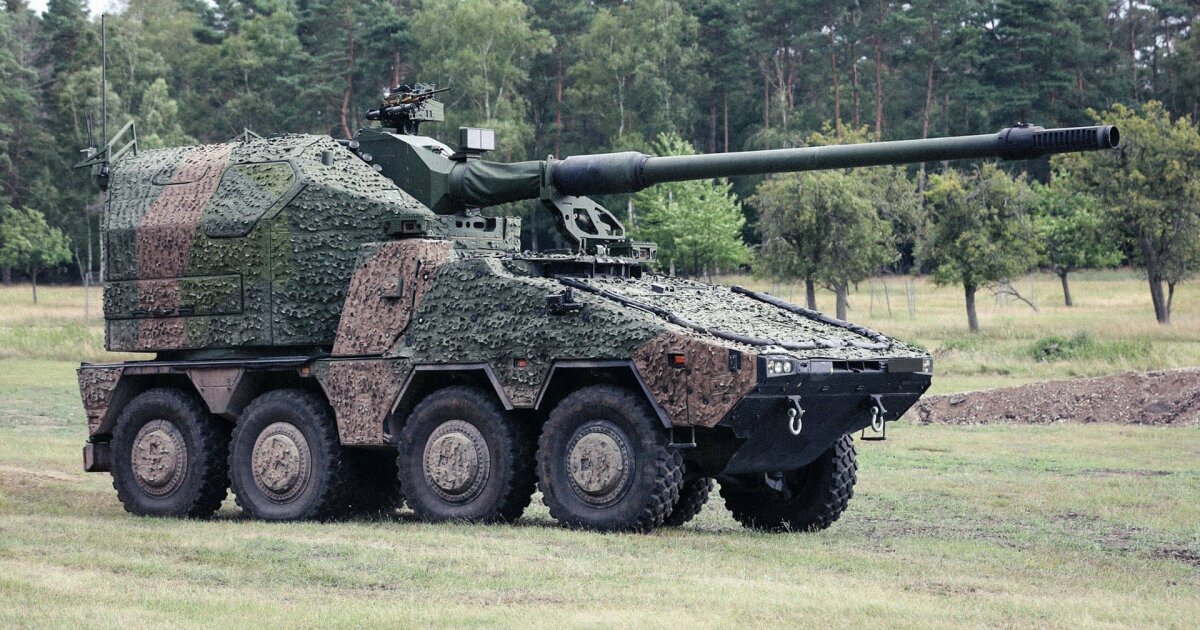
The British Army is packing a lot of firepower into a very small chassis by placing an order for 72 Remote Controlled Howitzer 155 (RCH 155) systems mounted on alarmingly compact Boxer armored vehicles that are practically dwarfed by the remotely operated guns sitting on top of them.
Even good intentions can have unavoidable consequences, as the British government has learned. To help combat the Russian invasion, the British Army sent its entire inventory of 68 AS90 155mm tracked self-propelled howitzers to Ukraine. That was all very noble in the eyes of some, but it produced the obvious result – when you give all your artillery away, you don’t have any left for yourself.
That isn’t quite as lacking in foresight as it might seem at first glance, however, as the AS90 howitzers were Cold War relics already slated for decommissioning by 2030. However, Whitehall does have an annoying tendency to dispose of vital military equipment at the drop of a hat – or worse, before a replacement has been secured. As a result, the British Armed Forces in the 21st century have had to spend years at a stretch without aircraft carriers, command and reconnaissance planes, STOVL fighter jets, assault ships and more because No. 10 was in an almighty hurry to scrap the present ones before the new ones were even ordered.
RCH 155
Since 2024, a similar situation has faced the Army when it comes to artillery. Giving the AS90s to Ukraine has produced an uncomfortable gap that needs filling, so the call went out to vendors to come up with a proper replacement.
The one opted for is the RCH 155. Built as a joint venture between KNDS and Rheinmetall, it’s not only a replacement but a significant shift in mobile artillery to meet the challenges of the changing geopolitical situation.
The first thing that comes to mind when looking at the new gun is that the whole setup seems completely out of proportion. The RCH 155 looks ridiculously large compared to the Boxer 8×8 Armoured Vehicle that it sits on top of. It resembles nothing so much as a deck gun off a frigate with too long a barrel sitting on the back of a pickup truck. However, there is a definite logic behind this seemingly mad design.

ARTEC
The departure from conventional design is based on discarding the traditional self-propelled artillery philosophy where the vehicle is a single, heavily armored, tank-like platform. In contrast, the RCH 155 is modular, with the vehicle chassis and autonomous gun system designed independently of one another. That allows for much greater flexibility in the final configuration and a more mobile and agile end product.
Traditional tracked vehicles require heavy equipment transporters or rail infrastructure to move long distances without wearing out their tracks and transmissions. In contrast, the Boxer can self-deploy over roads exceeding 435 miles (700 km) at speeds of up to 60 mph (100 km/h). This allows the gun to be shifted at a moment’s notice. Using the Boxer platform also means the vehicle can effectively be transformed into an artillery system simply by installing the appropriate module. The Boxer’s chassis, engine, and drivetrain are standardized and can be repaired or replaced relatively quickly.
Meanwhile, the RCH 155’s Autonomous Artillery Gun Module (AGM) is fully automated and can be operated by the crew of two without them having to leave the Boxer’s cab. Shell fuses can be programmed automatically, while a robotic loading arm handles both projectiles and propellant charges. Impressively, the system can even load and fire while the vehicle is moving.

ARTEC
By incorporating a new hydro-pneumatic recoil system and a structural interface that absorbs and dissipates the firing energy across the entire 8×8 wheel platform, the Boxer can absorb the shock of firing while driving and there’s no need for the hydraulic stabilizing spades that must be lowered into the ground before firing on conventional guns. This also allows the turret to turn 360° and fire at any angle of elevation, even on sloping terrain.
All of this adds up to an artillery system purpose-built for “shoot-and-scoot” warfare. Upon receiving target coordinates, the RCH 155 can aim and fire up to nine rounds in rapid succession before speeding away in around 30 seconds, before enemy artillery has time to return fire. Since it can fire on the move, it’s even more annoying for enemy gunners to deal with. In addition, the system is capable of Multiple Round Simultaneous Impact (MRSI), where varying barrel elevation and propellant charges allow up to five rounds to follow different ballistic trajectories yet strike the target simultaneously, which tends to be a bit alarming for those on the receiving end.
The first vehicles are expected by 2028, with operational deployment by about 2030.
“This major investment is defense delivery for the battlefield and for Britain’s economy,” said Defence Secretary John Healey MP. By securing next-generation artillery with Germany, not only are we rearming to strengthen NATO against growing Russian aggression but also creating highly skilled jobs here in Britain. This is what we mean when we say defense is an engine for growth – investment in our security that powers new jobs across the country.”
Source: Ministry of Defence