
Whenever adult Star Wars fans complained about the prequels, George Lucas always gave the same defense: Star Wars wasn’t made for adult fans.
“When I did the third one it was the Ewoks. ‘Those are little teddy bears! This is a kids movie, we don’t want to see a kids movie!’” Lucas said in 2024. “I said: ‘It is a kids movie. It’s always been a kids movie.’”
We may come to look back on The Mandalorian and Grogu as the tipping point where Star Wars stopped making kids movies and started making dad movies. Sure, the adorable Baby Yoda got his full legal name in the title, and yes, Jon Favreau dedicates plenty of this big-screen adaptation of the hit streaming TV series to the tyke’s child-friendly antics.
But unlike all the orphaned, loner heroes of Lucas’ Star Wars movies, the Mandalorian is a father. And the film around him, with its heavy use of old fashioned special effects and original trilogy callbacks — not to mention its themes about the bond between parent and child — feels targeted to middle-aged viewers hungry to relive their youthful moviegoing experiences with their parents at Return of the Jedi 40 years ago, now with their own kids.
READ MORE: Actors Who Turned Down Major Star Wars Roles
The results are serviceable enough — and calculated in a way that suggests serviceable enough (and utterly inoffensive) was Lucasfilm’s goal here. Despite the fact that The Mandalorian and Grogu follows three seasons of a streaming television larded with dense religious sci-fi mythology, the movie presents such a simple, straightforward story it requires almost no knowledge of Star Wars or The Mandalorian to follow it. In short: Mando (Pedro Pascal, with an assist from suit performers Brendan Wayne and Lateef Crowder) and his adopted son Grogu (as himself) work as “independent contractors” for the New Republic, the galactic government formed following the Empire’s defeat in Return of the Jedi.
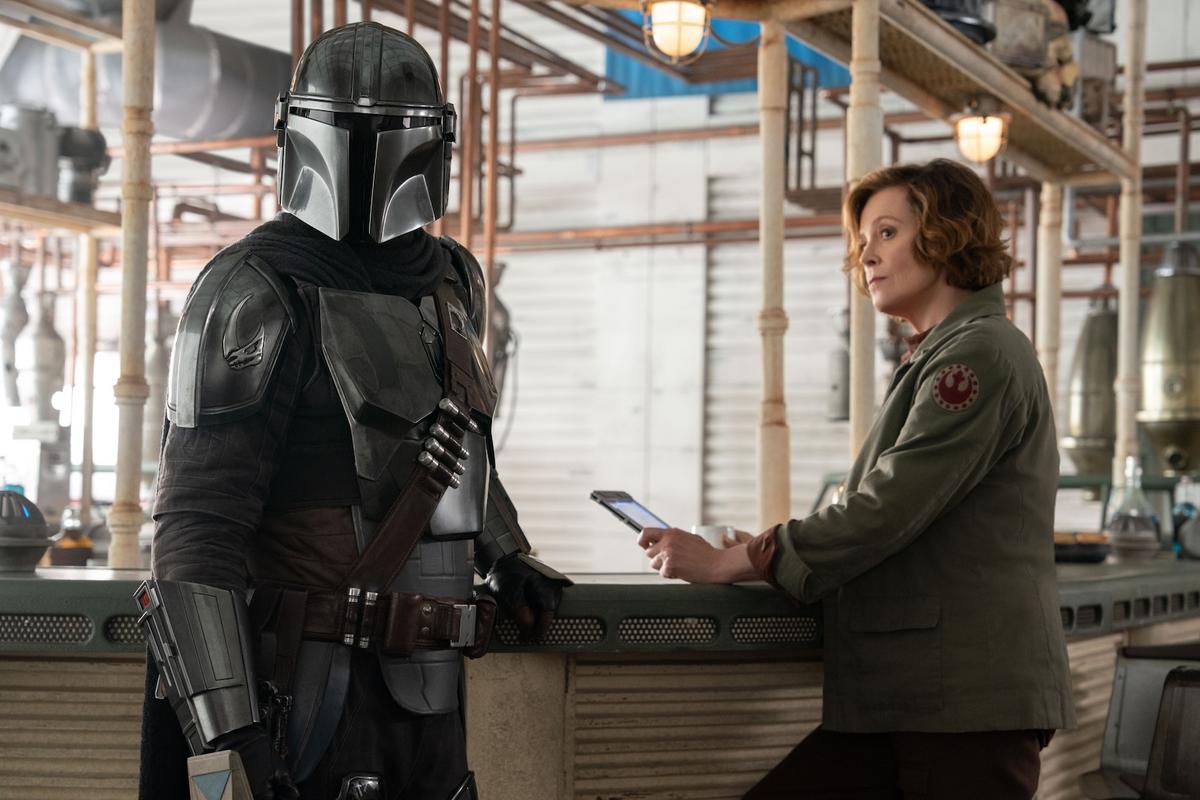
Their boss, Colonel Ward (Sigourney Weaver), tasks the duo with hunting down Imperial fugitives and bringing them to justice. When one particular warlord proves hard to find, Ward sends the Mandalorian to “The Twins,” a pair of Hutts with information on the missing criminal they will trade in exchange for the return of Rotta the Hutt (Jeremy Allen White), the son of late space gangster Jabba the Hutt.
Locating Rotta is just one piece of a more complicated puzzle that involves deadly bounty hunters, pit-fighting monsters, remnants of the old Empire, and the first Hutt in Star Wars history with six-pack abs. (You ever see a giant alien worm with a washboard stomach? It’s quite a sight.)
The busy plot cannot entirely obscure the prevailing sense that The Mandalorian and Grogu, for all its elaborate production and creature design and “filmed for IMAX” visuals, is really just a couple of Mandalorian episodes gussied up for big-screen release, with Weaver, only present in a handful of scenes, playing the role of this week’s grossly overqualified guest star.
The movie’s set pieces are a little grander than the ones The Mandalorian typically produced for Disney+; AT-ATs look even more imposing in the boxy IMAX frame. Otherwise, the feature recreates the episodic vibe of the show’s first season. The Mandalorian and Grogu is a straightforward adventure with almost no character development and little to discover below its handsome surface. Even the two-act structure (complete with a cliffhanger right around the one-hour mark), suggests it could have been rejiggered from a pair of scripts for the never-made fourth season of The Mandalorian.
The only sequence that really surpasses its source material is a nearly silent interlude focused on Grogu alone on a hostile alien world. This segment amounts to a whimsical ten-minute short, a minimalistic tale buried inside this prime example of Hollywood maximalism. It’s also as impressive a showcase for practical puppeteering as has been presented in a Hollywood movie since the glory days of the Muppets, not to mention the kind of purely visual storytelling that very few $150 million blockbusters dare to attempt. It brings the entire film to life — at least for a few minutes.
The rest of Mandalorian and Grogu leans into familiar Star Wars iconography; busy fight sequences, chases, gloopy gloppy monsters, and high-speed dogfights (which at least are enlivened by the massive dimensions of an IMAX screen). In interviews, Jon Favreau speaks quite eloquently about video game technology and its benefits for The Mandalorian, like the Unreal Engine that powers the“The Volume” LED video walls that create many of Star Wars’ exotic alien worlds. With The Mandalorian and Grogu he also adds some video game aesthetics to his bang of tricks, including extensive point of view shows. (The film’s mission-based conceit could easily be repurposed for Jedi Survivor DLC if Lucasfilm ever wants to add Mando to that game.)
The Mandalorian, like Clint Eastwood’s Man With No Name is an inherently static character; although he’s shifted his allegiance a little through the years, his emotional growth moves as slowly as Jabba the Hutt, and his inner life is as opaque as his unbreakable helmet. What little emotion there is to latch on to here comes from his affection for Grogu, and the film’s emphasis on the importance of generational ties. But for a parent getting the opportunity to take their own child to their first Star Wars movie in a theater, maybe that’s all that’s necessary.
Additional Thoughts:
-The parental dynamics in The Mandalorian and Grogu don’t end with the title characters. Rotta the Hutt has his own daddy issues, something he announces early and often in the film. It’s odd, though, that he does it in a voice that’s been so pitched down, until it’s impossible to tell by sound alone that it’s The Bear’s Jeremy Allen White portraying the character. White’s low-energy delivery also makes a poor match for the burly, brooding Rotta. If you didn’t want the quiet smouldering that White typically brings to his roles, if you’re going to disguise his voice as it emanates from a character that already looks nothing like him, why cast him in the first place? The whole character is built out of strange and confusing choices.
-The best performance in this movie — besides the puppeteers behind Grogu’s amusingly childish shenanigans — comes from Martin Scorsese, who voices the short-order cook who provides Mando with information about the Hutts. That said, nothing he or anyone else in this movie says or does is as funny as the sight of the words “MARTIN SCORSESE” in the opening credits of a Star Wars movie.
RATING: 6/10
Actors Who Were Wasted in Star Wars Roles
These wonderful stars have appeared in Star Wars movies and shows, but only in parts so small they left us disappointed.