

A volcanic mystery reveals that rising magma has a stealth mode
In 2022 a swarm of earthquakes in the Azores suggested that an eruption was imminent, but none happened. Now we know why, and it means magma can be sneakier than we knew
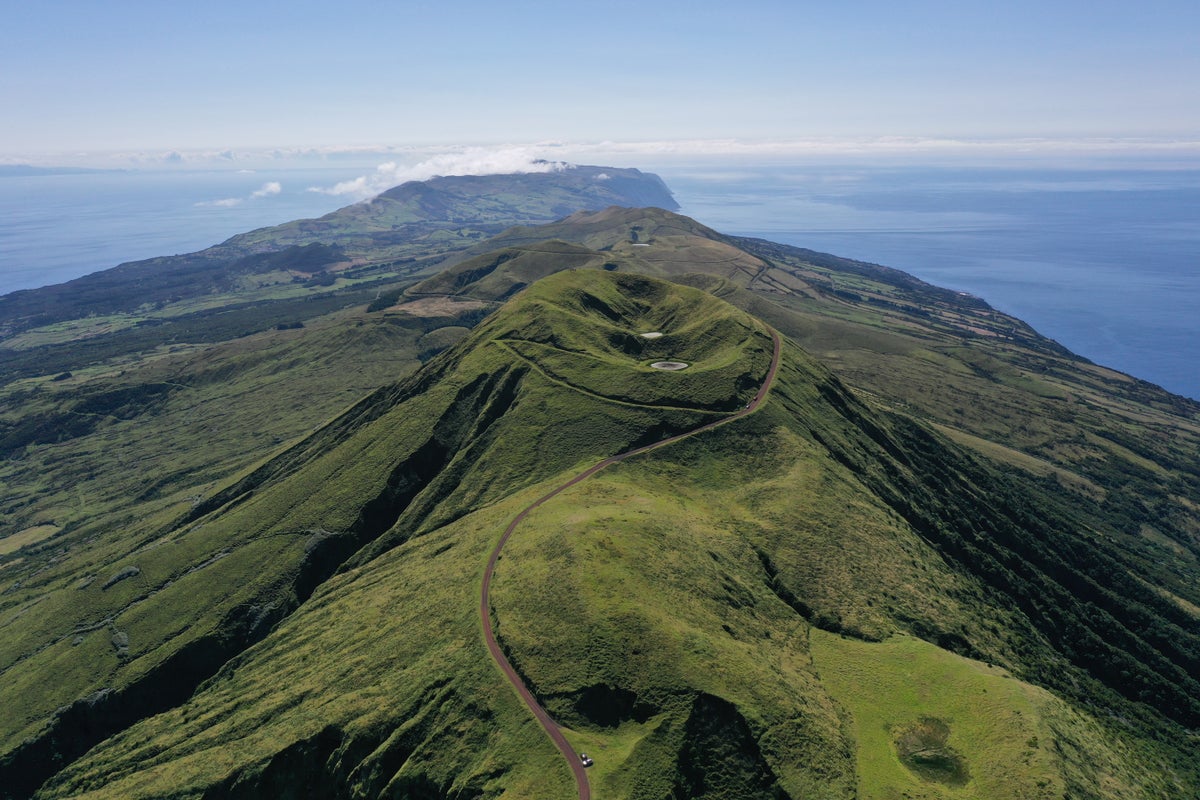
The valleys scoring through São Jorge Island’s central spine are surface expressions of the fault the magma was sneaking up through.
On March 19, 2022, São Jorge Island—a volcanic isle in Portugal’s Azores archipelago—started shaking. The thousands of tremors suggested that either an eruption or a major earthquake was imminent, and a precautionary evacuation plan was activated. But the seismic activity fizzled out and nothing else happened, leaving volcanologists and seismologists to puzzle over the episode.
A new study, published Thursday in Nature Communications, offers a disquieting explanation. Just prior to the explosion of seismic activity, a sheet of magma that could fill about 32,000 Olympic-size swimming pools had rocketed up from a depth of at least 12 miles to just a mile below São Jorge’s surface in no more than a day.
Unusually, this magma didn’t generate any large, rock-breaking quakes because it found a preexisting fault network that it could tunnel through. The seismic swarm only happened after the magma had almost reached the surface. If an eruption had taken place, people would have already been in harm’s way by the time the multitude of quakes had alerted the authorities.
On supporting science journalism
If you’re enjoying this article, consider supporting our award-winning journalism by subscribing. By purchasing a subscription you are helping to ensure the future of impactful stories about the discoveries and ideas shaping our world today.
“This is a bit of a wake-up call that these things could happen really quickly, and perhaps more quietly, than we anticipated,” says Rebecca Williams, a volcanologist at the University of Hull in England, who wasn’t involved with the new study.
The Azores islands have twin volcanic engines: one is a rising fountain of superheated rock known as a mantle plume, and the other is the islands’ location atop three diverging tectonic plates, which allows hot rock to rise, decompress and melt. São Jorge last experienced a land eruption in 1808. It’s only a matter of time before another takes place, which is why the March 2022 rumbling put everyone on edge.
Figuring out what happened took several lines of evidence. A few days into the quaking, satellite and GPS data revealed that something else had already happened: the northern and southern edges of São Jorge had inflated, while two islands to either side of São Jorge had moved ever-so-slightly farther away from it.
This indicated that by the onset of the seismic crisis on March 19, a sheet of magma had already emplaced itself below São Jorge—but it hadn’t erupted. “It was a failed eruption,” says study co-author Pablo Gonzalez, a volcano geophysicist at the Spanish National Research Council.
Before the seismic swarm, there were only two seismometers on São Jorge. In the days to months after the swarm started, dozens of extra sensors were placed on the island, on the surrounding seafloor and on several nearby islands. By detecting more than 18,000 additional quakes, scientists were able to better understand what had occurred, and where, beneath São Jorge.
“The magma intrusion occurred almost instantly, in a matter of hours,” Gonzalez says. It moved from the upper mantle to the top of the crust, all without making any large quakes—but how?
It seems the magma was channeled through the Pico do Carvão fault system, a preexisting labyrinth that forms a visible trench on the island’s verdant surface. “A fault is full of more permeable materials and natural fractures,” says co-author Stephen Hicks, a seismologist at University College London. That meant the magma could easily, and stealthily, pry its way through the crust, rather than having to smash through solid rock.
The magma had significant upward momentum. “This could have made it all the way up,” Williams says. But it didn’t, partly because the magma eventually hit a rigid geologic barrier at the base of São Jorge and partly because when the magma stalled, its fluids and gases leaked out into fault cracks nearby, reducing its buoyancy and triggering thousands of modest quakes—the seismic swarm that got everyone’s attention.
In 2022 São Jorge got lucky. But this study shows how “magma can get so close to the surface and not have any visible effects,” Gonzalez says. It underscores that molten rock can sometimes be remarkably sneaky, confounding attempts to forecast when, and if, an eruption will happen.
It’s Time to Stand Up for Science
If you enjoyed this article, I’d like to ask for your support. Scientific American has served as an advocate for science and industry for 180 years, and right now may be the most critical moment in that two-century history.
I’ve been a Scientific American subscriber since I was 12 years old, and it helped shape the way I look at the world. SciAm always educates and delights me, and inspires a sense of awe for our vast, beautiful universe. I hope it does that for you, too.
If you subscribe to Scientific American, you help ensure that our coverage is centered on meaningful research and discovery; that we have the resources to report on the decisions that threaten labs across the U.S.; and that we support both budding and working scientists at a time when the value of science itself too often goes unrecognized.
In return, you get essential news, captivating podcasts, brilliant infographics, can’t-miss newsletters, must-watch videos, challenging games, and the science world’s best writing and reporting. You can even gift someone a subscription.
There has never been a more important time for us to stand up and show why science matters. I hope you’ll support us in that mission.