
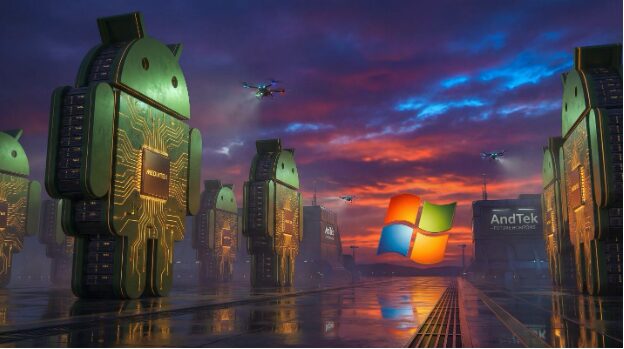
For those of us who have been around long enough to remember when “WinTel” was a term of endearment (or a curse, depending on your stock portfolio), the idea of someone displacing Microsoft and Intel feels a bit like suggesting the sun might decide to rise in the west tomorrow. But as I look at the shifting tectonic plates of the technology landscape from my office in Bend, it’s becoming clear that the sun isn’t just shifting; it’s being replaced by a giant green robot and a Taiwanese powerhouse.
We are on the verge of a transition where Android for the PC becomes the dominant paradigm, fueled by a partnership between Google and MediaTek. Let’s call it AndTek. And if you think Microsoft and Intel are ready for this, you probably also thought Internet Explorer was a “long-term strategic advantage.”
The Windows Browser Blunder, Replayed
Microsoft has a peculiar talent for losing markets they already own. Remember the browser wars? Microsoft had 90%+ market share with Internet Explorer, became complacent, stopped innovating, and then watched in stunned silence as Chrome ate their lunch. They are currently doing the exact same thing with Windows.
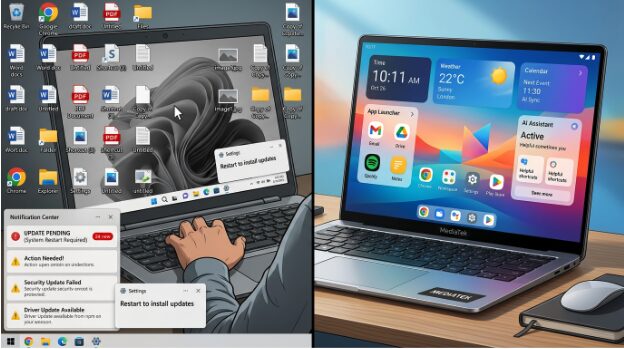
Windows has become a bloated, legacy-ridden platform that feels increasingly like a “legacy tax” on hardware. Meanwhile, Intel—once the undisputed king of silicon—has spent the last decade tripping over its own feet, struggling with 7nm and 5nm transitions while ARM-based competitors started sprinting. By the time Intel realized that power efficiency actually mattered, the mobile world had already passed them by.
The Developer Exodus: Why Android is the New Home Base
In the world of SDTimes, we know that platforms live and die by their developers. Right now, if you’re a developer, where is the excitement? It’s not in writing Win32 apps or even trying to navigate the fractured world of Windows on ARM. It’s in the Android ecosystem.
Android developers are already building for a billion-plus devices. The leap from a smartphone to a “PC-form-factor” Android device is a hop; the leap from x86 Windows to ARM Windows is a treacherous mountain climb through a valley of emulation layers.
- Engagement: Developers are more engaged with Android because that’s where the users—and the money—are.
- AI Leadership: While Microsoft is busy trying to shove “Copilot” into every corner of the OS (often with mixed results), Google’s Gemini AI is natively integrated into the very fabric of the Android kernel.
- Native AI: Google is well ahead of Microsoft on AI integration, offering a cohesive experience that spans from the cloud to the edge, something Microsoft is still struggling to replicate across its disjointed product lines.
The Mobile Failure: A Flank Wide Open
Microsoft and Intel’s failure to enter—and stay—in the smartphone market was more than just a missed revenue opportunity; it was a strategic catastrophe. By failing to secure the “pocket,” they left their “desktop” flank completely exposed.
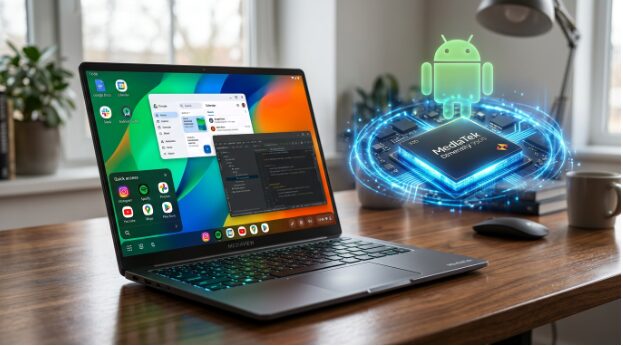
Every person under the age of 30 treats their smartphone as their primary computer. To them, a “PC” is just a smartphone with a bigger screen and a keyboard. This is where MediaTek comes in. MediaTek has quietly become the volume leader in smartphone chipsets, refining the art of high-performance, low-cost ARM silicon. They have the scale that Intel lacks and the mobile-first DNA that Microsoft can’t seem to clone.
Naming the Beast: AndTek or GooTek?
If Google and MediaTek are to truly displace WinTel, they need a brand. AndTek has a nice ring to it—it sounds like something that’s meant to be there. Other options? GooTek sounds like a brand of industrial adhesive, and MediaGoog sounds like a failed social media platform. Let’s stick with AndTek. It signals the union of the world’s most popular OS and the world’s most efficient silicon.
The Google Problem: Focus and Marketing
However, before we crown AndTek the new kings, we have to address the “Google in the Room.” Google’s historic lack of focus is legendary. They launch products with fanfare and then abandon them like a teenager loses interest in a hobby (RIP Google Reader, Stadia, and a hundred others).
To make AndTek work, Google needs:
- Sustained Marketing: Not just “hey, look at this cool thing,” but a decade-long commitment to the PC form factor.
- OEM Relations: They need to treat Dell, HP, and Lenovo like partners, not just “vessels for Chrome.”
- Stability: Developers need to know that the “Android PC” APIs won’t change every six months on a whim.
Qualcomm’s Missed Connection
You might be asking, “What about Qualcomm?” Qualcomm had the first-mover advantage with Microsoft. But the Snapdragon X Elite’s launch was hampered by Microsoft’s inability to deliver a compelling ARM-native Windows experience. Qualcomm hitched their wagon to a horse that didn’t want to run.
To replace MediaTek in this new alliance, Qualcomm would need to pivot away from Microsoft and embrace the “Android PC” vision fully. They have the performance, but they lack the “easy-to-work-with” reputation that MediaTek has cultivated with the smaller, hungrier OEMs.
A World Reimagined: Life After x86
Imagine a world where your PC is just as instant-on as your phone. Where your battery lasts three days, not three hours. Where every app you own works seamlessly across every screen you own. That is the world AndTek promises.
In this world, “Booting up” becomes a relic of the past. Your computer is always connected, always updated, and—thanks to Gemini—always anticipating what you need next. It’s a world where the “PC” finally stops being a “Personal Computer” and starts being a “Personal Companion.”
Wrapping Up

The era of WinTel is closing. Microsoft’s lack of focus and Intel’s manufacturing stumbles have created a vacuum that AndTek (Android + MediaTek) is perfectly positioned to fill. With a developer base that is already mobile-native and an AI platform in Gemini that is outpacing the competition, Google finally has the pieces to win the desktop. If they can just stay focused long enough to finish the game, the PC market is theirs for the taking.