
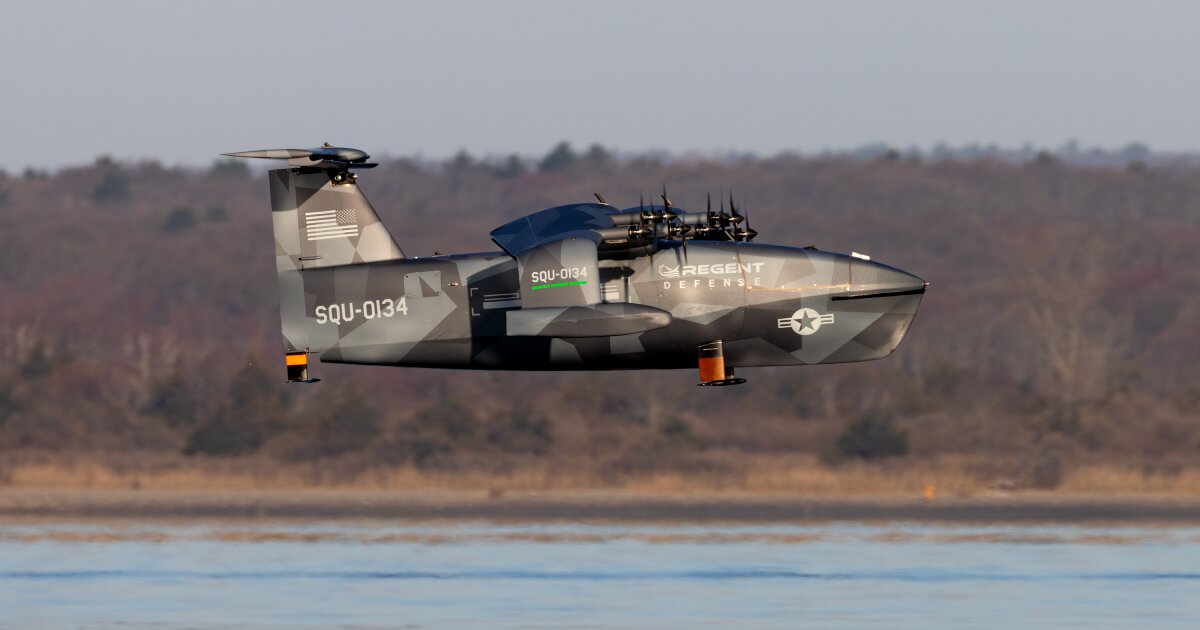
Regional Electric Ground Effect Nautical Transport (REGENT) has completed the maiden flight of Squire, an autonomous variant of the company’s Wing-in-Ground Effect Seaglider aircraft that’s being pitched to the US military for logistical duty.
If you’ve been following the news out of military circles lately, one thing that stands out as a common trend is that the Western powers are reacting to the current geopolitical situation by initiating major rearmament drives intended to not only reequip and modernize their forces, but to do so as fast as possible.
Part of this effort involves not only investing in flashy things like lasers and missiles or vitally mundane tasks like building up stockpiles of munitions and spares, it also includes adapting new or previously overlooked technologies to speed up and improve the resilience of logistical systems that keep soldiers supplied in the field.
Squire
REGENT’s Squire project combines three technologies in hopes of giving the US military an advantage in the logistical realm – autonomous flight systems, Wing-in-Ground (WIG) Effect, and electric propulsion.
Since 2020, the company has been working on an electric fixed-wing aircraft that exploits the WIG Effect to create a craft that flies at an altitude that is about equal to or less than half the length of its wingspan. When it does this, drag is reduced significantly as the proximity to the ground disrupts the formation of vortices at the wingtips. However, the party piece is that the air trapped under the wing creates a high-pressure cushion effect with a lift-to-drag ratio beyond that of a conventional aircraft.
The upshot is that a WIG aircraft can carry heavier payloads over greater ranges than conventional craft as it skims over open ground or water. This is especially important for electrically powered craft that have notoriously short range.
Last year, REGENT showed off its Viceroy prototype, which is an electric-powered commercial passenger plane that can carry a crew of two and 12 passengers. With a wingspan of 65 ft (20 m), it has a top speed of 160 knots (180 mph, 290 km/h) and a range of 160 nm (180 miles, 290 km).
REGENT
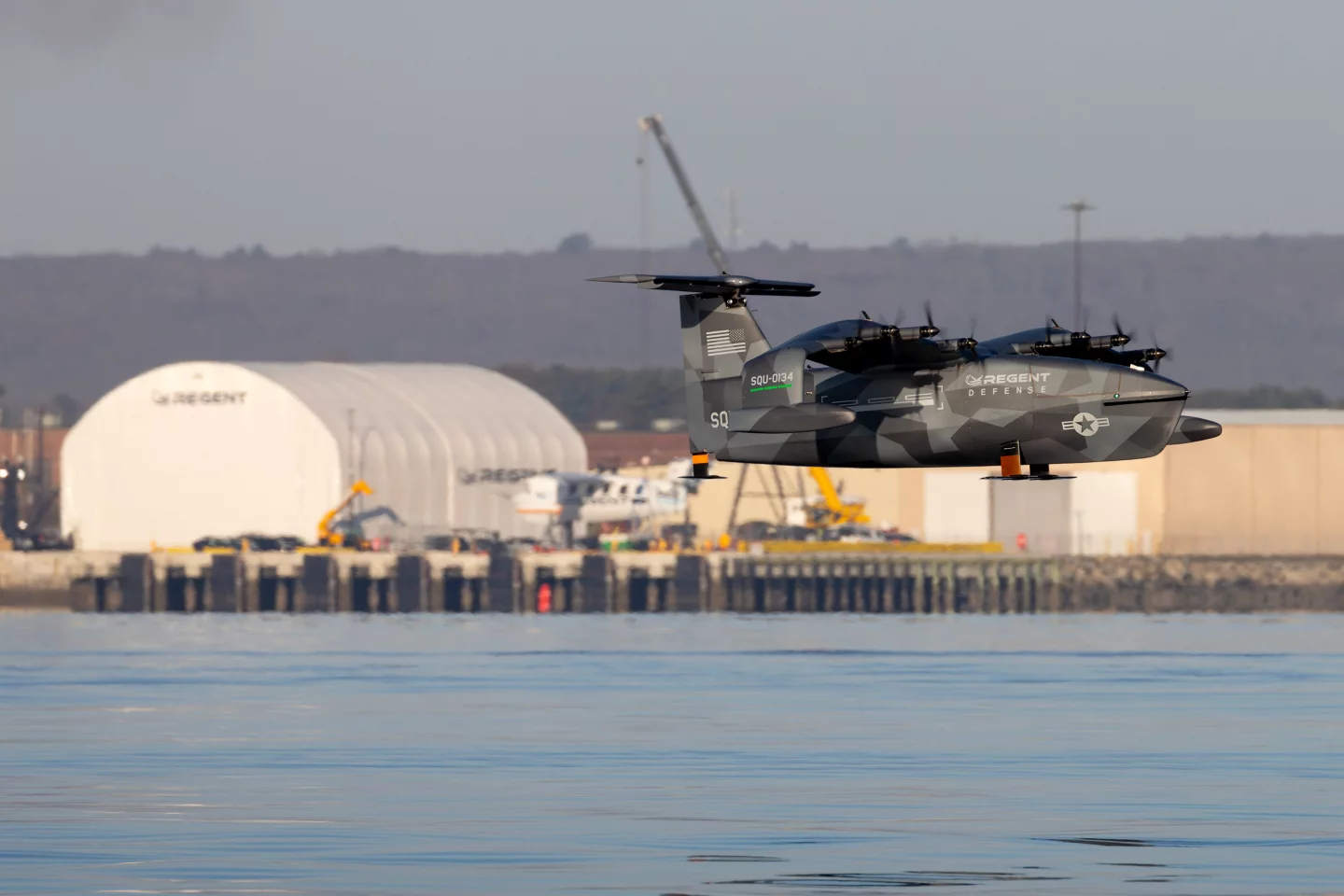
Now the company has rolled out Squire, which is an uncrewed, autonomous version of the Viceroy that is built to military specifications. Like the Viceroy, the Squire is a seaplane, but it is only about a quarter of the size of the Viceroy, with an 18-ft (5-m) wingspan and only half the speed and a range of only 100 nm (115 miles, 185 km). However, it can handle a payload of 50 lb (23 kg).
According to REGENT, the Squire operates in three different modes. During its April 13 maiden flight, it floated on its boat-like hull. When running on the water, a hydrofoil arrangement lifted the hull out of the water as it sped up to reduce drag. When the craft’s speed reached a critical speed, the WIG effect came into play and the Squire was airborne.
The recent test demonstrated that the Squire was capable of making the necessary transition autonomously between the different modes. According to the company, the US Defense Department has shown interest in Squire or some variant that could be used to close time-critical logistical gaps.
“Defense customers require platforms that can operate across wide maritime areas with speed, range, and mission flexibility, without relying on traditional and often vulnerable infrastructure,” said Tom Huntley, General Manager of REGENT Defense. “Squire is designed to meet that exact need. This demonstration shows real progress toward delivering a high-speed autonomous capability for missions such as ISR, tailored logistics, and anti-submarine warfare.”
Source: REGENT