

Brand strategy is entering a more demanding era.
For CEOs, CMOs, and CFOs, the question is no longer whether brand matters. The question is whether brand can help solve the organizational problems that determine growth, profitability, customer trust, internal alignment, and enterprise value.
That is the right question.
Brand should not sit outside the economics of the business. It should help improve them.
For many organizations, brand strategy has long been treated as a clarifying exercise. Define the position. Sharpen the promise. Align the story. Refresh the identity. Improve consistency.
Those remain important outcomes, but they are no longer sufficient.
A clear brand that does not change decisions, behavior, customer experience, or financial performance is underleveraged. A clear brand that helps leadership solve the right problems can become a true business asset.
This article is part of Branding Strategy Insider’s FREE newsletter. Join the world’s smartest marketers and subscribe here for actionable insights delivered directly to your inbox.
The Problem Is Not A Lack Of Ideas
Most companies have no shortage of ideas.
They have growth ideas, product ideas, campaign ideas, service ideas, partnership ideas, innovation ideas, customer experience ideas, and technology ideas. What they often lack is a disciplined way to determine which ideas deserve capital, attention, and organizational commitment.
This is where brand can play a more consequential role.
Brand is not only how a business expresses itself. Properly understood, it is a lens for deciding what the business should do. It helps leaders determine where to focus, what to simplify, what to stop, what to scale, and where value can be created faster.
For the financially minded CEO, CMO, and, of course, CFO, this is where brand strategy becomes more than marketing. It becomes a management discipline.
Brand strategy should help answer the questions that sit behind performance:
Where is customer trust being lost?
Where is the offer harder to understand or buy than it should be?
Where is pricing power being weakened?
Where is portfolio complexity suppressing growth?
Where are sales and marketing working from different assumptions?
Where is the customer experience failing to deliver the promise?
Where is culture slowing execution?
Where is capital being spent on activity that does not create measurable value?
Where could the brand create new demand, new revenue, or stronger retention?
These are not communication problems alone. They are organizational problems. Brand is one of the few disciplines capable of connecting customer choice, market position, internal behavior, and business economics in a single operating frame.
Brand As A Business Lens
Strong brands are not built by messaging alone. They are built through management decisions.
What the company prioritizes.
What it refuses to pursue.
How it enters the market.
How it prices.
How it sells.
How it serves.
How it organizes the portfolio.
How it aligns employees.
How it earns trust.
How it makes choice easier.
This is why brand belongs closer to the operating agenda.
When brand is viewed only as marketing, it is often asked to express decisions that have already been made. When brand is used as a business lens, it improves the quality of those decisions before capital, talent, and time are committed.
That distinction has financial consequences.
A brand lens can reveal why growth has slowed. It can expose the gap between what leadership believes the business stands for and what customers actually experience. It can show where complexity is creating hidden cost. It can identify where the market may be willing to pay more because the value is clearer, more trusted, or more differentiated. It can help CFOs distinguish between brand investment and brand activity.
That is not soft work.
That is value creation.
From Brand Clarity To Brand Performance
We repositioned The Blake Project around a simple mandate: Brand strategy should perform like a financial asset.
For us, that means brand work must be judged the way the rest of the business is judged: by its ability to strengthen pricing power, improve conversion, increase retention, support growth, and contribute to enterprise value.
We call this point of view For The EBITDA because brand should not be managed outside the economics of the business. It should help improve them.
This is a shift in expectation.
Brand strategy still needs to create meaning. It still needs to build differentiation. It still needs to give people a reason to choose, believe, advocate, and stay. But it also needs to help leadership make better decisions about where value can be created and how quickly that value can be tested.
The more complex the organization, the more important this becomes.
In many companies, the barrier to growth is not lack of ambition. It is fragmentation. The strategy is understood differently by different functions. Sales needs sharper tools. Marketing needs clearer proof. Finance needs a stronger business case. Operations needs a practical path. Culture needs a reason to change behavior. Customers need less friction and more confidence.
Brand strategy can help integrate these demands when it is built to solve business problems rather than merely express business intent.
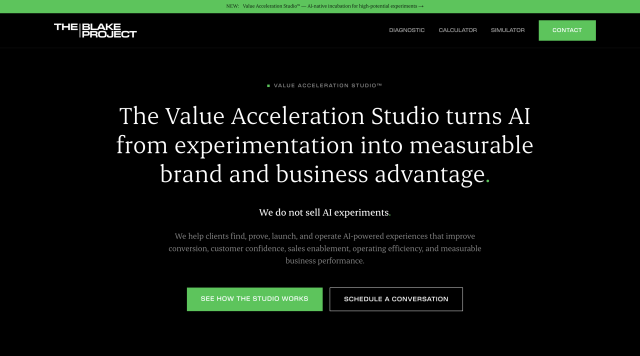
Introducing The Blake Project’s Value Acceleration Studio™
As part of this shift, we developed the Value Acceleration Studio™, a human-led, AI-enabled offering designed to help leadership teams solve organizational problems through the lens of brand.
The Studio helps identify, prototype, launch, and scale brand-driven experiences with the potential to create measurable business value.
The technology accelerates the work. Human judgment determines what is worth building.
That distinction matters.
AI has made it easier to generate concepts, create prototypes, simulate experiences, and move faster from idea to execution. But speed alone does not create value. In some cases, it simply allows weak ideas to move through the organization faster.
The harder task is deciding which problems matter, which opportunities are worth pursuing, which solutions are strategically consistent, and which initiatives have a credible path to financial impact.
The Blake Project’s Value Acceleration Studio™ is built for that task.
It begins with a business issue, not a technology brief.
The issue may be slow growth, weak conversion, low retention, customer confusion, portfolio complexity, poor differentiation, sales friction, internal misalignment, capital inefficiency, or an experience that fails to deliver on its promise.
From there, brand becomes the organizing lens:
What must the customer believe?
What must the organization make easier?
What behavior needs to change?
What experience would increase trust?
What proof would move a prospect closer to purchase?
What would improve confidence, commitment, or renewal?
What would make the brand more valuable to the business?
What would give leadership a stronger case for investment?
The output may be a digital experience, sales tool, customer decision aid, value calculator, loyalty platform, branded service concept, education platform, licensing model, internal alignment system, or prototype for a new growth opportunity.
The form follows the problem.
The standard is measurable value.
What The Value Acceleration Studio™ Looks Like In Practice
A brand-driven experience is not a gimmick. It is a business response made visible.
- For a company with a complex offer, The Blake Project’s Value Acceleration Studio™ might create a customer decision tool that helps prospects understand which solution fits their situation, reducing sales friction and improving conversion quality.
- For a premium brand facing pricing pressure, it might build a value calculator that helps buyers understand the economic advantage of choosing the higher-value option, strengthening confidence and protecting margin.
- For a company with a confused portfolio, it might create an interactive architecture experience that makes the role of each brand clearer for customers, sales teams, channel partners, and leadership.
- For a sales organization struggling to communicate differentiation, it might build a guided selling platform that turns brand positioning into a more persuasive commercial conversation.
- For a company with retention risk, it might create a loyalty or education experience that increases perceived value after purchase and gives customers stronger reasons to stay.
- For a leadership team struggling with internal alignment, it might develop an employee activation system that helps people understand what the strategy means for their daily decisions, not just what it says in a deck.
- For a brand with unused equity, it might prototype a licensing, partnership, or branded service model that tests whether meaning and trust can become a new revenue stream.
In each case, The Blake Project’s Value Acceleration Studio™ is not starting with the question, “What can we build?”
It is starting with a more valuable question:
What business problem can brand help solve?
Closing The Gap Between Insight And Implementation
One of the persistent weaknesses in brand strategy is the gap between strategic clarity and organizational action.
Leadership teams can leave a strategy engagement aligned and energized, only to see the work slow as it moves into the business. Functions interpret the strategy differently. Sales asks for tools. Marketing translates strategy into campaigns. Technology waits for direction. Finance asks what the return will be. Culture absorbs only fragments of the change.
The result is often a strong strategy with weak activation.
The Blake Project’s Value Acceleration Studio™ is designed to reduce that gap.
Its operating rhythm is straightforward:
Identify the opportunity.
Build the experience.
Launch quickly.
Measure honestly.
Scale what works.
Transfer capability into the organization.
This rhythm allows leadership teams to test how brand strategy can improve the business in practical, visible ways. It also creates evidence.
Market evidence.
Customer evidence.
Behavioral evidence.
Financial evidence.
That evidence helps leaders make better decisions about what to fund, what to refine, what to scale, and what to stop.
Stopping matters. A disciplined brand strategy should prevent poor investment as much as it creates new opportunity.
Why This Matters To CEOs, CMOs, And CFOs
For CEOs, the value is focus.
The Value Acceleration Studio™ helps concentrate leadership attention on the organizational problems that matter most to growth and enterprise value. It translates brand strategy into experiences that can inform capital allocation, customer experience, go-to-market priorities, portfolio decisions, and culture.
For CMOs, the value is proof.
The Studio creates a path beyond campaign performance. It helps show how brand can influence conversion, sales confidence, customer education, retention, pricing power, and demand quality. It positions marketing as a growth and value-creation discipline, not only a communications function.
For CFOs, the value is discipline.
The Studio helps distinguish brand investments with value-creation potential from activity that is difficult to justify. It gives finance a clearer way to evaluate brand-led initiatives against outcomes that matter: revenue quality, margin opportunity, retention, capital efficiency, and enterprise value.
For all three, the value is speed governed by judgment.
In a market where AI has made building easier, competitive advantage will not come from generating more ideas. It will come from applying sharper judgment to the opportunities that matter most.
Brand Must Change The Economics Of Choice
Every business is shaped by choices.
The customer’s choice to consider.
The buyer’s choice to trust.
The employee’s choice to act.
The channel partner’s choice to support.
The market’s choice to pay more.
The investor’s choice to believe the company can grow.
Brand influences these choices when it is managed with discipline.
That is why brand strategy must now be held to a higher standard. It must clarify meaning, but it must also improve decisions. It must differentiate the business, but it must also reduce friction. It must inspire people, but it must also help the organization execute. It must create belief, but it must also create value.
The Blake Project’s Value Acceleration Studio™ was created for leadership teams that want brand to do more than express the business.
It was created for leaders who want brand, their most valuable intangible asset, to help improve the business.
The Work Ahead
AI has made it easier to build.
It has not made it easier to know what is worth building.
That still requires strategy, judgment, customer understanding, organizational insight, and financial discipline.
The next era of brand strategy will belong to organizations that can identify the problems limiting growth, solve them faster, and scale what creates value without confusing speed for progress.
Because brand should help solve what limits business growth.
Learn More
If your leadership team is facing a growth, conversion, retention, pricing, portfolio, or alignment problem that brand may be able to solve, The Blake Project’s Value Acceleration Studio™ can help identify what is limiting growth and determine what is worth building.
Schedule a conversation with The Blake Project to explore whether the Value Acceleration Studio™ is right for your organization.
At The Blake Project, we help leaders turn brand into a disciplined driver of financial performance — strengthening pricing power, competitive position, and enterprise value. Email us to start a conversation about enduring profitable growth. For The EBITDA.
Branding Strategy Insider is a service of The Blake Project, a strategic brand consultancy focused on turning brand into pricing power, growth, and enterprise value.