
Telemedicine has changed how people think about healthcare. Not long ago, visiting a doctor meant waiting rooms, travel, and a lot of back and forth. Now, many patients expect to connect with a doctor in minutes, often from their phone.
That shift has pushed healthcare providers and businesses to rethink how they deliver services. Telemedicine apps are no longer optional for many organizations. They are becoming part of the basic setup.
But when it comes to building one, most people get stuck on two things. Cost and features. How much should you invest, and what actually needs to be inside the app?
Let’s break it down in a way that makes sense.
Why Telemedicine Is Growing So Fast
The demand for telemedicine did not appear overnight. It built up over time. People want faster access to care. Doctors want to manage their time better. Hospitals want to reduce pressure on physical infrastructure.
There is also a practical side to it. Remote consultations save time for everyone involved. Patients do not need to travel, and doctors can handle more appointments in a day.
Because of this, more businesses are now exploring Telemedicine App Development Services to create platforms that actually solve these problems instead of just adding another digital layer.
What Does It Really Cost to Build a Telemedicine App
This is where things usually get confusing. There is no fixed price, and anyone who gives you a single number upfront is oversimplifying it.
Still, you can think of it in ranges.
Rough Cost Breakdown
| App Type | What You Typically Get | Estimated Cost |
| Basic App | Video calls, login, booking | $25,000 to $70,000 |
| Mid-Level App | Chat, payments, records | $80,000 to $150,000 |
| Advanced App | Integrations, analytics, AI features | $150,000 to $300,000 |
| Enterprise Platform | Full-scale system with high scalability | $300,000+ |
Now here is the important part. These are just rough ranges. The actual cost almost never stays exactly within these numbers.
A small change like adding a new integration or redesigning the user flow can push the cost up. On the other hand, simplifying features can bring it down.
So it is better to treat these numbers as a starting point, not a final estimate.
What Actually Drives the Cost
If you are trying to control your budget, you need to know what really affects it.
Feature Complexity
This is the biggest factor. A simple video consultation app is one thing. A system with AI recommendations, wearable integrations, and analytics dashboards is something else entirely.
More features mean more development time. It is that simple.
Compliance and Security
Healthcare apps are not like regular apps. You are dealing with sensitive data, and that changes everything.
If you are targeting the US market, following standards related to Healthcare Software Development in USA is not optional. It affects how you design the system, how data is stored, and how users interact with it.
This part often takes more time than people expect.
Platform Choice
You will need to decide whether to build for iOS, Android, or both.
Native apps usually perform better, but they cost more because you are essentially building two versions. Cross platform development can save money early on, but it might come with limitations depending on your feature set.
There is no universal answer here. It depends on your users and priorities.
Integrations
Most telemedicine apps do not work in isolation. They connect with other systems like EHRs, payment gateways, and pharmacy services.
Each integration adds another layer of complexity. It is not just about connecting systems. It is about making sure everything works smoothly together.
Development Team
The team you choose also plays a big role. Some businesses prefer working with a Mobile App Development Company in USA because of better communication and familiarity with local regulations.
Others go with offshore teams to reduce costs. Both approaches can work, but the experience will be different.
Core Features You Should Not Skip
It is easy to get carried away with features, but every telemedicine app needs a solid foundation.
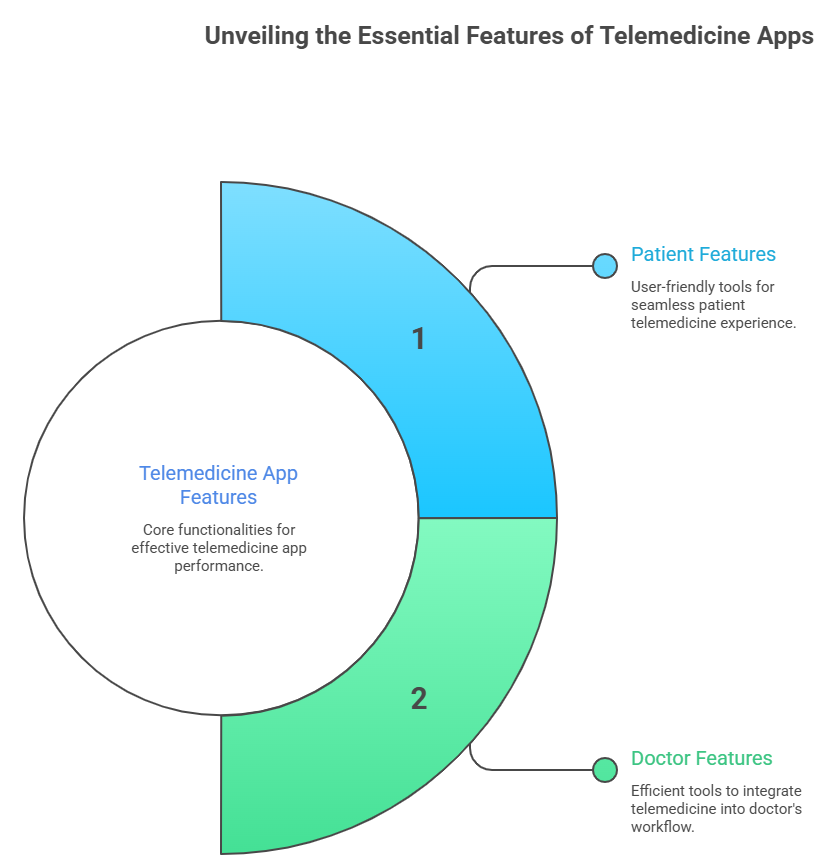
For Patients
- Simple registration and login
- Doctor search and filtering
- Appointment booking
- Video consultations
- Messaging or chat
- Online payments
- Access to prescriptions and history
If these basics are not smooth, users will not stick around.
For Doctors
Doctors need something that fits into their routine, not something that slows them down.
- Appointment management
- Patient records access
- E-prescriptions
- Consultation history
- Schedule control
A complicated interface can quickly become a problem here.
Admin Side
This is where everything is controlled behind the scenes.
- User management
- Reports and analytics
- Payment tracking
- System settings
It may not be visible to users, but it is critical for running the platform.
Features That Can Come Later
Once the basics are in place, you can think about adding more advanced features.
- AI symptom checkers for quick guidance
- Remote monitoring using wearable devices
- Multilingual support for wider reach
- Analytics dashboards for insights
- Cloud infrastructure for scaling
These are valuable, but not all of them need to be there from day one.
How Long Does It Take to Build
Timeline is another area where expectations can go wrong.
Typical Timeline
- Basic app: 3 to 6 months
- Mid-level platform: 6 to 9 months
- Advanced system: 9 to 12 months or more
But again, these are just estimates.
Projects often take longer because requirements change, integrations take more time than expected, or testing reveals issues that need fixing.
So it is better to plan with some flexibility instead of expecting a strict deadline.
The Real Value Behind Telemedicine Apps
At the end of the day, this is not just about building an app. It is about improving how healthcare is delivered.
A well-built telemedicine platform can:
- Reduce operational costs
- Reach more patients
- Cut down missed appointments
- Improve efficiency for doctors
- Enhance patient experience
That is why many healthcare businesses see it as a long-term investment.
Challenges You Should Be Ready For
It is not all straightforward. There are challenges, and it is better to be aware of them early.
- Regulatory requirements can slow things down
- Data security needs constant attention
- User adoption depends heavily on usability
- Integrations can get complicated
None of these are deal breakers, but they do require planning.
Final Thoughts
Building a telemedicine app is not just about technology. It is about creating something that works in real situations, for real people.
The cost can vary a lot. The timeline can shift. Features can evolve over time. That is normal.
What matters is starting with a clear idea, focusing on what is essential, and improving step by step.
If you get the basics right, everything else becomes easier to build on.
And in the long run, a well-designed telemedicine app is not just a product. It becomes part of how healthcare is delivered every day.