
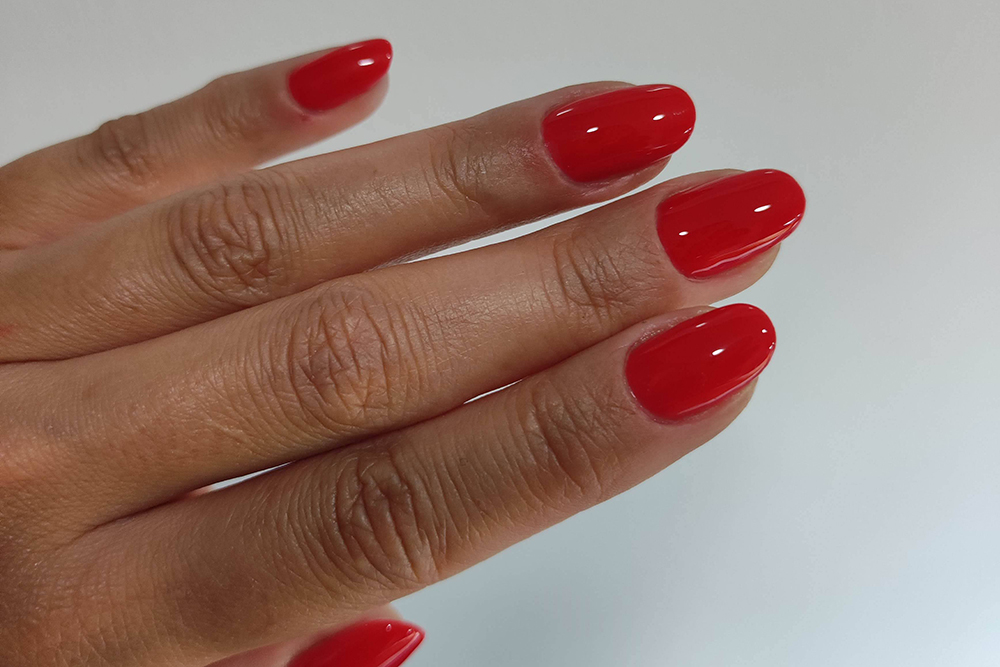
To the nail novice, walking into the salon for an appointment can feel a little daunting. Yes, it’s relaxing—and you leave with a beautiful new manicure—but choosing the right treatment isn’t always straightforward. With so many innovations in the nail space, from soak-off gel to acrylics to Gel-X extensions to builder gel, it’s not always obvious what your nails actually need. Much of it, however, comes down to personal preference, which makes the whole process far less intimidating.
For now, we’re going to focus on builder gel. If your nails have ever chipped or broken, especially right after a fresh manicure, builder gel might become your new best friend. Here’s the basic lowdown: It’s a hard gel that lasts longer than regular soft gel and helps your nails feel longer and stronger. It’s a dream for anyone who wants to open a can of soda without worrying their nails will break, types a lot or works with their hands—or basically anyone who wants a long-lasting manicure.
Ahead, two experts weigh in on everything you need to know about builder gel, including what it is, the pros and cons and whether it’s actually better for your nails. Consider this your builder gel 101.
Featured Experts
- Sofiia Mazur is a nail artist and educator in Calgary, Alberta
- Valeriia Telemaniuk is an international nail artist, educator, beauty industry judge and Founder of Altera Nails in San Diego
What Is Builder Gel?
Builder gel is a hard gel nail product. Technically speaking, it’s a “durable polymer material used to strengthen natural nails or create length and structure,” says San Diego nail artist Valeriia Telemaniuk. Like regular soft gel polish, “it cures under a UV or LED lamp and forms a strong, rigid layer that protects the nail while maintaining a natural look,” she adds. “In simple terms, it works like protective armor for your nails as it reinforces the natural nail, allows you to grow beautiful length, and keeps your manicure looking polished and elegant for weeks.”
One thing you’ll notice about builder gel is that it has a thicker consistency, as it’s a “durable gel used to strengthen and shape natural nails,” says Calgary, Alberta nail artist Sofiia Mazur. “Unlike regular gel base, which is thinner in consistency and less durable, builder gel creates structure, helping strengthen the nail, add length if needed, and protect it from breaking.”
When it comes to builder gel, one of the most talked-about benefits is how long the manicure lasts. “Builder gel is especially popular for clients who want long-lasting, natural-looking nails with added strength but without the heaviness of acrylic systems,” says Mazur. And it truly is long-lasting: “A properly applied builder gel manicure can last up to four weeks without chipping,” adds Telemaniuk.
Note that, unlike gel polish, builder gel must be carefully filed off to remove it and cannot be soaked off with acetone, notes Telemaniuk.
When to Get Builder Gel
Builder gel is a good option for many people. It’s “a perfect choice for people who want stronger, longer-lasting nails while keeping a natural look,” says Mazur. “It’s especially helpful for those with weak, thin or easily breaking nails because it adds structure and support to the natural nail.”
Some worry that builder gel may look too thick or bulky on their nails, but this isn’t the case, as thinner builder gel formulas look completely natural. “I especially recommend it for people who like medium or long nail lengths, because it allows natural nails to grow strong and maintain that length for up to four weeks without breaking,” says Telemaniuk. “But it’s also very helpful for short nails. For example, people who work in offices and type on keyboards all day put a lot of mechanical stress on their nails, and natural nails alone often cannot withstand that pressure without reinforcement.”
Those with busy lifestyles or young kids can benefit from builder gel as well. “Interestingly, many new moms choose builder gel,” says Telemaniuk. “Natural nails can actually become very thin and sharp at the edges, which can accidentally scratch a baby’s skin.” When you wear properly applied builder gel, your manicure gives you smooth, strong nails that are more comfortable.
There are a few limitations to builder gel, however. “It may not be suitable for clients with overly damaged nails, infections or those who tend to pick or peel their manicures,” says Mazur. “In those cases, it’s best to focus on restoring nail health before applying any enhancements.”
Parents should also avoid letting their young children get builder gel until they’re teenagers. “I recommend starting no earlier than 13 or 14 years old, when the nail plate and nail bed are fully developed,” says Telemaniuk. “Before that age, I generally do not recommend applying any artificial nail materials.”
How to Apply Builder Gel
One downside of builder gel is that it is best applied by a professional to get the proper results, so there’s little room for a DIY manicure with this product. Both nail experts recommend going to a professional for this nail treatment. “If someone wants to do their nails at home, a simple gel base is a much safer option,” says Mazur. “It is easier to apply, thinner and does not require building structure, which makes it more beginner-friendly while still giving a good-looking manicure.”
The reason for avoiding builder gel at home is the potential for damage. “Builder gel can be difficult for beginners because it’s easy to apply too much product or create an incorrect structure, which can lead to lifting or damage to the natural nail,” says Telemaniuk. “It’s also technically challenging to apply evenly on your dominant hand.” However, if you consider yourself an expert-level at-home nail artist, read on for steps to help guide you.
Proper preparation and technique are key. “First, apply a very thin layer of rubber base and cure it in a UV/LED lamp for about 60 to 120 seconds, depending on the brand,” says Telemaniuk. “Next, apply a thin wet layer of builder gel without curing it. Then, place a small bead of builder gel on the nail and use a fine brush to gently distribute the material across the nail plate to create the structure. After shaping the nail, cure it in the lamp for about 60 seconds. Repeat the process nail by nail, and once everything is cured, finish with a top coat to seal the manicure.”
If you’re in the market for builder gel, both artists recommend American Creator Framework Gel ($30). You can also try options like The GelBottle BIAB ($21), which stands for builder in a bottle. Lastly, there are top coats and polishes that give a builder gel-like effect, like Olive & June Builder Gel Polish ($12) and Aprés Nail Builder Top Gelcoat ($15).
The Difference Between Builder Gel and Regular Gel, Gel-X and Acrylics
With so many different nail options out there, here’s a breakdown of the differences between the most common ones.
“Builder gel is used to strengthen and structure the natural nail,” says Mazur. “It is thicker than regular gel polish and allows a nail technician to build shape.”
Next, soft gel polish is what you’d receive when you ask for a “regular gel manicure” at the nail salon. “Regular gel polish is much thinner and is mainly used for color,” says Mazur. “It is very lightweight and does not add strength or structure to the nail, so it works best on already healthy, strong nails.”
Gel-X is a more recent innovation that has become hugely popular with nail artists, sometimes even replacing acrylic services. Gel-X is a “full coverage soft gel extension system,” says Mazur. “Instead of building the nail with gel, a pre-shaped soft gel tip is applied over the natural nail and secured with gel adhesive to instantly create length and shape.”
Lastly, acrylics are “created by mixing liquid monomer and powder polymer to form a hard material that air dries,” says Mazur. “Acrylic nails are typically stronger and more rigid than builder gel, but can feel heavier and look less natural if not applied carefully.”
Is Builder Gel Better for Your Nails?
Rather than being “better” for your nails, builder gel is simply one option, depending on your nails’ health and needs. That being said, Telemaniuk is a big proponent of builder gel. “Builder gel is one of the best materials for natural nails today, especially in 2026,” she says. “When applied correctly, it protects and strengthens the natural nail while still allowing it to grow in a healthy way. At the same time, it creates a strong but lightweight structure that looks thin, elegant and very natural.”
However, proper application and removal are key, emphasizes Mazur. That’s why seeing a professional is so important for this nail service.