

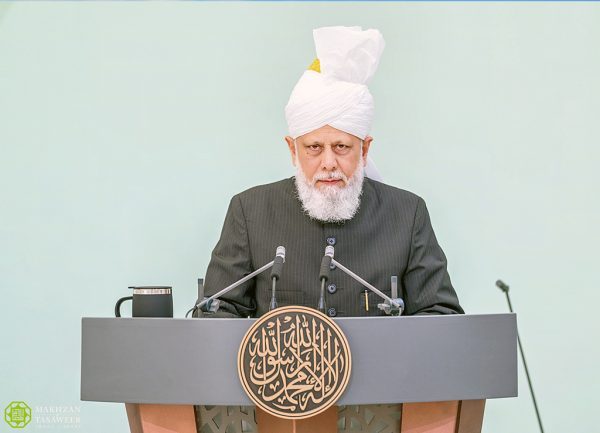
After reciting Tashahhud, Ta‘awwuz and Surah al-Fatihah, His Holiness, Hazrat Mirza Masroor Ahmad (aba) said that he would continue narrating incidents from the life of the Promised Messiah (as) which exhibit the lofty standards of his truthfulness.
Truthfulness of the Promised Messiah (as) in the Court Case Against Him
His Holiness (aba) said that once, a person named Dr Henry Martyn Clark charged the Promised Messiah (as) with attempted murder. The Promised Messiah (as) stated that this was an extremely dangerous case in which he could have been sentenced to death. The Promised Messiah (as) said:
‘‘Jesus Christ (as), the righteous and chosen of God, was put behind bars out of fear of Jews. A similar case was filed against me, with the difference that while the case against Jesus (as) was brought up by the Jews, in my case it was a reverend clergyman and doctor, i.e. Dr Martyn Clark, who accused me of attempted murder.
The evidence he mustered seemed thorough, so much so that even Maulvi Abu Sa’eed Muhammad Hussein Batalvi, an archenemy of this Jama‘at, appeared as a witness and did his utmost to establish the case against me. The case was heard by Captain Douglas, the Deputy Commissioner of Gurdaspur, who is now posted probably at Simla. The case was duly heard and completed, and all the witnesses against me were produced with great fanfare and clamour. In the circumstances, not even the best of lawyers could say that I would be acquitted. The prevailing situation and other factors demanded that the case be committed to the sessions, who could have sentenced me to transportation for life or even to death. But just as God forewarned me about the case, so did He reveal to me in advance that I would be acquitted. A large number of people belonging to my Jama‘at knew about this revelation.
When the case reached a stage when the prosecution and my opponents believed that the magistrate would commit the case to the Sessions, Captain Douglas told the Police Superintendent that he had a hunch that the case was a frame-up. He couldn’t believe that such an attempt was ever made and that the defendant sent someone to murder Dr Clark. He asked the superintendent to investigate the case himself. This was the time when not only were my opponents busy plotting against me, but those who claimed that their prayers were heard and accepted were tearfully soliciting God to punish me. But who can fight God? I also know that some people approached Capt. Douglas and tried to influence him, but he, being a just and fair magistrate, told them that he could not be a party to such an outrage. In short, when the case was entrusted to Capt. Le Marchand, for a renewed investigation, he summoned Abdul Hamid and told him to state the truth. Abdul Hamid repeated the same old story he had related before the Deputy Commissioner. Actually, at the very start, he was warned that the slightest deviation from his original statement would render him liable to prosecution; that is why he repeated the same statement he had made earlier on. The Police Superintendent told him that he had already related the same story, but the Deputy Commissioner was not satisfied that he was telling the truth. When Captain Le Marchand again told him to tell the truth, he started crying and fell at the feet of the Captain, imploring him for protection. The Captain reassured him and told him to go ahead.
At this, he came out with the truth. He confessed that he had been coerced into making his earlier statement and deposed that Mirza Sahib had never sent him to murder anyone.
The Captain was overjoyed at this statement and sent a telegram to the Deputy Commissioner that he had solved the case. The case once again came up for hearing at Gurdaspur. Capt. Le Marchand was sworn in and recorded his affidavit. I could notice that the Deputy Commissioner was visibly pleased that the truth had come out. But he was also furious at the Christians who had given false evidence against me. Addressing me, he said that I had the right to file a suit against them. But, as I am totally disinclined to litigation, I said I didn’t want to enter into any litigation, for my suit was filed with God. At this Capt. Douglas straightaway wrote down the judgement and read it out to a large number of people who had gathered there. Addressing me, he said, ‘Congratulations, you stand acquitted.’…
At the time, it seemed as if the whole world was lined up against me and this is what usually happens that when people decide to hurt you, the whole world turns against you; it is God alone Who comes to the rescue of His true servants.’ (Lecture Ludhiana, pp. 28-31)
Lawyers Awestruck by His Trutufulness
His Holiness (aba) related the impressions of a lawyer who represented the Promised Messiah (as) in this case. The lawyer said that he had represented many people in various court cases and had observed for himself that even apparently pious people would change their testimonies in lieu of legal counsel. He said, however, he had only ever observed one person who remained steadfastly attached to the truth, and that was the Promised Messiah, Hazrat Mirza Ghulam Ahmad (as). He said that he had advised the Promised Messiah (as) to deliver a prepared response; however, it contained falsities. The lawyer advised that the defendant was free to give any statement they wished and that it was not legally binding. The Promised Messiah (as) responded that though the courts may allow this; however, the court of God does not permit falsehood. Therefore, the Promised Messiah (as) staunchly said that he would not stray from the truth whatsoever. The lawyer responded that the Promised Messiah (as) would thus potentially be placing himself in difficulty.
The Promised Messiah (as) replied that the real difficulty would be displeasing his God by uttering falsehood. It is recorded that the Promised Messiah (as) said this with great passion. The lawyer said that in this way, the Promised Messiah (as) would not benefit from his legal advice. The Promised Messiah (as) replied by saying he never once depended on his legal advice, for his depended only on God. He had hired the lawyer as a necessary and required means, and because he had known the lawyer to be straightforward and truthful. The Promised Messiah (as) said that he did not care if he was ultimately convicted, because he would be happy knowing that he remained steadfast upon the truth in order to please. God. It was as a result of this truthfulness that the Promised Messiah (as) was ultimately acquitted of this false charge against him.
His Holiness (aba) said that the charge levelled against the Promised Messiah (as) had been that he had sent a man named Abdul Hamid to kill Dr Henry Martyn Clark. The Promised Messiah’s (as) lawyers had advised him to say that he did not know and had never met Abdul Hamid. The lawyers said that if the Promised Messiah (as) said this, then he would certainly be acquitted; otherwise, he would certainly be indicted. The Promised Messiah (as) said that he would never abandon the truth, even if it meant that he would be sentenced to death. The Promised Messiah (as) said that Abdul Hamid used to visit Qadian, and he knew him, hence he could not lie and say that he had no idea who Abdul Hamid was. The lawyers then advised that if the Promised Messiah (as) would not lie, then he should, at the very least, give some sort of ambiguous answer by which it could be gleaned that the Promised Messiah (as) did not know Abdul Hamid. However, the Promised Messiah (as) could not do so. In court, when asked, the Promised Messiah (as) clearly said that he knew Abdul Hamid. The lawyers were certain that the Promised Messiah (as) would lose the case. However, they were astonished to see that whilst remaining steadfast upon the truth, the Promised Messiah (as) won the case.
Testimony of Non-Ahmadis About His Adherence to the Truth
His Holiness (aba) said that there was a Hindu man who said that he had known the Promised Messiah (as) since his childhood, as they were the same age. He said that from his childhood, he had known the Promised Messiah (as) to be truthful, trustworthy and pious. The Hindu man said that he felt as though Parmeshwar had come down and adopted the form of the Promised Messiah (as).
His Holiness (aba) said that the Promised Messiah’s (as) father would be worried about the Promised Messiah’s (as) future, as he did not take up any work or did not have any aptitude for managing properties or real estate. Once, the Promised Messiah’s (as) father asked someone to speak to the Promised Messiah (as) and encourage him to take up some form of work to establish his future. When he went to the Promised Messiah (as) and offered him a job. In response, the Promised Messiah (as) said, ‘My father worries for no reason. Tell him that I have already been employed by the One by whom I wished to be employed.’ Upon hearing this, the Promised Messiah’s (as) father said that if he had said this, then it was true, because he knew that his son never lies.
His Holiness (aba) said that a man who was travelling missed his train. At the time, there was a great deal of opposition against the Promised Messiah (as) that had spread far and wide. This man thought that since he was near the Promised Messiah’s (as) village, why not go see the Promised Messiah (as) for himself. And so, he went to meet the Promised Messiah (as), and immediately upon meeting him, he realised that all those who opposed the Promised Messiah (as) were certainly wrong, because the man he was seeing before him could certainly never be a liar or false. Thus, he pledged allegiance to the Promised Messiah (as) and accepted Islam Ahmadiyyat.
His Holiness (aba) said that another person relates that he too had heard widespread opposition to the Promised Messiah (as) and thought that if all the clerics deemed him to be false, then he must certainly be false. However, he came across some Ahmadis who advised him to read a book written by the Promised Messiah (as) titled, Izala-e-Auham. Upon reading this book, he felt all his doubts being removed, and so he went to meet the Promised Messiah (as). Upon seeing his countenance, he was convinced that this could not be the image of a liar, and so he pledged allegiance to the Promised Messiah (as).
His Holiness (aba) quoted the Promised Messiah (as), who writes that when one adopts truthfulness, that truthfulness becomes a light, and that light protects them from all sorts of difficulties and hardships.
His Holiness (aba) prayed that may Allah enable everyone to realise this reality and remain steadfast upon the loftiest standards of truthfulness.