
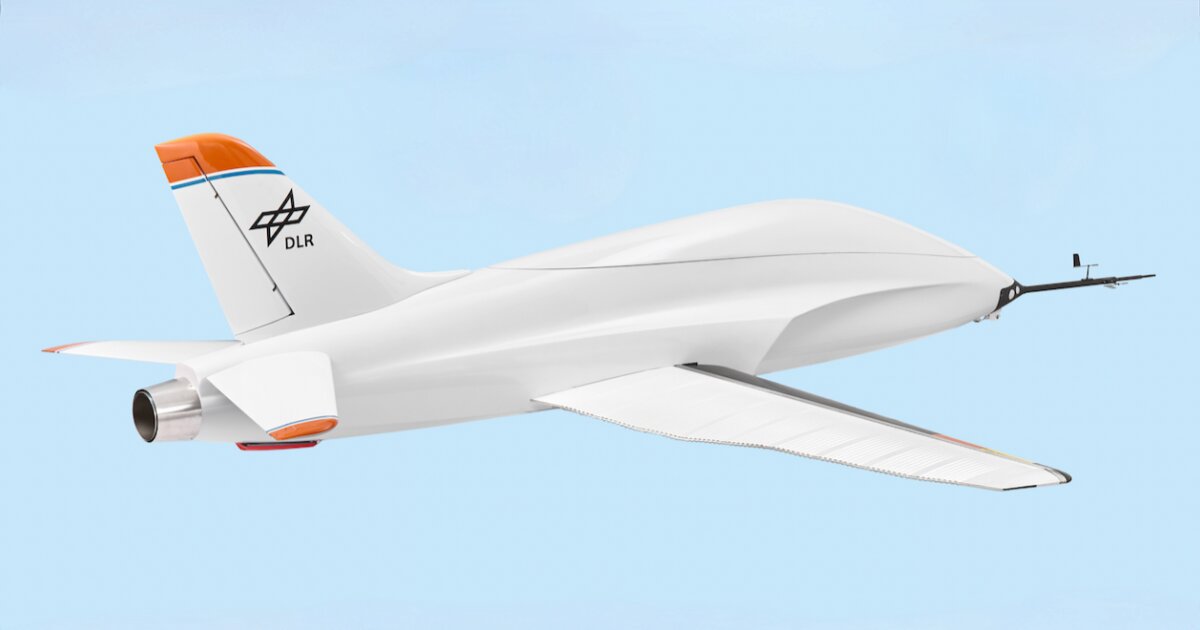
Imagine looking out the window of an airborne airplane and seeing the wing rippling and twisting. You’ll probably have a mini heart attack. Yet, this is what German engineers have created: prototype morphing wings that change their shape mid-flight.
Created by the German Aerospace Center (Deutsches Zentrum für Luft- und Raumfahrt; DLR), the project, aptly named morphAIR, aims to make aircraft more efficient and easier to control.
Most creatures that move through air or water display remarkable fluidity and adaptability in motion. Birds, for example, are capable of incredibly precise, complex adjustments across their entire wing. Likewise, their aquatic counterparts, fish, move their bodies and fins with a grace that could rival even the most seasoned ballet dancer.
On the other hand, airplanes have traditionally relied on rigid wings and fixed control surfaces, using flaps, ailerons, and rudders to change direction. These separate movable parts add mechanical complexity, weight, noise, maintenance demands, and aerodynamic losses.
So why have these wings remained the standard for decades, when it’s obvious they are not optimal for maneuvering? The simple answer is: engineering compromise.
You see, a wing that’s ideal for take-off may not be ideal for cruise. A wing that’s ideal for cruising is not ideal for landing. A wing that’s ideal for one speed, altitude, or maneuver is suboptimal for another … and so on. You get the gist. Modern aircraft wings are a carefully engineered compromise, designed to be as ideal as possible in many scenarios.
The German Aerospace Center is challenging this approach. Why not engineer adaptability instead of compromise? The solution: morphAIR, a morphing wing that could become high-lift when needed, low-drag when cruising, responsive when turning, and stable in turbulence.

DLR (CC BY-NC-ND 3.0)
“The morphing wing can change its shape during flight, allowing it to adapt optimally to different flight conditions,” explains project leader Martin Radestock from the DLR Institute of Lightweight Systems.
The wings are made entirely of fiber-reinforced composites, featuring a “shape shifting” trailing edge section. This feature is enabled by a Hyperelastic Trailing Edge Morphing system (HyTEM), a DLR-developed technology that allows the wing to deform seamlessly, without steps.
“The HyTEM concept replaces conventional flaps and ailerons with an intelligent system comprising several small actuators distributed across the wingspan. These can precisely adjust the wing profiles at 10 points without creating gaps between sections. The continuous shape reduces profile drag. In addition, lift, induced drag and aircraft control can all be influenced in a targeted manner – a major advantage for aerodynamics and flight mechanics,” Radestock elaborates.
DLR engineers developed an AI-assisted flight control system designed specifically to make full use of the morphing wing’s unique movement capabilities. During flight, the adaptive algorithm continuously monitors the aircraft’s actual behavior and compares it against a trained model. When deviations are detected, whether from turbulence, damage, or a failing actuator, the system redistributes commands across the wing’s many distributed actuators in real time, maintaining stable flight. The algorithm was also trained on deliberate failure scenarios, teaching it to recognize and compensate for faults that would cripple a conventional fixed-wing system.
Feeding this AI is an equally clever form of sensing.
Rather than blanketing the wing in sensors, DLR engineers developed a method to reconstruct the full aerodynamic pressure distribution across the wing from just a small number of measurement points. This gives the flight control system an immediate, live awareness of the airflow around the wing at any given moment. By comparing the reconstructed pressure field against the expected state, the system can automatically detect local disturbances and respond before they escalate.

DLR (CC BY-NC-ND 3.0)
Together, the adaptive control algorithm and pressure reconstruction enable morphAIR to truly “feel” and “think” about how it is flying. That’s as close to real bird adaptability as aircraft wings have ever gotten.
To test the concept, the DLR fitted an uncrewed experimental aircraft, PROTEUS, with both conventional and morphing wing sets. The successful trials primarily demonstrated basic airworthiness and system integration, forming a vital foundation for further development and testing.
While these wings won’t be coming to commercial aircraft anytime soon, they’re a significant development for unmanned aircraft. As a next step, DLR plans to demonstrate scalability with a test flight using a PROTEUS with a total mass of 70 kg (154 lb).
You can see the wings in shape-shifting action by scrolling down to the video in the link below.
Source: DLR