
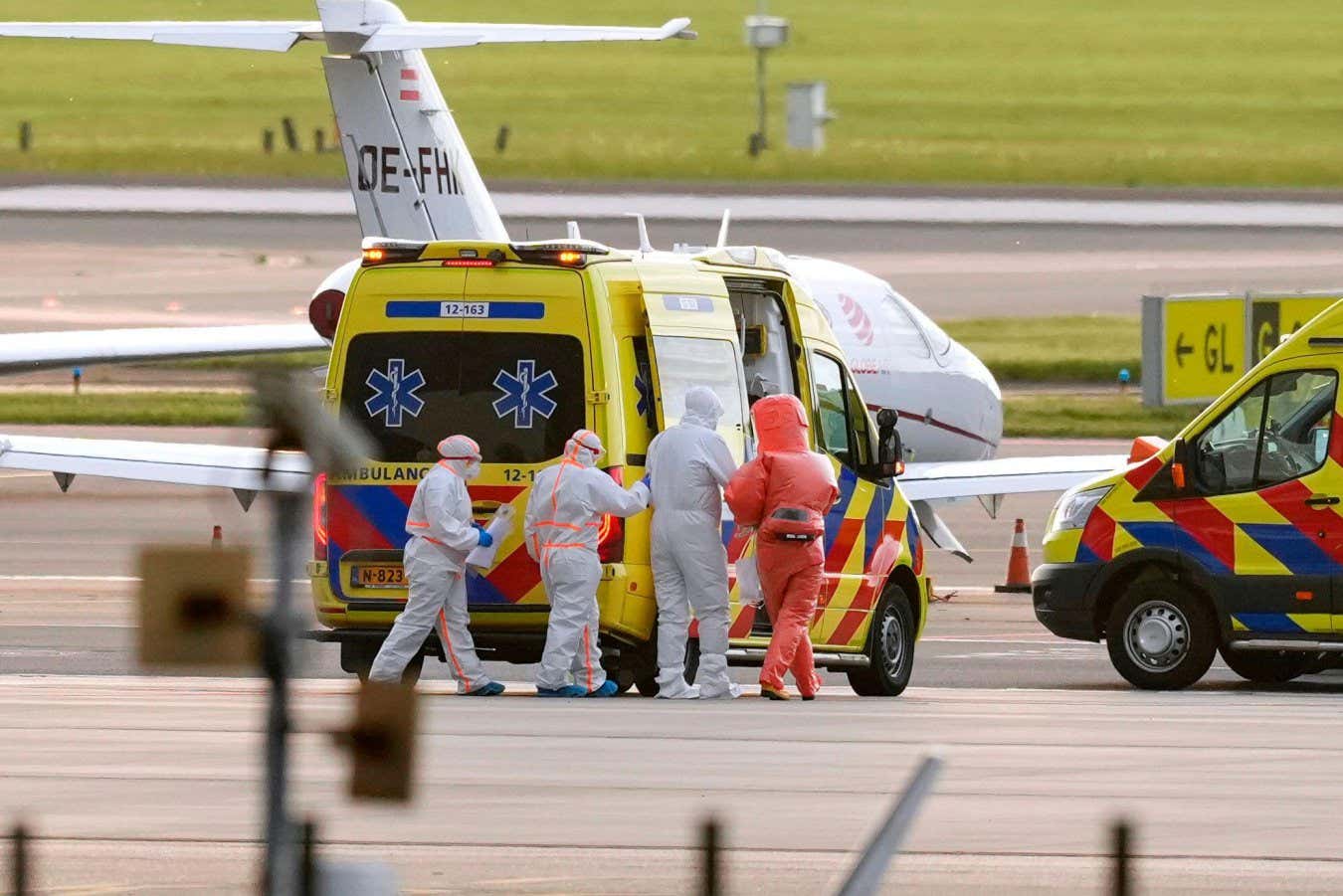

Medics escort a person with a suspected hantavirus infection to an ambulance after being flown to Amsterdam, the Netherlands
Peter Dejong/Associated Press/Alamy
The outbreak of hantavirus on board the cruise ship MV Hondius is unlikely to become an epidemic, the World Health Organization announced today.
In a press briefing, a panel of WHO scientists sought to quell worldwide fears over the outbreak and reassure the public that we aren’t about to see a repeat of the covid-19 pandemic. The panel also said it intended to stay until all journalists’ questions were answered and expressly stated that it was important that people not be alarmed by the cluster on the ship.
“This is not covid; this is not influenza,” said WHO scientist Maria Van Kerkhove at the briefing. “This is not the start of an epidemic; this is not the start of a pandemic.”
So far, there have been five confirmed cases of hantavirus and three more suspected cases. Three of those who fell ill have died.
Two patients in hospital in the Netherlands and a person in intensive care in South Africa are all reported to be improving, the WHO said.
Hantaviruses are a group of viruses carried by rodents that can cause severe disease in humans. People usually get infected through contact with infected rodents or their urine, droppings or saliva.
Tests in South Africa carried out on two passengers from the ship have identified the pathogen as Andes virus, the only known hantavirus that can spread from human to human.
It is also one of the hantaviruses known to cause a severe illness in humans called hantavirus cardiopulmonary syndrome, with a mortality rate of up to 50 per cent.
Tedros Adhanom Ghebreyesus, director general of the WHO, said in a press briefing that because the incubation period of the virus is six weeks, it is possible more cases will be reported in coming weeks
However, the public health risks remain low because the virus requires close physical contact to transmit between people, and careful contact tracing and international cooperation will break the chain of transmission, said Ghebreyesus.
So far, every nation called on to assist in managing the crisis has cooperated fully, he said.
“There’s no need to panic the entire population,” said Abdirahman Mahamud, also at the WHO.
He said only symptomatic, infected people should be isolated. Those who may have been exposed to the virus will only require “active monitoring”.
Mahamud said the current situation is most analogous to an outbreak of Andes virus in Argentina between November 2018 and February 2019 that infected 34 people and caused 11 deaths. That began at a birthday party with approximately 100 guests. While the outbreak was serious, the virus didn’t go on to spread widely in the community.
“The main concern is the possibility of limited person-to-person transmission,” Luis Marcos at Stony Brook Medicine in New York state tells New Scientist. “However, such transmission appears to be inefficient and can typically be managed with standard isolation and quarantine precautions.”
“Overall, the risk of widespread transmission remains low, and the current level of concern may be greater than warranted,” he says.
Marcos suspects a maximum of 10 to 15 people who were on the cruise will end up being infected. Quarantine of people from the cruise will be enough, he says, and there is “no pandemic potential at all”.
Luis Escobar at Virginia Tech warns that the threat posed by hantaviruses should be taken seriously. “I believe hantavirus has pandemic risk, especially hantavirus causing respiratory syndromes,” he says.
He and his team published a study in 2025 reporting that there were more hosts of the virus than previously known. They analysed over 14,000 blood samples for hantavirus from 49 species at 45 field sites, finding 296 positive samples across 15 rodent species, including six new species not previously reported as hosts. The team identified Colorado, Virginia and Texas as particular hotspots for the virus.
However, Escobar believes the public health measures being taken will mitigate the pandemic risk from the current outbreak.
Topics: