
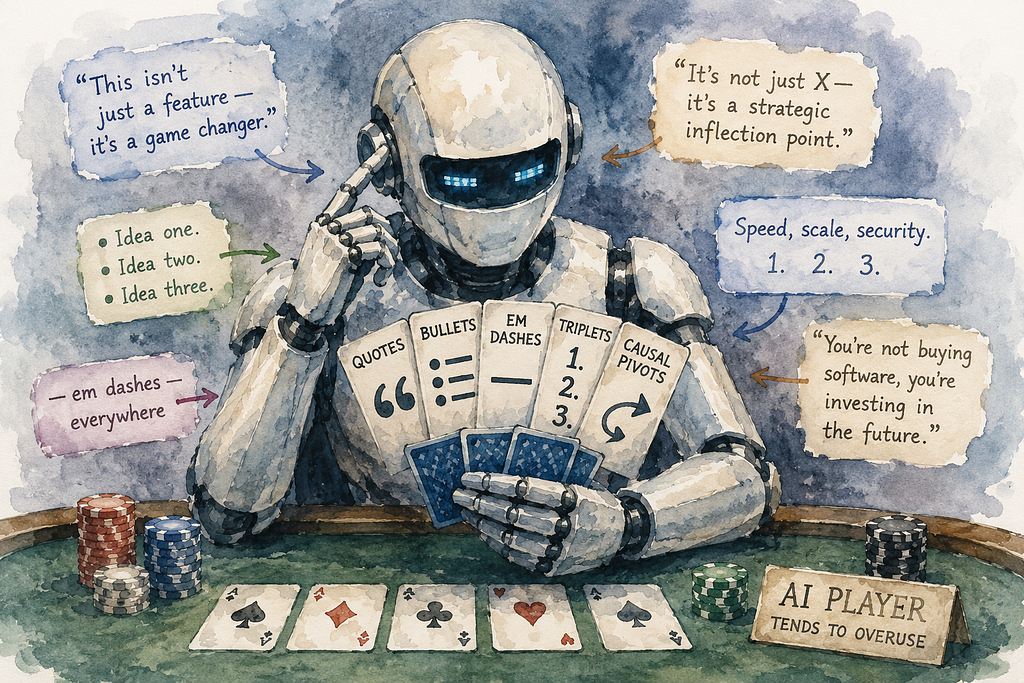
Forget AI detection tools. There are telltale signs anyone can use to sniff out machine-generated text.
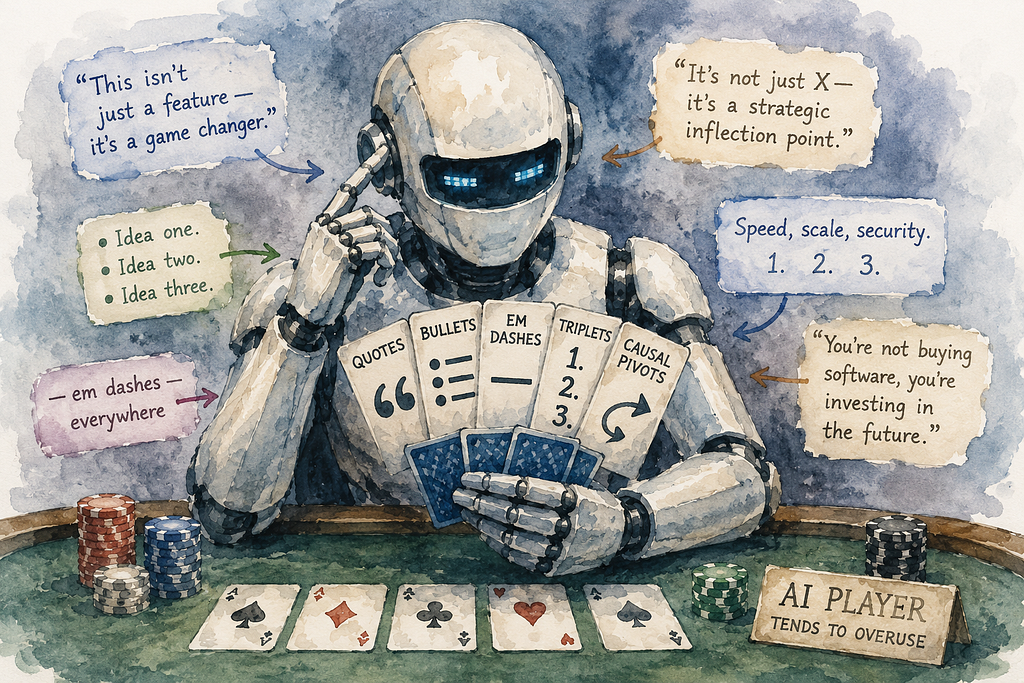
The more I work with large language models, the more I see patterns. Not just vague impressions; specific, repeated writing habits that show up with almost mechanical regularity. Once you see them, you can’t unsee them.
Like an novice poker player, AI has tells. Some are obvious. Some are subtle. But if you’re responsible for brand voice, editorial standards, or in-house content production, you need to be able to spot them on sight.
Here are five to watch for.
1. Quotes, Bullets, and Em-Dashes .. Everywhere
AI loves formatting devices. Not because they’re wrong, but because they’re easy.
Quotation marks pop up with alarming regularity, even when nothing is being directly quoted. You’ll often see entire sentences wrapped in quotes for no clear reason, as if the AI is hand-gesturing air quotes to signal skepticism.
No attribution, no reference to dialogue, just quotation marks used for emphasis. Humans do this occasionally. AI does it habitually.
Then there are bullet points.
Bulleted lists are useful. They break up complex sections into digestible chunks and make long-form text scannable. They’re a staple of consultancy reports and analyst forecasts.
But AI will default to them even when they aren’t necessary. Instead of developing an argument organically, it will fragment ideas into tidy, evenly spaced chunks:
- Idea one.
- Idea two.
- Idea three.
When every explanation becomes a mini-outline, the prose starts to feel like a slide deck that escaped into paragraph form.
And then there’s the em dash.
I’m fond of the em dash. It’s a powerful device for introducing an adjacent thought or quick pivot. Used sparingly, it adds emphasis or changes the rhythm.
Used constantly, it becomes a crutch.
AI frequently substitutes em dashes for commas, full stops, or structural transitions. The result is breathless, over-connected prose that feels synthetically dramatic.
2. The Causal Pivot
Generative AI has a particular fondness for the contrastive device, a rhetorical move that says something isn’t one thing, but is something bigger, better, or more dramatic.
You’ll recognize the pattern:
- “This isn’t just a product launch — it’s a strategic inflection point.”
- “It’s less about efficiency; more about transformation.”
- “You’re not buying software, you’re investing in the future.”
We were taught to use this device in journalism. Copy editors call it a ‘causal pivot’, a way to inject tension and emphasis into a sentence.
It works. In moderation.
The problem is repetition. AI leans on this structure so heavily that once you spot it, you’ll see it everywhere. Paragraph after paragraph framed as a rhetorical correction.
When every idea is positioned as a revelation, nothing feels revelatory.
For brand teams, this matters. Overuse of this device doesn’t just signal AI involvement. It also makes messaging feel inflated and salesy — particularly in B2B contexts where credibility rests on precision, not drama.
3. Trios and Triplets
There’s a long-standing principle in writing that complex ideas are easier to digest when structured in threes.
Beginning, middle, end.
Problem, solution, outcome.
Speed, scale, security.
Three is satisfying. It feels complete.
AI understands this, perhaps too well.
When every paragraph contains three examples, three benefits, or three implications, the rhythm becomes predictable. The prose starts to feel geometrically perfect. Suspiciously so.
Human writers use the rule of three intentionally. AI uses it by default.
The difference is subtle but important. Intentional structure creates clarity. Mechanical repetition creates pattern fatigue – like an entire song arranged in staccato.
If you’re reviewing a draft and everything comes in evenly spaced triplets, that’s a strong tell.
4. It’s All Just Too Clean
This one is harder to articulate, but once you’ve felt it, you’ll recognize it.
AI writing is often technically flawless. Grammatically clean. Logically arranged. Tonally consistent.
And sterile.
Real human writing has friction. A stray metaphor. An unexpected aside. A moment of rhythm change. A sentence that runs long and then snaps short. A personal observation that bends the structure slightly out of shape.
AI can imitate these moves, but it rarely introduces them organically. Its “human touches” tend to be evenly distributed and strategically placed, rather than connected to a genuine perspective.
If a piece of content contains no lived experience, no tonal unpredictability, no small irregularities — just perfectly smoothed language — it feels manufactured.
Ironically, this sterility is also what makes AI useful. It’s excellent at delivering clean, efficient information. For internal summaries, first drafts, or structured briefs, that’s exactly what you want.
But when that same smoothness carries into thought leadership or brand storytelling, it can strip away credibility.
Readers don’t just evaluate what you say. They evaluate how it feels, and AI writing often feels off.
5. Dense Prose That Skips the Bridge
AI prose can be fluent while quietly skipping cognitive steps.
You’ll see authoritative conclusions arrive quickly, stacked one after another, without much narration of how we got there. Industry shorthand appears without sufficient context:
“Priced in.”
“Structural shift.”
“Protocol ossification.”
“Cross-vertical synergies.”
The terminology may be correct. The logic may even hold up under scrutiny. But the connective tissue is thin.
Human writers tend to walk readers across the bridge. They signal transitions. They define terms when needed. They slow down before accelerating.
AI often teleports, and readers switch off.
If the content assumes too much shared knowledge, you narrow your audience without meaning to. Lean too heavily on consultant-speak (strategic repositioning catalyzed by cross-vertical alignment), you increase cognitive load while decreasing clarity.
Why This Matters for Corporate Content Teams
None of these tells mean you shouldn’t use AI. In fact, most teams should be using it more. It accelerates ideation and brings structure to messy thinking. With the right prompts and processes it can generate competent first drafts at remarkable speed.
But competence isn’t differentiation.
If your competitors are also using AI (and you know they are), the advantage shifts from whether you use it to how you refine it.
Pasting AI outputs directly into blogs, white papers, or campaign pages is a recipe for failure. To win at AI content you need to:
- Recognize mechanical patterns.
- Inject genuine perspective.
- Rebuild arguments where reasoning is compressed.
- Remove rhetorical inflation.
- Restore brand voice and texture.
In other words, AI remains a tool — a good and effective one when used correctly.
Tried and true structural devices aren’t the problem. Over-automation is. The key is to keep creative control and ensure the content has your personal stamp all over it.
AI Is the Intern, Not the Author
When AI fails its because it’s been left to its own defaults: reaching for quotation marks when it wants emphasis, triplets when it wants structure, contrastive pivots when it wants a bit of drama, and jargon when it wants to signal authority.
For marketing leaders, the opportunity is to operationalize AI responsibly. Treat LLMs the way you would a fast, capable intern, one who produces impressive drafts but still needs a clear brief, supervision, shaping, and strategic alignment.
The competitive advantage will come from knowing which patterns to keep, which to cut, and where to add the human judgment that no model can simulate.
How Everyone Can Tell You Write With AI was originally published in The Startup on Medium, where people are continuing the conversation by highlighting and responding to this story.