
Migrating to microservices architecture is one of the most impactful technical decisions a growing business can make, and when done right, it does not have to bring your operations to a halt. The short answer: successful migration depends on phasing the transition carefully, starting with the right services, and keeping your existing system functional throughout the process.
Businesses that approach this incrementally, rather than as a full rewrite, report significantly fewer disruptions and faster time-to-value.
What Is Microservices Architecture and Why Does It Matter for Business?
Before getting into the how, it helps to be clear on the what. Microservices architecture is a design approach where a software application is broken down into small, independent services that each handle a specific business function. These services communicate with each other through APIs and can be developed, deployed, and scaled independently.
For businesses running on monolithic systems, this matters a lot. A monolith means one large codebase where everything is connected. Update one part, and you risk breaking another. Scale one feature, and you have to scale the entire system. That gets expensive and slow, fast.
According to a survey by O’Reilly, over 77% of organizations that have adopted microservices report improved scalability and deployment frequency. That is not a minor operational improvement. That is a structural shift in how fast a business can move. (source)
How to Migrate to Microservices Architecture Without Grinding Operations to a Stop
This is the core question most engineering leaders and CTOs are wrestling with. The fear is real: what if the transition breaks something critical? What if customers notice? What if the team cannot keep up?
The answer lies in a phased, service-by-service extraction strategy rather than a big-bang rewrite. Here is how that typically unfolds.
Start with a Service Inventory
Map out every function your current monolith handles. Payments, user authentication, notifications, reporting, and so on. Not all of these need to be extracted at once. In fact, some may never need to be.
Identify the Right First Services
The best services to extract first are those that are relatively self-contained, have clear inputs and outputs, and are causing the most pain in your current setup. A billing module that slows down every deployment is a strong candidate. Your core user database probably is not.
Use the Strangler Fig Pattern
This is the most widely recommended migration approach. You build new microservices alongside the existing monolith, gradually routing traffic to the new services while the old system continues to operate. Over time, the monolith shrinks and the microservices take over. The business keeps running throughout.
Set up API Gateways Early
This is non-negotiable. An API gateway acts as a single entry point for all client requests, routing them to the appropriate microservice. Without this, inter-service communication becomes a mess very quickly.
Invest in Observability from Day One
Logging, monitoring, and distributed tracing need to be in place before you go live with any microservice. When something breaks across five different services, you need to know exactly where and why.
Monolith vs. Microservices: A Practical Comparison for Business Leaders
| Factor | Monolithic Architecture | Microservices Architecture |
| Deployment | Full system redeployment | Independent service deployment |
| Scalability | Scale everything or nothing | Scale only what you need |
| Development speed | Slows as codebase grows | Teams work independently |
| Fault isolation | One bug can affect all | Failures stay contained |
| Initial complexity | Lower | Higher |
| Long-term maintenance | Gets harder over time | Easier with proper setup |
This table tells a clear story. Microservices introduce upfront complexity, but they pay off significantly as your product and team scales. For businesses handling high transaction volumes, complex workflows, or rapid feature development, the trade-off is almost always worth it.
The Role of ERP Systems in Microservices Migration
One area that often trips businesses up is their ERP ecosystem. Enterprise resource planning systems are deeply embedded in operations, touching finance, inventory, HR, and more. When you are restructuring your application layer, ERP integration cannot be an afterthought.
If your business requires custom-built ERP Software Development Services, the migration plan needs to account for how those services will communicate with your new microservices layer. In most cases, you will need to expose ERP functionality through well-documented APIs and treat the ERP as a service rather than a central hub everything else depends on.
Why Third Party Integrations Need Special Attention
Modern businesses run on dozens of connected tools:
- Payment gateways,
- CRMs, marketing platforms,
- Logistics providers.
When you migrate to microservices, each of these connections needs to be re-evaluated.
This is where third party API integration services become critical. Rather than hardwiring these integrations into your new microservices, the smarter approach is to create dedicated integration layers or adapter services. This way, if a third-party provider changes their API or you switch vendors entirely, you only update one service instead of rearchitecting half your system.
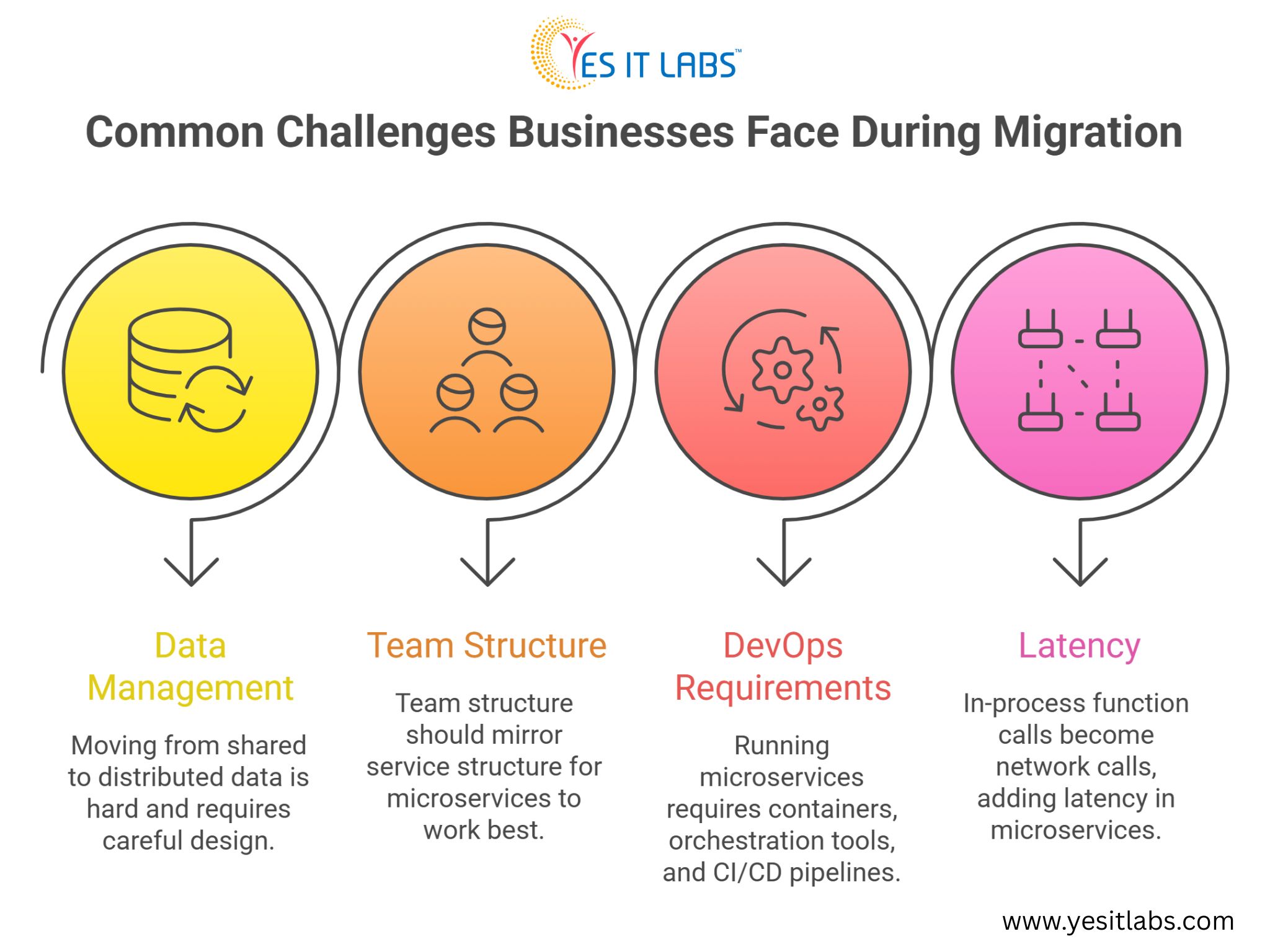
Common Challenges Businesses Face During Migration
Migration projects do not fail because the technology does not work. They fail because of planning gaps and team misalignment. Here are the challenges that come up most consistently.
Data management complexity
In a monolith, all services share one database. In microservices, each service ideally owns its own data store. Moving from shared to distributed data is genuinely hard and requires careful design to avoid data inconsistency.
Team structure does not match the architecture
Microservices work best when organized around the Conway’s Law principle: your team structure should mirror your service structure. If you have one large team managing everything, the benefits of microservices are harder to realize.
Underestimating DevOps requirements
Running microservices means running containers, orchestration tools like Kubernetes, CI/CD pipelines, and more. If your DevOps capability is not ready, the operational overhead can outweigh the benefits.
Latency between services
What was a simple in-process function call in a monolith becomes a network call in microservices. This adds latency. Good architecture design minimizes this, but it never disappears entirely.
Practical Advice: Building the Right Team for Migration
No migration succeeds without the right people executing it. This is not a project you hand off to a junior team or try to manage with part-time attention.
If your internal team lacks microservices experience, the pragmatic move is to hire dedicated full stack developers who have worked on distributed systems before. Full stack developers are particularly valuable in microservices contexts because each service often spans frontend interfaces, backend logic, and database interactions.
Similarly, if you are managing this at scale and need to move quickly, the decision to hire a web development team with microservices expertise rather than building that capability from scratch internally can cut months off your timeline. External teams bring pattern recognition from previous migrations that internal teams simply do not have yet.
FAQ: Migrate to Microservices Architecture
What is the best migration strategy for moving from monolith to microservices?
The Strangler Fig pattern is the most practical approach for most businesses. It allows you to build and deploy new microservices incrementally while the monolith continues to operate. This avoids the high risk of a full system rewrite and keeps your operations running during the transition. Most successful migrations take six to eighteen months depending on system complexity.
How do we know which services to extract first?
Start with services that are loosely coupled from the rest of the system, have clearly defined boundaries, and are causing the most friction in your current setup. Avoid extracting anything that shares heavy data dependencies with multiple other parts of the system early on. Quick wins early in the process build team confidence and prove the approach before tackling harder extractions.
Will microservices migration affect our customers?
If done correctly, customers should notice nothing except improvements. The goal of a phased migration is to keep the user-facing system fully operational throughout. That said, poor planning around API versioning or data migration can cause visible issues, which is why the planning phase matters as much as the execution phase.
How much does microservices migration typically cost?
Costs vary significantly based on system size and team composition. A mid-size business migrating a moderately complex monolith can expect to invest anywhere from $150,000 to $500,000 or more when accounting for development time, infrastructure changes, and testing. The ROI typically comes through reduced infrastructure costs at scale, faster deployment cycles, and lower maintenance overhead over time.
Do we need to migrate everything to microservices?
No, and this is an important point. Not every part of your system needs to become a microservice. Some functions are stable, low-risk, and not worth the effort of extracting. A hybrid architecture where the core legacy system handles some functions while new microservices handle others is a completely valid and often more practical end state.
Conclusion
Migration is not a technical problem with a technical solution. It is an organizational decision that requires technical execution. The businesses that get this right are the ones that treat migration as an ongoing process rather than a one-time project, invest in the right team early, and resist the pressure to move faster than their infrastructure and team readiness can support.
Microservices architecture offers real, measurable advantages in scalability, deployment speed, and fault tolerance. But those advantages only show up if the migration itself is handled with the same level of rigor you would apply to any mission-critical business initiative. Plan the phases. Extract thoughtfully. Monitor obsessively. And build with the long term in mind.